
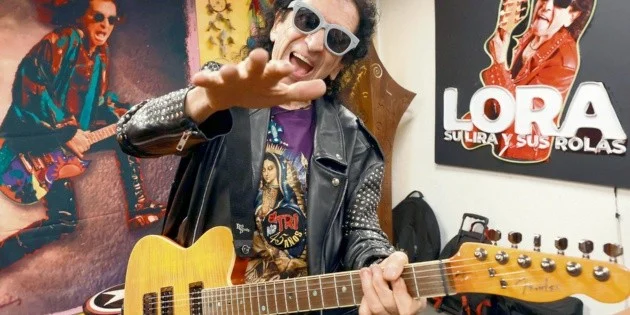
Álex Lora, often heralded as a foundational prophet of Spanish-language rock in Mexico, is embarking on a significant European tour to commemorate an extraordinary 58-year dedication to the rock and roll genre. This milestone career, marked by relentless creativity and social commentary, positions Lora not merely as a musician but as a cultural icon whose influence transcends generations. In a recent statement that has sparked considerable discussion within the Latin American music landscape, Lora asserted, with his characteristic foresight and irreverence, that "narcocorridos are nothing more than rock and roll, rearranged and commercialized." This provocative declaration underscores his enduring role as a commentator on contemporary musical trends and the commercial pressures shaping them, all while maintaining his unwavering commitment to rock’s authentic spirit.
A Career Forged in Fire: The Roots of a Rock Legend
Born in Puebla, Mexico, Álex Lora’s journey into rock and roll began in the tumultuous year of 1968, a period profoundly significant for Mexico due to the student movement and the Tlatelolco Massacre. It was against this backdrop of social upheaval and nascent youth counterculture that Lora co-founded Three Souls in My Mind, a pioneering band that laid the groundwork for what would become El Tri. This early era was characterized by intense governmental repression and censorship of youth expressions, particularly rock music, which was often viewed with suspicion as an imported, subversive influence. Despite these formidable challenges, Lora and his band persevered, developing a raw, authentic sound that resonated deeply with the disenfranchised youth. Their music became a crucial outlet for expressing the realities, frustrations, and aspirations of a generation navigating a rapidly changing and often repressive society. The transition from Three Souls in My Mind to El Tri in 1981 marked a new chapter, but the core ethos of social critique, musical integrity, and a direct connection with the audience remained unchanged.
For nearly six decades, Lora has been a consistent voice for the common Mexican, crafting songs that chronicle the nation’s social fabric. He laments that while "the population grows," the "opportunities remain the same" as they were half a century ago, a poignant observation that speaks to the enduring socio-economic disparities in Mexico. What is remarkable is the timelessness of his compositions. Lora himself often expresses surprise, noting that songs he "invented more than 50 years ago" are still listened to by today’s audiences who "feel like I just invented them 15 days ago." This sustained relevance is a testament to the universality of his lyrical themes and his uncanny ability to tap into the collective consciousness of the Mexican people. His music serves as a living historical document, reflecting national identity and societal challenges with an immediacy that transcends temporal boundaries.
The Philosophy of Rock: Irreverence and the Fountain of Youth
Lora’s vision of rock and roll extends beyond mere musical style; it is a philosophy of life. Clad in his iconic Virgen de Guadalupe T-shirt, an electric guitar perpetually in hand, he embodies the fusion of Mexican popular culture and rock’s rebellious spirit. For Lora, rock is more than entertainment; it is the "source of youth" and, crucially, the wellspring of "irreverence," a quality he argues is increasingly scarce in today’s commercial music landscape. This reverence for irreverence harks back to rock’s rebellious origins, a genre born from challenging norms and questioning authority. Lora sees artists like The Rolling Stones and Paul McCartney as eternal symbols of this spirit, figures who, despite their age, continue to exude a vitality and defiance that defies conventional expectations. His own enduring energy, both on and off stage, serves as a powerful testament to this belief, proving that rock and roll can indeed be an elixir for perpetual youth and an antidote to creative complacency.
Deconstructing "Narcocorridos": A Lora-esque Critique of Commercialism
Lora’s pronouncement on narcocorridos as "revolcados" (literally "tumbled" or "rearranged," implying diluted or commercialized) rock and roll offers a critical perspective on the evolution of popular music. He contends that contemporary genres like urban music and narcocorridos are essentially "rock and roll revolcados y comercializados para tratar de hacerlos llegar a un mayor número de gente" (rock and roll twisted and commercialized to try and reach a larger number of people). This statement is not a dismissal of the genres themselves but rather a commentary on the underlying commercial motivations that, in his view, can strip music of its raw authenticity.
Narcocorridos, a subgenre of the traditional Mexican corrido, narrate stories of drug traffickers, their exploits, and their lives, often glorifying a criminal lifestyle. They emerged primarily from the border regions of Mexico and the United States, gaining significant traction in the late 20th and early 21st centuries. Musically, they typically employ traditional norteño or banda instrumentation, but their narrative focus on illicit activities distinguishes them. Lora’s analysis suggests that the sensationalism and widespread appeal of narcocorridos, much like certain facets of urban music, leverage elements of rebellion and counter-culture inherent in rock, but repackage them for mass consumption, potentially sacrificing artistic depth for commercial viability. This perspective invites a broader discussion about genre purity, the influence of market forces on artistic expression, and the often-blurred lines between artistic commentary and commercial enterprise in the music industry. It highlights Lora’s consistent role as a critical observer of the cultural landscape, always ready to challenge prevailing narratives and defend the core values of rock and roll.
A Global Mission: Uniting "La Raza" through Rock
In a world increasingly marked by inequality and division, Álex Lora is harnessing the power of rock to "unir a la raza" (unite the people). This mission takes him across continents, from Mexico and South America to the United States and, prominently, Europe. The "Adicto al Rocanrol" tour is not merely a series of concerts; it is a cultural bridge-building initiative, leveraging music’s universal language to foster connection and solidarity.
The European leg of the tour, a significant undertaking for a band with such a long history in Latin America, kicks off with two pivotal concerts in Spain. The first is scheduled for October 8 at Sala Riviera in Madrid, a renowned venue known for hosting major international acts. Four days later, on October 12, El Tri will perform at Sala Razzmatazz in Barcelona. This specific date holds double significance, as it not only marks a key stop on the tour but also coincides with the commemoration of Lora’s 58 years in rock and roll, a journey that began in 1968. The choice of Spain as a primary European destination is strategic, given the shared language and the substantial Latin American diaspora, ensuring a fervent reception for El Tri’s iconic sound.
Beyond Spain, the tour’s extensive itinerary through October includes performances in Switzerland, Italy, France, Germany, Denmark, and England. This comprehensive European presence underscores the international appeal of El Tri’s music and Lora’s enduring legacy. For a band that has produced an astonishing 55 albums—53 physical releases and two digital-only projects—the opportunity to engage with a diverse European audience is a testament to their global reach and the timeless resonance of their rock anthems. Lora has expressed genuine enthusiasm for returning to Spain, a country where El Tri has cultivated a loyal following over decades, reflecting the band’s ability to transcend geographical and cultural boundaries. The logistical complexity of organizing such an extensive tour for a band of El Tri’s stature, involving multiple countries and diverse audiences, highlights the dedication of their team and the unwavering demand for their electrifying live performances.
The Avándaro Legacy and a Historic Vow Renewal
Álex Lora’s personal life is as intertwined with the history of Mexican rock as his musical career. His "adicción al rocanrol" is mirrored by his profound devotion to Chela Lora, his "domadora" (tamer, a term of endearment), who has been his musical partner and wife for an incredible 46 years. Their relationship, a cornerstone of Lora’s life and career, began at the legendary Festival de Avándaro in 1971. This festival, often referred to as Mexico’s Woodstock, was a pivotal moment in the history of Mexican rock, emerging amidst intense governmental repression. It was a brief but potent explosion of youth culture, music, and counter-cultural expression that, despite subsequent governmental crackdowns on rock, cemented the genre’s place in Mexican society. It was in this crucible of music and rebellion that Álex and Chela’s enduring love story began, a narrative that has become almost as iconic as El Tri’s music itself.
Their commitment has been celebrated through 12 vow renewals over the years, each a testament to their enduring bond. One particularly memorable renewal occurred in Las Vegas in 2011, coinciding with Álex Lora receiving the prestigious Latin Grammy Lifetime Achievement Award (Premio a la Excelencia Musical). This award recognized his immense contributions to Latin music, celebrating a career defined by innovation, resilience, and an unwavering connection to his audience. The confluence of personal celebration and professional recognition on such a significant occasion underscored the holistic nature of Lora’s life—music, love, and legacy intertwined.
Now, Álex and Chela Lora are preparing for their 13th vow renewal, an event poised to be as unique and unforgettable as their storied career. This time, the ceremony will take place on July 25 at the iconic Palacio de los Deportes in Mexico City, a massive indoor arena capable of hosting tens of thousands of fans. What makes this event truly "histórico" is its setting: it will occur live during an El Tri concert, transforming a musical performance into a collective celebration of love and commitment. Lora enthusiastically stated, "It will be something historic because, as far as I know, no one has ever renewed vows at a show. Besides, with all the people, it’s going to be something magical." This public declaration of love, shared with "toda la raza" (all the people/fans), encapsulates the intimate yet expansive connection Lora has always fostered with his audience. It signifies not just a personal milestone but a communal moment, reinforcing the idea that El Tri’s journey is a shared experience with its devoted followers. The Palacio de los Deportes, a venue synonymous with grand musical spectacles in Mexico, provides the perfect backdrop for such an unprecedented and heartfelt occasion, further cementing Álex Lora’s place not only as a rock legend but as a figure whose life is openly and deeply interwoven with the fabric of his nation and its people.
Broader Impact and Lasting Legacy
Álex Lora’s influence extends far beyond the stage and recording studio. He is a cultural touchstone in Mexico, a symbol of perseverance, authenticity, and unwavering commitment to one’s artistic vision. His ability to consistently articulate the realities of his country through his lyrics has made him a voice for the voiceless and a chronicler of contemporary history. His legacy is evident in the continued relevance of El Tri’s music across multiple generations, inspiring countless musicians and resonating with new audiences who discover the raw power and truth in his songs.
The ongoing European tour and the highly anticipated 13th vow renewal are not just events; they are testaments to an enduring spirit. They underscore that rock and roll, in Lora’s hands, remains a potent force for social commentary, cultural identity, and human connection. In an ever-evolving music industry, Álex Lora stands as a beacon of artistic integrity, demonstrating that genuine expression, combined with a profound understanding of one’s audience, can create a legacy that defies time and trends. His journey is a vibrant narrative of rock’s power to unite, provoke, and eternally inspire.

0 Comments