
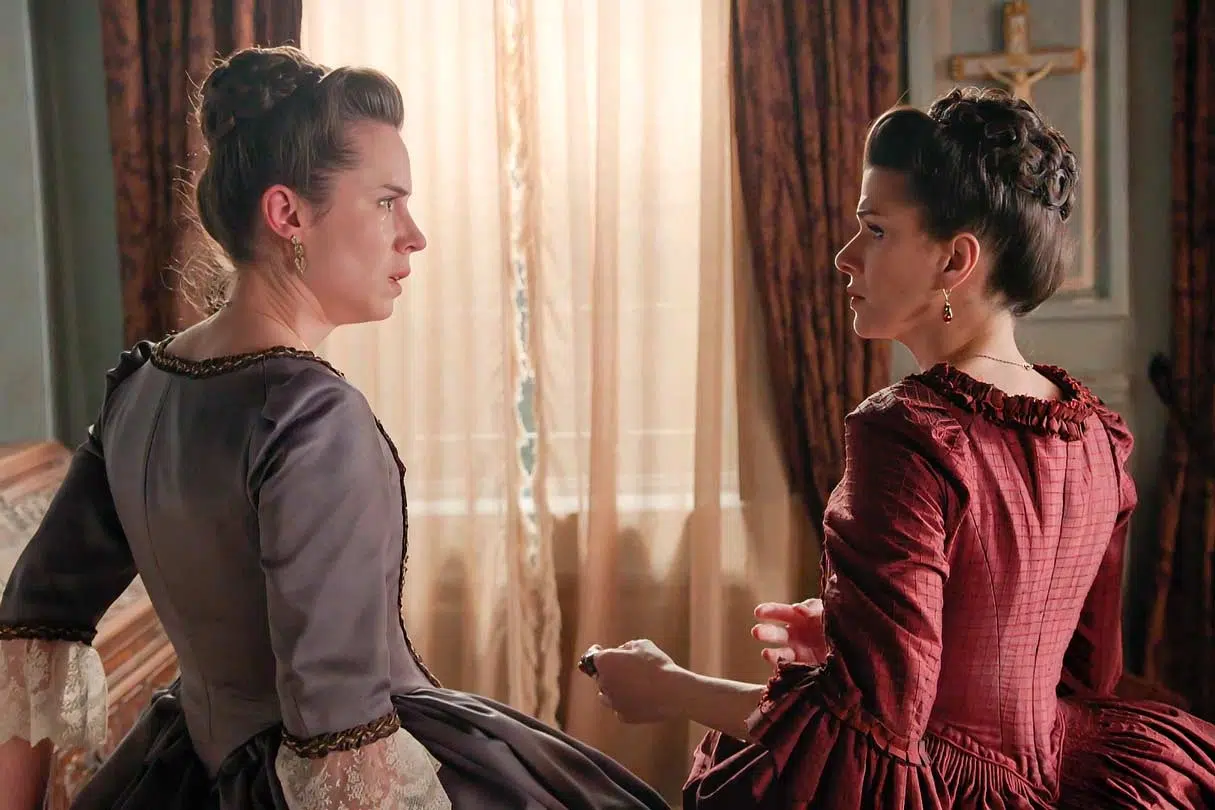
The opulent private chambers of the Duchess of Miramar, a space typically reserved for quiet contemplation and aristocratic repose, became the unlikely stage for a dramatic confrontation that could irrevocably alter the intricate power dynamics within the fictional world of "Valle Salvaje." The scene opens with an assertive gesture from Victoria, one that Mercedes, the Duchess of Miramar, is immediately unwilling to tolerate. This initial resistance sets the tone for a deeply personal and psychologically charged encounter, as Victoria seeks to pierce through Mercedes’ carefully constructed defenses.
The narrative unfolds as Victoria intrudes upon Mercedes’ personal sanctuary. The Duchess, clearly desiring solitude and explicitly wishing to avoid Victoria’s company, attempts to dismiss her. "Victoria, please, leave my room," she commands, her voice laced with an unmistakable air of finality. This immediate rejection, however, fails to deter Victoria, who has clearly arrived with a singular purpose: to force Mercedes to acknowledge a shared, uncomfortable truth.
Victoria’s persistence is not born of mere obstinacy, but from a conviction that they have both been subjected to a profound deception. She directly confronts Mercedes with a witnessed event: "Did you not see how Dámaso mocked Rafael?" This pointed question is designed to bypass Mercedes’ ingrained skepticism and appeal to her sense of justice, or at least her capacity for observation. Victoria’s strategy is to highlight a specific instance of perceived humiliation, hoping it will serve as a catalyst for Mercedes to question her own perceptions.
For weeks, Mercedes has viewed Victoria’s interventions as merely another tactic in their ongoing feud, a calculated maneuver in an entrenched rivalry. To entertain Victoria’s claims, in Mercedes’ estimation, would be to concede ground, a capitulation she is unwilling to entertain. Her resistance stems from a deeply ingrained belief that Victoria’s motives are always self-serving, a perception likely cultivated by the very manipulations Victoria is now attempting to expose. The history between these two women, as portrayed in the series, has been one of consistent opposition, making Mercedes’ initial dismissal of Victoria’s warning entirely predictable within the established narrative.
However, Victoria escalates her argument beyond a single incident. She begins to articulate a pattern of deceit, suggesting that Dámaso’s actions are not isolated betrayals but indicative of a consistent modus operandi. "He has been mocking us all this time, and that is his true face," Victoria declares, her words painting a picture of a man who has systematically played both women against each other. This accusation suggests a calculated strategy of manipulation, where Dámaso has exploited their individual desires and vulnerabilities, weaving a web of cross-promises and tailored lies. The implication is that Dámaso has been operating on dual fronts, fostering separate relationships and expectations with both Victoria and Mercedes, all while maintaining an illusion of sincerity. This revelation, if true, would represent a significant breach of trust, impacting not only their personal lives but potentially their social standing and influence within the fictional society depicted in "Valle Salvaje."
The weight of Victoria’s accusations finally begins to penetrate Mercedes’ formidable defenses. A crack appears in her stoic facade, allowing a sliver of doubt to emerge. This doubt crystallizes into a poignant question, one that betrays a dawning horror: "How could I not have seen it before?" This moment marks a critical turning point for Mercedes, forcing her to confront the unsettling possibility that she has been a pawn in a larger game, potentially manipulated from the outset. The emotional impact of this realization is palpable, suggesting a profound crisis of confidence and a re-evaluation of her own judgment.

The most devastating realization for Mercedes comes when she articulates the truth she can no longer deny: "He has deceived me like a fool." This declaration, heavy with a potent mix of fury and mortification, signifies a point of no return in her perception of Dámaso. The phrase "deceived me like a fool" underscores a deep sense of personal humiliation, suggesting that her trust has been not only misplaced but egregiously betrayed, leaving her feeling vulnerable and exposed.
In the wake of this shattering admission, Victoria extends an unexpected olive branch. She acknowledges their shared predicament, recognizing that they have both fallen victim to the same deception. "I gave my love to that man as you gave yours to Dámaso, and he has deceived us both," Victoria states, her words a bid for solidarity born from shared pain. This attempt at alliance, however, is met with renewed resistance from Mercedes.
Mercedes, still grappling with the raw emotions of her revelation, is not yet ready to embrace such an alliance. She rebuilds her defenses with a chilling coldness, severing any nascent connection. "Victoria, please, you and I are different," she asserts, her tone sharp and dismissive. She delivers a final, unambiguous statement: "We will never be confidantes, let alone friends." This pronouncement is intended to draw a clear and unbridgeable line between them, reinforcing their established adversarial relationship.
Despite the finality of Mercedes’ words, the tremor in her voice betrays a deeper impact. Victoria’s warnings, however unwelcome, have resonated more profoundly than Mercedes is willing to admit. The seed of doubt concerning Dámaso has been firmly planted, and the narrative suggests that there is no turning back from this realization. The implications of this internal shift within Mercedes are significant.
What makes this scene particularly revealing is not Mercedes’ ultimate rejection of Victoria, but the potent undercurrent that remains. Two women, who have spent weeks locked in a bitter conflict, now discover they share a common adversary. While Mercedes may outwardly maintain her distance, "Valle Salvaje" strongly implies that her emphatic declaration of "we will never be friends" could very well be the initial step towards the opposite outcome. This subtle shift in the narrative foreshadows a potential realignment of alliances, driven by a shared grievance.
Dámaso, the architect of this complex web of deceit, appears to believe he has achieved a decisive victory. However, the narrative suggests his calculations are flawed. As the two women he has so meticulously manipulated begin to exchange glances of dawning understanding, the established rules of the game are poised to change dramatically. This burgeoning, albeit unspoken, alliance between Victoria and Mercedes presents a formidable new challenge to Dámaso’s machinations. The potential for their combined strength, fueled by a shared sense of betrayal, could prove to be his ultimate undoing. The dramatic tension in "Valle Salvaje" is amplified by this unfolding psychological drama, as the characters navigate a landscape of shifting loyalties and unearthed truths. The series, through this pivotal scene, underscores the power of shared experience in forging unexpected bonds, even between the most unlikely of individuals. The consequences of Dámaso’s deceit are far from over, and the future trajectory of the narrative appears to hinge on the evolving relationship between these two formidable women.

0 Comments