
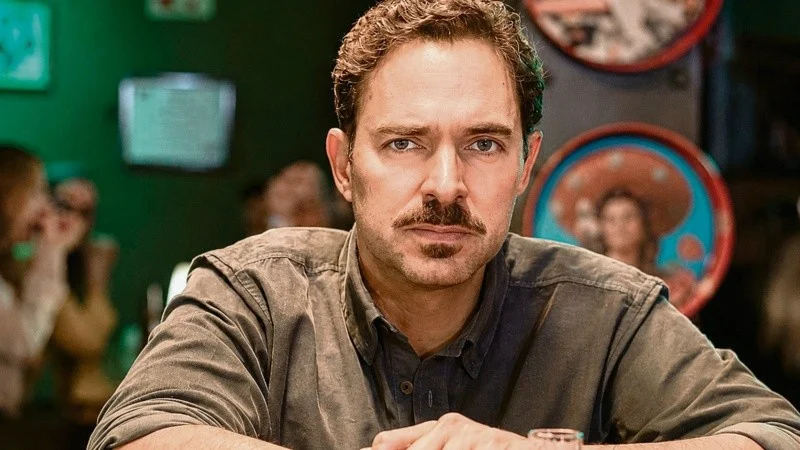
A single DNA test has the power to shatter the foundations of a family, a dramatic premise at the heart of "El Otro Padre," the new Mexican series currently captivating audiences and ranking as the most-watched title on Netflix in Mexico. This ten-episode production, which premiered on July 22, delves far beyond the initial biological revelation, meticulously exploring profound questions: What constitutes true family belonging? How long can secrets be sustained? And, most critically, what truly defines a parent—blood ties or the unwavering decision to nurture and care?
The series orchestrates a complex narrative around these existential inquiries, primarily through the journey of Gustavo, a pivotal character portrayed by Sebastián Dante. He is part of an acclaimed ensemble cast that includes seasoned actors Silvia Navarro, Manolo Cardona, Erik Hayser, and Paola Núñez. The central conflict ignites when a teenage daughter requires a kidney transplant, a medical necessity that inadvertently uncovers a shocking truth: the man who has raised her shares no biological connection. This revelation serves as the catalyst, unleashing a cascade of secrets and emotional turmoil that reverberates through every character, challenging their perceptions of family, loyalty, and self.
Sebastián Dante, in an interview, articulated that the initial medical crisis functions merely as a gateway into a much deeper drama, one whose true potency lies in the exploration of affective bonds. "It’s a very endearing story," Dante explained to EL INFORMADOR. "The initial conflict detonates a multitude of situations, moments, and new conflicts. It doesn’t just speak of the lack of an organ or an illness, but also of family communication, of those intricate situations we often live, suffer, and don’t know how to confront." This thematic depth was, for the 30-year-old actor, the project’s primary allure. He described it as the first "green flag" he encountered, appreciating "the profundity with which it portrays family themes that we often don’t even dare to touch upon in fiction." Dante emphasized the universal relatability, noting, "There are many moments where I identify, not just with my character, but with several others in the series. I believe that universality allows the story to resonate and move countless Mexican families. That’s precisely what made me think, ‘this story is really good’."
Gustavo’s Journey: A Secret Burden and the Quest for Self-Acceptance
Within the intricate family tapestry, Gustavo emerges as a young man whose personal history remains partially veiled for a significant portion of the series. Dante elaborated on his character’s intimate battle, which profoundly shapes his trajectory. "Gustavo is a very beautiful person. As the episodes advance, you discover many things about his story. But, in essence, he is someone very empathetic, very luminous, very loving, and very attentive to his family," Dante revealed. Yet, beneath this seemingly bright exterior, Gustavo carries a secret that torments him, "practically not letting him breathe." Despite his deep affection for his parents and siblings, he struggles to find the trust to share this hidden part of himself. "He lives a very strong internal struggle until the moment he decides to assume who he truly is and accept the path he is meant to live. He is a character with whom I connected deeply and who moved me from the very first moment," Dante shared, highlighting the profound personal connection he forged with the role.
The actor’s understanding of Gustavo gained an additional layer of significance when the series’ writer, Roberto Stopello, shared the personal origins of the character’s conflicts during filming. This trust profoundly influenced Dante’s approach to each scene. "It moved me deeply," Dante recalled. "I believe Gustavo learns to express his needs, communicate his desires, and set boundaries. That’s a process that, in one way or another, traverses all of us. How do we manage to be who we truly are in a world that often judges, discriminates, or is not tolerant? That’s what moved me most about the character." Dante further detailed, "Roberto Stopello, the author of the series, shared with me that Gustavo has much of his own story. It’s not an autobiography, but there are personal experiences, emotions, and conflicts that he transferred to the character." This revelation underscored the authenticity and vulnerability embedded in Gustavo’s narrative. Dante concluded by expressing his gratitude: "For me, it was an honor to be able to represent such an intimate part of someone. It was also very beautiful to build the family dynamic with my colleagues. Little by little, we ended up feeling like a real family, and that made all the scenes much more honest."
The Nuance of Paternity: Love Transcending Genetics
While "El Otro Padre" is initially propelled by a genetic test, the series deliberately shifts the discourse towards a deeper understanding of human connections. The central question of who truly merits the title of "father" permeates the entire narrative, culminating in an answer that, for Dante, far surpasses any laboratory result. "Ultimately, one is a father much more by decision than by DNA," Dante asserted. "In our country, paternity remains a complicated issue. There are many fathers who are not present, and there are also people who, without sharing biological ties with you, end up becoming your true parents. I like to think precisely about that: that love transcends genetics." He elaborated on this powerful perspective: "Ultimately, it is love and the decision to care for another person that truly build paternity. That decision to accompany and be there for someone seems to me one of the deepest and most beautiful acts that exist." This theme resonates deeply within Mexican society, where diverse family structures and the concept of "chosen family" often hold significant cultural weight.
Illuminating the Organ Donation Crisis and Ethical Dimensions
Beyond its core familial drama, "El Otro Padre" thoughtfully incorporates the critical issue of organ transplantation and its complex ethical implications. For the cast, this aspect of the production necessitated an immersion into a reality largely unknown outside medical circles, a reality that impacts thousands of Mexican families and generates multifaceted debates. "While working on the series, we immersed ourselves in this entire context and discovered many things that I completely ignored," Dante recounted. "We learned how waiting lists function, donations, medical protocols, and even the existence of the clandestine organ market." He described the experience as eye-opening: "It’s a very harsh reality. There were definitely many aspects that surprised me and made me understand the enormous complexity behind a story like this."

In Mexico, the demand for organ transplants, particularly kidneys, far outstrips the supply. According to the National Transplant Center (CENATRA), thousands of patients are on waiting lists for organs, with kidney transplants consistently being the most needed. The series’ portrayal of this issue offers a vital platform for public awareness, shedding light on the bureaucratic hurdles, the emotional toll on families, and the critical need for organ donors. By touching upon the grim reality of illegal organ trafficking, the show also prompts a crucial, albeit disturbing, conversation about desperation and exploitation within the healthcare system. Cultural critics might commend the series for tackling such a sensitive and socially relevant topic, using its popular platform to educate and provoke thought on a matter of public health and human ethics.
Production Excellence and Collaborative Spirit
The project also presented Sebastián Dante with the opportunity to share the screen with highly respected performers. He spoke warmly of the collaborative atmosphere during filming, particularly his experience with Silvia Navarro, who portrays his mother in the series. "Silvia and Paola Núñez are two great pillars of the series. I had admired them for a long time, but had never worked with them," Dante stated. "With Silvia, I shared many more scenes because she plays my mom. Besides being an extraordinary actress, she is a hilarious person, very loving, and very close with the entire team. She has a very beautiful energy that makes the atmosphere on set warm and relaxed. That helps immensely when you’re working on such intense scenes." The palpable chemistry and genuine camaraderie among the cast undoubtedly contribute to the authenticity and emotional resonance that viewers experience. This synergistic environment, where seasoned actors mentor newer talent and a collective passion for the story prevails, is often a hallmark of successful productions.
Netflix’s Strategic Investment in Authentic Latin American Narratives
"El Otro Padre"’s success is not an isolated incident but rather a testament to Netflix’s strategic and significant investment in original Latin American content. Over the past few years, the streaming giant has increasingly focused on producing local stories that resonate globally, recognizing the rich storytelling traditions and vast talent pool across the region. Series like "La Casa de las Flores," "Control Z," and "¿Quién Mató a Sara?" have demonstrated the immense appeal of Mexican productions, blending unique cultural elements with universal themes that transcend geographical boundaries. "El Otro Padre" fits perfectly into this strategy, leveraging the enduring popularity of the Mexican melodrama while infusing it with contemporary social issues and a modern narrative approach. A hypothetical Netflix executive might comment on the importance of empowering local creators to tell authentic stories that reflect the diverse experiences of their audiences, further cementing Netflix’s position as a global content leader.
The Evolving Mexican Melodrama: A Modern Interpretation
As "El Otro Padre" continues to rank among Netflix’s most-watched titles in Mexico, Dante has also begun experiencing the series from a viewer’s perspective. He notes a unique editing style that preserves the inherent emotional core of Mexican melodrama while injecting a contemporary rhythm that sustains tension from one episode to the next. "It has been very beautiful. I have received messages from family, friends, and also many people on social media who have identified with the story and with Gustavo," Dante shared. "That’s the most beautiful thing about fiction: when someone can see themselves reflected in a character and find there a reflection on their own life." He praised the production’s technical execution: "Moreover, now that I’m watching the finished series, I’m also surprised as a viewer. The editing has a very agile rhythm. Although it retains all the essence of Mexican melodrama, the story advances with great intensity and always leaves you wanting to see the next chapter. That makes me very happy, both as an actor and as a spectator."
This blend of traditional emotional depth with a faster, more cinematic pace represents an evolution of the Mexican melodrama, a genre historically known for its protracted narratives. "El Otro Padre" demonstrates that contemporary audiences appreciate the genre’s emotional richness but also demand dynamic storytelling that keeps them engaged. Cultural analysts might view this series as a prime example of how traditional genres can be successfully adapted for a global streaming audience, maintaining cultural specificity while adopting universal storytelling techniques. The series’ ability to generate empathy and facilitate self-reflection among viewers underscores the enduring power of narrative to connect individuals to shared human experiences, even amidst complex and challenging circumstances.
Conclusion: A Testament to Love, Choice, and Identity
"El Otro Padre" has quickly established itself as more than just a popular streaming series; it is a significant cultural touchstone that prompts critical reflection on the very fabric of family. By meticulously dissecting the themes of biological versus chosen parenthood, the corrosive nature of secrets, and the arduous journey toward self-acceptance, the series transcends conventional melodrama. It offers a nuanced exploration of modern familial dynamics, urging viewers to question societal norms and embrace a broader, more inclusive definition of what it means to belong and to love. Through compelling performances, particularly Sebastián Dante’s portrayal of Gustavo, and a narrative that expertly weaves personal drama with urgent social issues like organ donation, "El Otro Padre" exemplifies the power of contemporary storytelling to entertain, educate, and provoke meaningful dialogue. Its success on Netflix Mexico underscores the appetite for authentic, emotionally resonant narratives that bravely confront the complexities of the human condition, making it a powerful testament to the enduring bonds forged not by blood, but by love and unwavering choice.

0 Comments