
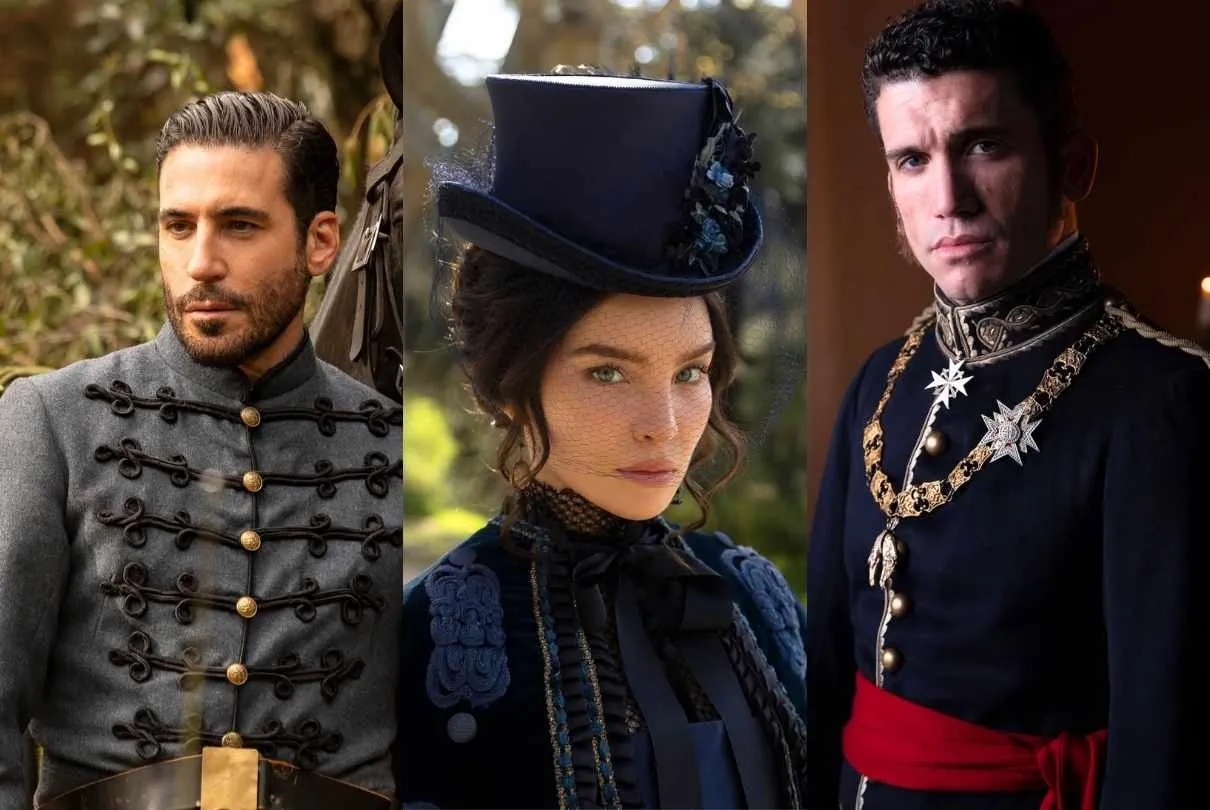
HBO Max has unveiled the first compelling glimpses of "Carlota," a sweeping new historical drama series poised to illuminate the extraordinary and turbulent life of Empress Carlota of Belgium. The ambitious production, spearheaded by a diverse international ensemble, promises a rich tapestry of power, ambition, romance, and the intricate political machinations that defined the last Empress of Mexico. The initial release of official images arrives at a poignant moment, coinciding with the anniversary of Carlota and Emperor Maximilian’s wedding, a pivotal event that catalyzed their ill-fated Mexican adventure and now serves as the thematic anchor for this highly anticipated series from Sony Pictures Television.
The first visual offerings immerse viewers in the opulent yet fraught world of the 19th century, introducing the key figures who will drive this dramatic narrative. Spanish pop sensation Belinda takes on the titular role of Carlota, embodying the intelligence and resilience of the Belgian princess who ascended to the throne of Mexico. Opposite her, Jaime Lorente, known for his powerful performances, portrays Emperor Maximilian, the Austrian archduke whose imperial aspirations would ultimately lead to his tragic demise. Miguel Ángel Silvestre, a prominent figure in Spanish television, steps into the role of Alfred van der Smissen, a significant figure in Carlota’s life and a point of personal intrigue. Completing the core cast in these initial reveals is Mabel Cadena as Josefa, suggesting a crucial role for her character within the imperial court.
These early images underscore the meticulous artistic direction of "Carlota." The production team has clearly strived for a contemporary reinterpretation of historical drama, blending an authentic sense of period with a fresh, engaging visual aesthetic. The intention is not merely to recreate the past, but to imbue it with a dynamism that resonates with modern audiences, while remaining steadfastly anchored in the monumental events that shaped the lives of its protagonists. The series aims to capture the grandeur and the gravitas of an era marked by imperial ambition and profound personal sacrifice.
Beyond the central quartet, "Carlota" boasts a robust supporting cast that further enhances its international appeal and historical depth. Mexican actress Bárbara de Regil is slated to portray Enriqueta Villalpando, a figure whose historical context within the Mexican political landscape will undoubtedly add layers to the unfolding drama. Sebastián Zurita takes on the role of Leonardo Márquez, a significant military leader during the Second Mexican Empire, promising to bring a potent element of conflict to the narrative. Irena Azuela is cast as La Viuda Fernández, hinting at a character with a potentially influential, perhaps clandestine, role. Adding to the Spanish contingent are Álvaro Rico, who plays Leopoldo, Carlota’s brother, offering a familial perspective on her journey, and Clara Alvarado, who steps into the role of Paula Kolonitz, a lady-in-waiting whose proximity to the Empress could yield significant plot developments.
A Superproduction Across Continents
The scale of "Carlota" is immediately evident from the production’s ambitious scope. Filmed over an intensive 17-week period, the series traversed a vast geographical landscape, capturing authentic environments across more than 40 distinct locations spanning both Latin America and Europe. This extensive shooting schedule underscores the commitment to historical accuracy and visual richness, aiming to transport viewers directly into the heart of the 19th century.
The sheer manpower involved in bringing this historical epic to life is staggering. The production enlisted a cast of 45 principal actors, supported by a massive chorus of approximately 1,370 extras who populated the scenes with authentic period detail. The soundscape and visual spectacle were further amplified by the involvement of 80 musicians and over 100 dancers and specialists, contributing to the immersive experience. These figures highlight "Carlota" as a true superproduction, designed to meticulously recreate the intricate universe of the era.
The creative leadership behind "Carlota" is equally impressive. The series is the brainchild of Carlos Quintanilla Sakar, who serves as showrunner, guiding the overall vision and narrative flow. He is joined by Adriana Pelusi, the principal screenwriter, responsible for crafting the compelling dialogues and intricate plotlines. The directorial reins are shared by Ana Lorena Pérez Ríos and José Manuel Cravioto, whose distinct artistic visions are expected to shape the visual language of the series. Complementing their work, David Azcano Lara and Ximena Amann lead the cinematography team, tasked with capturing the historical grandeur and emotional nuances of the story.
The Visual Narrative: Costume and Setting as Characters
A defining characteristic of "Carlota" is its profound emphasis on visual storytelling, with costume and location design elevated to the status of central characters themselves. The creative team has embarked on a mission to reinterpret the elegance and societal norms of the 19th century, forging a unique visual identity for the series. Costume design, in particular, is employed as a powerful narrative tool, charting the emotional evolution and personal journeys of the characters.

Loles García, the costume designer, articulated the team’s objective: to present a period piece with a contemporary sensibility. This involved extensive historical research to ensure accuracy, while also allowing for creative license to enhance the dramatic impact. "Each silhouette, color, and design choice is meticulously crafted to reflect the personal trajectory of characters like Carlota and Josefa," García explained, emphasizing how the attire serves as a visual diary of their experiences, aspirations, and internal struggles. The wardrobes are not mere historical reproductions; they are extensions of the characters’ personalities and their roles within the complex political and social landscape.
The chosen locations play an equally vital role in establishing the series’ authenticity and visual appeal. Historic palaces, ancient convents, sprawling gardens, and meticulously preserved historical streets were carefully selected and adapted to evoke the atmosphere of Imperial Mexico. Beyond these existing architectural gems, key sets, such as the imperial bedchamber of Carlota and Maximilian and the intimate confines of a ship’s cabin or stable, were purpose-built in studios. This dual approach—utilizing authentic historical sites and constructing bespoke environments—ensures a rich and varied visual tapestry that underscores the narrative’s scope and emotional weight.
Carlos Bodelón, the production designer, highlighted the delicate balance the team sought to strike between historical fidelity and dramatic license. "Every detail, from the furniture and upholstery to the carriages and the chromatic palette, has been considered to create a unique visual universe," Bodelón stated. This meticulous attention to detail extends to the smallest elements, contributing to a world that feels both historically grounded and artistically realized. The production design aims to immerse the audience in the era, allowing them to viscerally experience the opulence, the political intrigue, and the personal dramas that unfolded within these meticulously recreated settings.
Historical Context and Significance
The story of Carlota and Maximilian is a compelling chapter in 19th-century history, marked by imperial ambition, foreign intervention, and a tragic clash of cultures. Following the French intervention in Mexico and the establishment of the Second Mexican Empire under Napoleon III’s influence, Archduke Ferdinand Maximilian of Austria was persuaded to accept the Mexican throne in 1864, with his wife, Princess Charlotte of Belgium, by his side. Carlota, a strong-willed and politically astute royal, played a significant role in the decision to accept the crown and actively participated in governing the nascent empire.
However, the Mexican Empire was beset by internal dissent and faced formidable opposition from the Republican forces led by Benito Juárez, bolstered by increasing support from the United States following the American Civil War. Maximilian, despite his initial confidence, found himself increasingly isolated and outmaneuvered. As the empire crumbled under the weight of political instability and external pressures, Carlota embarked on a desperate diplomatic mission to Europe in 1866 to secure support for her husband’s regime. Her pleas to Napoleon III and Pope Pius IX proved futile, and the strain of her mission, coupled with the devastating news of Maximilian’s impending capture and execution, had a profound psychological impact.
Maximilian was captured by Juárez’s forces in May 1867 and executed by firing squad in Querétaro on June 19, 1867. Carlota, by then suffering from severe mental distress, spent the remainder of her long life in seclusion, primarily at Bouchout Palace in Belgium, where she died in 1927 at the age of 86. Her story is one of immense personal tragedy, a princess who dreamed of empire and found only ruin, forever etched in the annals of history as the last Empress of Mexico.
Analysis and Implications
The decision by HBO Max to invest in a high-profile historical drama like "Carlota" reflects a broader trend in streaming platforms to explore complex historical narratives with global appeal. By assembling an international cast and filming across diverse locales, the series aims to resonate with audiences across different cultural backgrounds, highlighting the universal themes of power, ambition, love, and loss.
The success of such productions can have several implications. For the actors involved, it offers a platform to showcase their talents on a global stage, potentially opening doors to further international opportunities. For the production itself, the meticulous attention to historical detail and visual grandeur sets a new benchmark for historical dramas, potentially influencing future productions in the genre.
Furthermore, the series has the potential to reignite public interest in a lesser-known, yet historically significant, period of Mexican and European history. By bringing the dramatic lives of Carlota and Maximilian to a wider audience, "Carlota" can serve as an educational and engaging entry point into understanding the complexities of 19th-century geopolitics, imperial ambitions, and the enduring impact of personal choices on historical events. The series’ success will likely depend on its ability to balance historical accuracy with compelling storytelling, offering viewers a captivating and thought-provoking exploration of a remarkable historical figure and her tragic reign.

0 Comments