
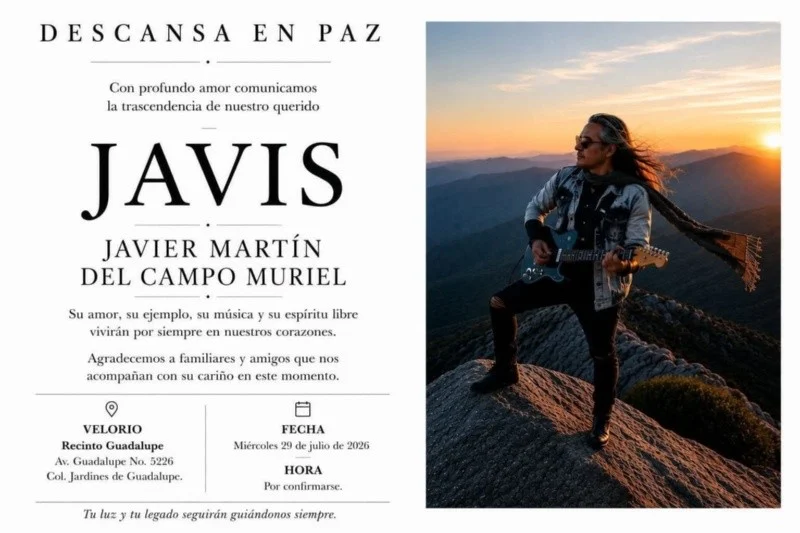
The news of Martín del Campo’s death on Tuesday, July 29, 2026, sent ripples through the music community and was initially confirmed by the Governor of Jalisco, Pablo Lemus, before being officially announced by the band itself. As of the current reporting, the specific causes of his passing have not been publicly disclosed, leaving fans and peers to reflect on his monumental contributions to Mexican popular music. The band utilized its social media platforms to communicate the somber news, simultaneously informing the public that a wake for their beloved founder would be held on Wednesday, July 30, 2026, at Recinto Guadalupe, located at Avenida Guadalupe 5226, within the Jardines de Guadalupe neighborhood. The precise schedule for the services is expected to be announced in due course.
A Legacy Forged in Sound: Javis’s Enduring Impact
Francisco Javier Martín del Campo Muriel’s journey began in San Luis Potosí, where he was born on April 8. From a young age, his passion for music was evident, leading him to become one of the pivotal figures who championed and propelled the nascent Mexican rock movement. His most significant contribution, and the vehicle for his artistic expression, was the formation of La Revolución de Emiliano Zapata in Guadalajara in 1969. This group, under Javis’s guidance, would not only achieve widespread recognition but also profoundly influence the landscape of Mexican music for decades.
The band’s initial foray into the music scene coincided with a vibrant yet tumultuous period for rock music in Mexico. The late 1960s and early 1970s saw a burgeoning counterculture, largely inspired by international movements, taking root among Mexican youth. La Revolución de Emiliano Zapata emerged as a powerful voice within this context, carving out a distinct identity with its raw energy and socially conscious lyrics. Their debut album, released in 1970, quickly garnered attention, but it was their groundbreaking track "Nasty Sex" that truly propelled them into the national spotlight.
"Nasty Sex" was more than just a song; it was an anthem that captured the rebellious spirit of the era. Its explicit lyrical content and unconventional sound challenged the prevailing conservative norms, making it a controversial yet immensely popular hit. The song’s success was a testament to Javis’s innovative compositional style and the band’s fearless approach to music. It resonated deeply with a generation seeking liberation and self-expression, solidifying La Revolución de Emiliano Zapata’s status as pioneers of Mexican rock. The track’s impact was so significant that it became a defining song of the period, often cited in discussions of the golden age of Mexican rock, alongside the legendary Avándaro Festival, which, though the band did not participate, represented the pinnacle of the countercultural rock movement.
Evolution and Reinvention: Navigating a Changing Musical Landscape
The trajectory of Mexican rock was not always smooth. The mid-1970s brought significant challenges, including a crackdown on rock venues, radio censorship, and a general societal shift that made it difficult for rock bands to maintain their initial momentum. Many groups either disbanded or adapted their sound to survive. La Revolución de Emiliano Zapata, under Javis’s strategic vision, chose the latter path, embarking on a remarkable artistic evolution that showcased their versatility and Javis’s depth as a composer.
This period saw the band pivot from its hard rock roots towards a more melodic, balada-oriented sound. This transition was not merely a commercial calculation but also reflected the band’s growth and Javis’s willingness to explore new musical territories. It was during this phase that they produced some of their most enduring and commercially successful hits, including "Cómo te extraño" and, most notably, "Mi forma de sentir."
"Mi forma de sentir," a composition by Javis himself, became an instant classic. Its heartfelt lyrics and captivating melody resonated with a broader audience, demonstrating the band’s ability to transcend genre boundaries. The song’s immense popularity was further cemented when it was famously covered by renowned singer Pedro Fernández, introducing Javis’s songwriting to an even wider demographic and ensuring its place in the pantheon of Mexican romantic ballads. This period of reinvention solidified La Revolución de Emiliano Zapata’s longevity and proved Javis’s exceptional talent for crafting songs that could touch the hearts of millions, regardless of musical trends. The band continued to record and perform, albeit with various lineup changes, always maintaining a connection to its founder’s original vision and musical integrity.

Tributes and Condolences: A Nation Mourns an Icon
The news of Javis’s passing prompted an outpouring of tributes from across the Mexican political and musical spectrum. Governor Pablo Lemus of Jalisco was among the first to express his sorrow and acknowledge Martín del Campo’s profound impact. "Today we sadly bid farewell to Javier Martín del Campo ‘Javis,’ a musician who left a deep mark on the history of Mexican rock and in the hearts of many generations through La Revolución de Emiliano Zapata, with great successes like ‘Mi forma de sentir,’" Lemus posted. He further added, "His passion for music, his talent, and the legacy he built will live on in every song and in the memory of those of us who admired him." The governor also extended his deepest condolences to Javis’s family, friends, bandmates, and the entire musical community, underscoring the widespread grief felt by many.
The band itself, in a poignant message shared on its official channels, reflected on Javis’s indelible spirit. "His love, his example, his music, and his free spirit will live forever in our hearts… Your light and your legacy will always guide us," the group wrote, encapsulating the profound personal and artistic void left by his departure. This statement not only conveyed the band’s sorrow but also reaffirmed their commitment to carrying forward the musical torch ignited by their founder.
Another legendary Mexican rock institution, El Tri, also paid its respects to the fallen guitarist. In a message shared on its social media platforms, El Tri offered a heartfelt farewell: "May you find peace on this last journey and may music accompany you to infinity. Your legacy will continue to sound in every guitar, in every song, and in every heart that vibrated with you." This tribute from a contemporary and fellow pioneer of Mexican rock highlights the mutual respect and camaraderie that existed within the national music scene, even among groups with distinct styles.
Beyond these official statements, countless fans, fellow musicians, and cultural commentators took to various platforms to share their memories and appreciation for Javis’s work. Social media feeds were filled with anecdotes, favorite song lyrics, and expressions of gratitude for the music that had soundtracked their lives. Music journalists and historians are expected to further analyze his career, solidifying his place in the annals of Mexican music history as not just a performer, but a true architect of sound.
The Enduring Resonance: Javis’s Legacy in Mexican Music
Francisco Javier Martín del Campo Muriel’s legacy extends far beyond the hit singles and albums. He was a trailblazer who, along with his band, helped define the sound of Mexican rock at a crucial juncture in its development. His ability to fuse diverse musical influences, his lyrical prowess, and his instrumental skill as a guitarist made La Revolución de Emiliano Zapata a unique and powerful force.
His career trajectory, from the rebellious rock of "Nasty Sex" to the tender ballads like "Mi forma de sentir," mirrors the evolution of Mexican popular music itself, demonstrating an artist’s capacity to adapt, innovate, and remain relevant across changing cultural landscapes. Javis’s contributions provided a template for future generations of musicians, proving that authenticity and artistic integrity could coexist with commercial success. He showed that Mexican artists could create music that was both deeply rooted in their cultural context and universally appealing.
The enduring popularity of La Revolución de Emiliano Zapata’s songs, decades after their initial release, is a testament to the timeless quality of Javis’s compositions. These songs continue to be played on radio, streamed online, and covered by new artists, ensuring that his musical spirit will continue to resonate with listeners for years to come. Javis’s passing marks the end of an era, but his music and his profound influence on the sound and soul of Mexico will undoubtedly live on, inspiring new generations of artists and captivating audiences worldwide. He leaves behind not just a discography, but a rich tapestry of musical history that fundamentally shaped Mexican identity through sound.

0 Comments