

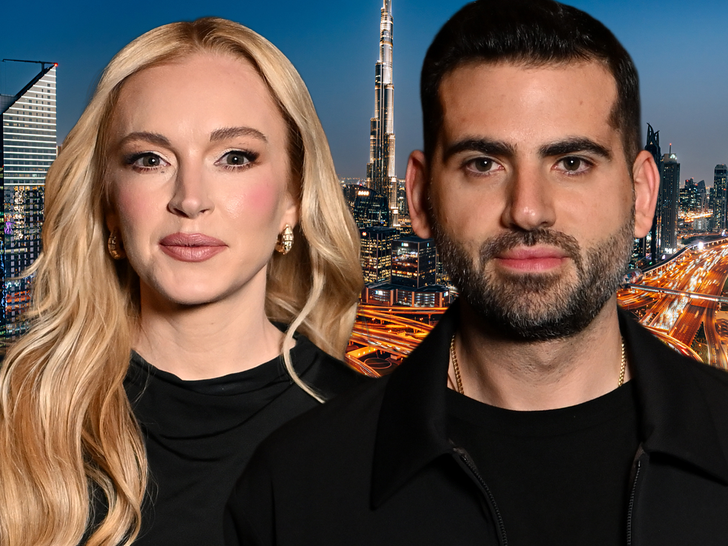
Sources close to actress Lindsay Lohan have confirmed that she and her family are safe and unharmed following a series of recent strikes targeting Dubai, attributed to Iran, as regional tensions continue to escalate. The news offers a reassuring update for fans and observers concerned about the well-being of the prominent expatriate celebrity amidst a rapidly evolving geopolitical landscape in the Middle East. Lohan, who has made Dubai her home for nearly a decade, is reportedly secure with her husband, Bader Shammas, and their infant son, Luai.
The confirmation comes at a time of heightened anxiety across the Persian Gulf, following a significant escalation in hostilities between Iran and an alliance believed to include the United States and Israel. The reported Iranian strikes on Dubai are understood to be retaliatory actions, prompted by earlier assaults on Iranian nuclear facilities and other strategically critical sites within Iran. This dangerous cycle of escalation has culminated in a period of unprecedented regional instability, underscored by the recent death of Iran’s Supreme Leader.
Lindsay Lohan’s Sanctuary in Dubai: A Decade of Privacy and Family Life
Lindsay Lohan’s decision to relocate to Dubai in 2015 marked a pivotal shift in her personal and professional life. The actress, who rose to global fame as a child star in films like "The Parent Trap" and "Mean Girls," had long grappled with intense media scrutiny and the demanding pressures of Hollywood. Her move to the United Arab Emirates was a deliberate step towards seeking a quieter existence, away from the relentless paparazzi culture that had defined much of her early career. As Lohan herself articulated in previous interviews, including a recent cover story for Vogue Arabia, Dubai offered her a unique sense of "serenity and peace," a stark contrast to the often chaotic environment of Los Angeles or New York.
Since settling in Dubai, Lohan has cultivated a personal life marked by stability and growth. Her relationship with financier Bader Shammas began in 2020, leading to their engagement in November 2021. The couple formalized their union in a private ceremony in July 2022, a testament to the privacy the city afforded them. The joyous arrival of their son, Luai, in July 2023, further cemented her commitment to her life in the UAE. These milestones have been largely shielded from the intense public gaze that once shadowed her every move, allowing her to build a family away from the constant glare of celebrity culture. Her recent appearance on the cover of Vogue Arabia in February 2026, where she reportedly reflected on her journey and even questioned why Hollywood hadn’t protected her more in her younger days, underscored her contentment with her current life path and her newfound sense of security. The immediate confirmation of her family’s safety provides a brief moment of relief amidst the broader regional anxieties.
The Genesis of Escalation: A Complex Geopolitical Tapestry
The recent strikes on Dubai are not isolated incidents but rather a dangerous manifestation of deeply entrenched geopolitical tensions that have simmered and periodically flared in the Middle East for decades. The immediate catalyst for Iran’s retaliatory actions appears to be a series of coordinated attacks, attributed to the United States and Israel, on several of Iran’s nuclear facilities and other key strategic installations. These preemptive or punitive strikes were likely aimed at degrading Iran’s nuclear program capabilities and its broader military infrastructure, which Western powers and Israel view as a significant threat to regional and global security.

Iran’s nuclear ambitions have been a contentious issue for years, with international bodies and Western nations expressing concerns about the potential for Tehran to develop nuclear weapons. While Iran consistently maintains its nuclear program is for peaceful purposes, distrust and a history of non-compliance with international safeguards have fueled a persistent standoff. Israel, in particular, views a nuclear-armed Iran as an existential threat, leading to covert operations and overt military threats throughout the years. The United States, under various administrations, has also maintained a robust policy of containing Iranian influence and preventing nuclear proliferation in the region.
The precise nature and targets of the alleged US and Israeli attacks on Iran prior to the Dubai strikes remain largely undisclosed, typical of such clandestine operations. However, intelligence reports and satellite imagery often hint at strikes on facilities related to uranium enrichment, missile development, or command-and-control centers. Such actions are inherently provocative and carry a high risk of escalation, as demonstrated by the subsequent Iranian response.
The Critical Development: The Death of Ayatollah Ali Khamenei
Adding a layer of unprecedented complexity and uncertainty to the unfolding crisis is the confirmation on Sunday, March 1, 2026, by Iranian State media, of the death of Ayatollah Ali Khamenei. Khamenei, who served as Iran’s president from 1981 to 1989 before ascending to the pivotal role of Supreme Leader, a position he held until his passing, was the spiritual and political arbiter of the Islamic Republic. His death at this critical juncture introduces a massive power vacuum and raises profound questions about Iran’s immediate and long-term trajectory.
Khamenei’s successor will inherit a nation grappling with internal economic challenges, widespread public dissent, and a rapidly escalating external conflict. The process of selecting a new Supreme Leader, typically overseen by the Assembly of Experts, is a highly secretive and politically charged affair. The identity and ideological leanings of the next leader will significantly shape Iran’s foreign policy, its approach to its nuclear program, and its engagement with regional and international actors. A more hardline successor could further inflame tensions, while a more pragmatic leader might seek avenues for de-escalation, though this seems less likely given the current climate. The timing of his death, amidst active military exchanges, could either prompt a period of internal consolidation and heightened aggression to project strength, or a temporary pause as the leadership transition unfolds.
Dubai’s Position and The Immediate Impact of Strikes
Dubai, a jewel in the crown of the United Arab Emirates, has long prided itself on its image as a global hub for finance, tourism, and innovation, known for its stability and safety in a turbulent region. The reported Iranian strikes on the city represent a direct challenge to this perception and a significant escalation of the regional conflict. While initial reports, including the confirmation of Lindsay Lohan’s safety, suggest that any direct impact on civilian areas may have been contained or minimal, the psychological and economic ramifications of such an attack are profound.
The UAE government, a steadfast ally of Western powers and a proponent of regional stability, has likely initiated robust defense protocols and emergency response measures. Dubai’s advanced missile defense systems, often developed in collaboration with international partners, would have been activated to intercept incoming projectiles. The fact that high-profile residents like Lohan are confirmed safe indicates either successful interception, strikes targeting specific non-civilian infrastructure, or a highly localized impact. However, the very act of targeting such a prominent civilian and economic center sends a clear message of Iran’s willingness to expand the conflict beyond traditional military targets.
Economically, even the threat of such strikes can have immediate repercussions. Global financial markets react negatively to regional instability, potentially impacting foreign investment, tourism, and oil prices. Dubai’s reputation as a safe haven for expatriates and businesses could be tested, leading to concerns among its large international population. The UAE leadership is expected to issue strong condemnations of any attacks on its sovereignty and civilian populations, while simultaneously engaging in diplomatic efforts to de-escalate the situation.
Broader Regional and International Implications
The escalation of hostilities, marked by strikes on both Iranian and Emirati territories, carries grave implications for the entire Middle East and beyond. The Strait of Hormuz, a critical chokepoint for global oil shipments, lies at the heart of this region. Any disruption here could send shockwaves through international energy markets, leading to volatile oil prices and potential global economic instability. Shipping lanes and air travel across the Gulf could also face increased risks, affecting international trade and logistics.
Internationally, the crisis demands urgent attention from major global powers. The United Nations Security Council is expected to convene emergency sessions, with calls for de-escalation, restraint, and a return to diplomatic dialogue. The United States, having been implicated in the initial strikes on Iran, finds itself at a critical juncture, needing to balance its strategic interests with the imperative to prevent a full-blown regional war. European powers, with significant economic ties to the region and a vested interest in non-proliferation, will likely amplify calls for diplomatic solutions and sanctions relief for Iran in exchange for nuclear concessions.
The succession crisis in Iran following Khamenei’s death further complicates these international efforts. Any new leadership will need to establish its authority, potentially through assertive foreign policy actions, making diplomatic breakthroughs challenging in the short term. Regional alliances are also being tested, with countries like Saudi Arabia, Bahrain, and other Gulf states closely monitoring the situation, fearful of spillover effects and potential direct involvement in the conflict.
Looking Ahead: An Uncertain Future
The confirmation of Lindsay Lohan and her family’s safety provides a small human element of relief amidst a crisis of immense geopolitical proportions. However, it does little to alleviate the profound uncertainty gripping the Middle East. The escalating cycle of strikes, coupled with the monumental leadership transition in Iran, paints a grim picture of potential further destabilization.
The international community faces an arduous task: to de-escalate tensions, prevent a wider regional conflict, and guide Iran towards a peaceful and verifiable nuclear program, all while navigating the complexities of a new Iranian leadership. The coming days and weeks will be critical in determining whether diplomacy can prevail over military confrontation, or if the region will plunge further into an era of heightened conflict. For residents of Dubai, expatriates and locals alike, the immediate focus remains on safety and vigilance, hoping for a swift resolution to the deepening crisis. The story, as is often the case in this volatile region, remains very much developing.

0 Comments