
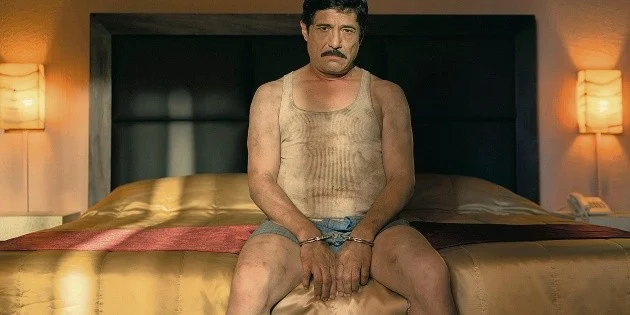
The gripping saga surrounding the final apprehension of Joaquín "El Chapo" Guzmán Loera, a figure synonymous with Mexico’s intricate drug war, has been recounted from numerous perspectives across various media. Yet, Guadalajara-born director Chava Cartas ventures into this well-trodden territory with a distinctive lens in his film, "La Captura." Instead of glorifying the notorious drug lord, Cartas’s latest cinematic offering pivots its narrative focus onto the federal police officers who participated in the pivotal operation, delving into the profound ethical quandaries they faced when confronted with one of the world’s most wanted men. The film, which premiered on Netflix on August 21st, aims to challenge conventional storytelling by centering on integrity and the often-unseen heroes of law enforcement.
A Moral Compass: The Director’s Vision
In a roundtable discussion, attended by EL INFORMADOR, Chava Cartas articulated the core philosophy underpinning "La Captura." The film, starring Alfonso Herrera and Noé Hernández, is designed to compel viewers to confront the same provocative question that ignited the project in the director’s mind. "When I began to read the documents of this story, the question that captivated me was: ‘What would I do? Would I have accepted the bribe? Would I have let that character go? Would I have done the right thing?’" Cartas reflected. He emphasized that when a story elicits such profound self-reflection, it inherently possesses the merit to be told. This introspective approach distinguishes "La Captura" from the multitude of productions that have historically focused on the allure and power of cartel leaders.
Cartas firmly stressed that the film’s objective was never to re-center the criminal kingpin in the narrative. "We have had enough years and enough money invested in telling the opposite, in narrating the dark side," he stated. "I have spent many years trying to approach the angles of the good guys. I believe that telling positive stories also benefits us as a society." This commitment to portraying a more optimistic and honorable facet of Mexico has been a consistent thread throughout his career, beginning with projects like "Rosario Tijeras" and continuing through "Contraataque." The latter, a film focused on security forces, served as a crucial precursor, paving the way for Cartas to explore narratives championing law enforcement. He explained that after "Contraataque," he discovered the story of two real federal police officers who simply did their job. "The accident was encountering that character; what was important to us were they," he underscored, highlighting the human element at the heart of the film.
Plot and Character Portrayals
"La Captura" draws inspiration from the definitive arrest of Joaquín "El Chapo" Guzmán, a high-stakes event that garnered global attention. In this fictionalized account, Héctor Kotsifakis embodies the criminal leader, while Alfonso Herrera and Noé Hernández portray federal police officers Arturo Carmona and Héctor Rosales, respectively. The narrative unfolds as these two officers, during a routine patrol, unexpectedly come face-to-face with the nation’s most elusive fugitive. The film meticulously avoids constructing a political discourse or passing judgment on the broader war against organized crime. Cartas reiterated his intent: "I am simply telling the story of two police officers who did their job. I want people to finish feeling proud that these heroes also exist. I want my children or grandchildren to know that there are good police officers too."
One of the principal challenges, as articulated by Cartas, was navigating a widely documented episode without inadvertently glorifying organized crime. He emphasized that "honesty was the main ingredient. To tell the truth as it is, without creating a pamphlet for one side or the other, without glorifying anyone. We are talking about two human beings facing an extraordinary situation within their work." This delicate balance was maintained by rooting the narrative in factual events while dramatically reconstructing the emotional and psychological spaces that were not publicly recorded.
Casting for Authenticity and Impact
The selection of the cast for "La Captura" was guided by Cartas’s vision for authentic and impactful storytelling. He revealed that his casting process often deviates from traditional auditions; instead, he frequently visualizes specific actors for roles while reading the screenplay. "When I read the script, I immediately thought of Alfonso Herrera. I needed a police officer with presence, with personality," Cartas explained. Having previously collaborated with Herrera, Cartas was confident in the actor’s ability to convey the necessary gravitas and integrity.
The choice of Noé Hernández for the other lead police officer was strategic, aiming to leverage the actor’s past roles to create immediate dramatic tension. "I wanted the audience to have that initial doubt, because many times we have seen him as an antagonist. That played in favor of the drama," Cartas noted, indicating a deliberate effort to subvert audience expectations and deepen the characters’ initial distrust. For the pivotal role of Joaquín Guzmán, Héctor Kotsifakis was cast, alongside Juan Pablo Cruz García, who hails from Guasave, Sinaloa. Cartas prioritized respecting the regional origins and linguistic nuances of the characters. "I don’t believe in forcing an actor to do an accent that doesn’t belong to them. Sinaloans have a very specific way of speaking, and we preferred to preserve that authenticity," he affirmed, underscoring a commitment to cultural accuracy.
Production Challenges: Bringing the Unseen to Life
The production of "La Captura" presented significant technical and logistical demands, particularly concerning action sequences. Cartas cited the tunnel scene, through which the drug lord makes an escape attempt, as one of the most complex. "We found a tunnel in Chihuahua, but it was impossible to flood it. So we built a container in the shape of the tunnel and, instead of filling it with water, we submerged the container. It was a technical solution that allowed us to film the scene," he detailed, showcasing the ingenuity required to overcome practical limitations.
Adverse weather conditions, specifically low temperatures, posed another substantial challenge for the cast and crew. "The actors were in the water for hours, practically with very little clothing. There were moments when we were already worried that someone might suffer hypothermia. They were very complicated days," Cartas recounted, highlighting the physical endurance demanded during filming. In terms of emotional intensity, the most difficult scene was the initial confrontation between officer Arturo Carmona and Joaquín Guzmán. Cartas aimed for a portrayal that was respectful to both individuals, presenting them as human beings defending their respective ideologies. "The scene had to convey that, without judging or educating anyone," he asserted, emphasizing the film’s non-judgmental stance.
Historical Context: The Saga of ‘El Chapo’ Guzmán’s Captures
To fully appreciate the narrative of "La Captura," it is essential to contextualize the real-life events surrounding Joaquín Guzmán Loera. "El Chapo" (meaning "The Shorty") rose to prominence as the leader of the Sinaloa Cartel, one of the most powerful drug trafficking organizations globally. His criminal career was marked by two audacious escapes from maximum-security prisons in Mexico, which significantly elevated his mythical status and challenged the authority of the Mexican state.
- First Capture (1993): Guzmán was first apprehended in Guatemala and extradited to Mexico, where he was sentenced to 20 years in prison for murder and drug trafficking.
- First Escape (2001): He famously escaped from the Puente Grande maximum-security prison in Jalisco, allegedly by bribing prison officials and being wheeled out in a laundry cart. This escape initiated a 13-year period as a fugitive, during which his power and influence grew exponentially.
- Second Capture (2014): After years of intense pursuit, Guzmán was recaptured in Mazatlán, Sinaloa, in February 2014, by Mexican marines in cooperation with U.S. law enforcement agencies. This capture was hailed as a major victory for both nations.
- Second Escape (2015): Just over a year later, in July 2015, Guzmán executed an even more elaborate escape from Altiplano federal prison, near Mexico City. This time, he fled through a sophisticated mile-long tunnel, complete with ventilation, lighting, and a motorcycle on rails, dug directly into his shower cell. This incident was a severe embarrassment for the Mexican government and intensified international pressure for his recapture.
- Final Capture (2016): The event that primarily inspires "La Captura" occurred in January 2016. After months of tracking, Guzmán was cornered and recaptured in Los Mochis, Sinaloa, following a raid by Mexican marines on a safe house. This operation involved a fierce shootout and a subsequent attempt by Guzmán to flee through a storm drain, only to be intercepted on a highway by federal police officers. It is this specific encounter and the moral choices faced by these officers that form the dramatic core of Cartas’s film. Following this final capture, he was extradited to the United States in 2017 and subsequently convicted on multiple charges in 2019, receiving a life sentence.
Redefining Narratives: Beyond the Narco-Series
Chava Cartas’s deliberate choice to spotlight the police officers rather than the criminal represents a significant departure from a dominant trend in contemporary Latin American media. The "narco-series" genre has proliferated across television and streaming platforms, often depicting drug lords with a complex mix of villainy, charisma, and even anti-heroic qualities. While these productions have garnered immense popularity, they have also faced criticism for potentially romanticizing crime, influencing public perception, and, in some cases, contributing to a "narco-culture" that blurs ethical lines.
Cartas’s project, "La Captura," explicitly seeks to counteract this narrative. By focusing on the integrity and difficult choices of law enforcement, he aims to contribute to a "positive Mexico" where heroism and adherence to duty are celebrated. He lamented the disproportionate amount of documentation and media attention dedicated to organized crime compared to the individuals who risk their lives to uphold the law. "There were many documents about everything surrounding organized crime, but very few about these two police officers. That’s what caught my attention the most. The film is also born to pay homage to them," he explained. This commitment aligns with a broader societal desire in Mexico to see stories that reflect the efforts of those working to build a more secure and just nation, offering a counter-narrative to the pervasive violence and corruption often highlighted.
Methodology: Fact Meets Fictionalized Drama
The film’s creation involved extensive research, drawing from public documents, videos, and official records of the operative. Cartas acknowledged the stark disparity in available information between the criminal and the police officers, a gap he sought to bridge through dramatic interpretation. He clarified that "La Captura" is not a documentary but a work of fiction based on real events. "We have a very clear backbone. There is a point A, a point B, and a point C that we respect because they occurred. Between those points, we built the film," he stated. This methodology allowed the filmmakers to maintain historical accuracy for the critical moments while creatively developing the emotional depth and interpersonal dynamics of the characters where official records were silent.
An example of this dramatic construction is the relationship between the two protagonists, who in the film are new partners just beginning to work together when they encounter Guzmán. "We needed the viewer to quickly understand that there was distrust between them. We didn’t have hours to develop it, so we looked for cinematic elements that would convey that relationship," Cartas explained, showcasing the blend of factual inspiration and narrative craftsmanship.
Mexican Cinema on the Global Stage
Following the international success of "Contraataque," Cartas observes a growing consolidation within the Mexican film industry, particularly in its capacity to produce action films that can compete on the global stage. He acknowledged that action-oriented productions inherently demand significant time and budget, two resources often scarce in the industry. However, he credited the backing of platforms like Netflix for enabling this growth. "Today we have the support of a studio like Netflix, and that allowed us to grow immensely in the production value of the film," he said.
Despite this enhanced capability, Cartas firmly rejected the notion of simply replicating Hollywood models. "We are not Hollywood, nor do we have to try to be. Our action has to feel Mexican. The important thing is not the explosions, but the characters and the drama they experience," he asserted. This philosophy underscores a commitment to developing a distinct Mexican cinematic identity that prioritizes authentic storytelling and character-driven narratives over spectacle for its own sake. Cartas expressed his ongoing dedication to developing stories where conflict transcends mere violence, returning always to the foundational question: "What I want is for the audience to sit down and ask themselves that question again: ‘What would I do?’ There lies the heart of ‘La Captura.’ Everything else is the context to talk about two people who decided to do their job."
By focusing on the moral fortitude of unsung heroes and challenging the conventional portrayal of notorious figures, "La Captura" aims to offer a refreshing and thought-provoking contribution to both Mexican and global cinema, fostering pride in integrity and selfless service.

0 Comments