
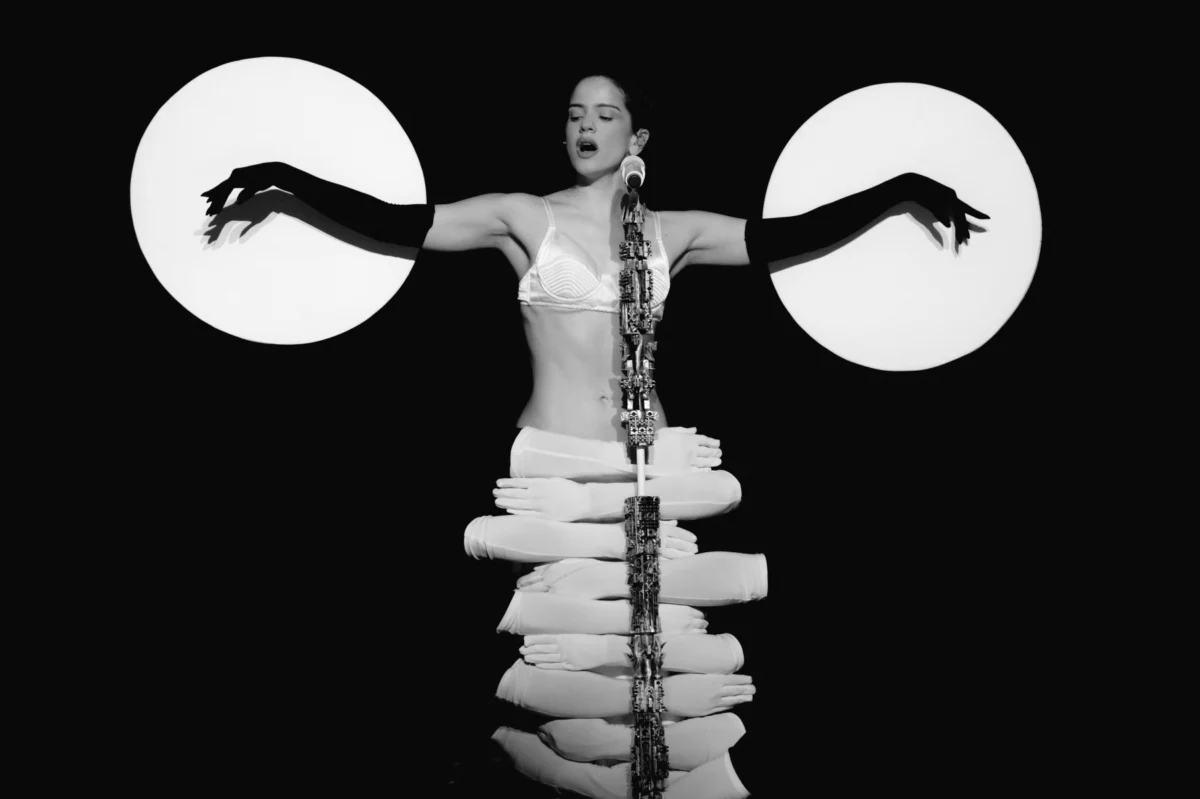
MEXICO CITY – During the electrifying first of her five-night residency at the iconic Palacio de los Deportes in Mexico City on Saturday, August 22, 2026, global music phenomenon Rosalía unveiled a significant inspiration behind her critically acclaimed heartbreak anthem "La Perla." The Spanish artist revealed to a rapturous audience of over 16,500 fans that the raw invective featured in the song, which she described as being directed at an "emotional terrorist," draws heavily from the legendary Mexican ranchera singer Paquita la del Barrio and her seminal track "Rata de Dos Patas."
Rosalía, currently on her highly anticipated LUX tour, expressed profound gratitude for the opportunity to perform in Mexico, a country she lauded for its "history, enormous tradition, and culture." She drew parallels between the soulful depth of traditional Mexican music and the visceral emotionality of flamenco, her own artistic roots. It was within this context that she shared the genesis of "La Perla," a track featured on her celebrated 2025 album of the same name and recorded as a powerful duet with Yahritza y Su Esencia.
"Ladies and gentlemen, without ‘Rata de dos patas,’ ‘La Perla’ wouldn’t exist," Rosalía declared from the stage, her voice resonating with sincerity. "So, thank you very much, Mexico, and thank you, Paquita la del Barrio. Today, I offer heartfelt thanks for the inspiration." The acknowledgement was met with thunderous applause and cheers, a testament to the enduring legacy of Paquita la del Barrio and the deep connection Rosalía has forged with her Mexican audience.
Paquita la del Barrio, a beloved icon whose career spanned decades and produced anthems of defiance and resilience like "Tres Veces Te Engañé" and "Las Rodilleras," passed away in February 2025 at the age of 77. Her passing marked the end of an era for Latin music, but her influence continues to resonate, as powerfully demonstrated by Rosalía’s public tribute. The revelation underscores the profound impact of regional Mexican music genres on contemporary global pop, highlighting how artists like Rosalía draw upon established traditions to create innovative and resonant new works.
The "living museum" of Rosalía’s LUX tour, characterized by its contemporary liturgy and avant-garde staging, featured another poignant moment of cultural exchange and personal revelation. The program included a "confessional" segment, a signature element of Rosalía’s performances where she invites celebrity guests to share intimate secrets. For her Mexico City debut, the esteemed guest was Mexican pop star Kenia Os.

Kenia Os Joins Rosalía for Intimate "Confessional"
Kenia Os, who recently navigated the public dissolution of her romantic relationship with Peso Pluma in June 2026, shared insights into her personal life during the confessional. When prompted about her romantic preferences, Os humorously noted that her "type of men" often tends to be singers. Rosalía, with a knowing smile, responded with a sharp observation that drew an immediate wave of approval from the crowd: "Do you know what singers usually have in common? They know how to sing, but they don’t know how to maintain harmony in a relationship."
Os elaborated on her relationship challenges, attributing them to her own assertive nature. She described herself as a woman who "sets boundaries and says what she doesn’t like," a quality she believes has complicated romantic partnerships. She recounted a past experience with a former partner, whom she referred to by the dismissive moniker "el cacas" (a Spanish slang term for feces). This individual was swiftly identified by social media sleuths as rapper Gera MX, a connection that gained traction online.
The story unfolded during Os’s first U.S. tour, a period marked by conflicting work schedules that led the couple to agree to a temporary break. However, Os discovered evidence of infidelity through her social circle, including "many gay friends," who informed her that her partner was secretly interacting with another woman on social media. When confronted, he reportedly dismissed her concerns, calling her "crazy" and denying any impropriety. "Ten days later, he started dating her," Os revealed. She concluded her anecdote with the adage, "An eye of a crazy woman never lies," a sentiment that resonated with Rosalía and the audience, leading to their shared agreement: "When they tell you it’s not her, it is her." This exchange provided a candid glimpse into the complexities of modern relationships, amplified by the public nature of celebrity lives and the pervasive influence of social media.
Visual Spectacle and Homage to Mexico
Beyond the lyrical and personal revelations, Rosalía’s performance was a visual feast. The artist debuted new, striking outfits for her renditions of songs like "Sexo, Violencia y Llantas," "Reliquia," and "Dios es un Stalker." During "Reliquia," Rosalía made a direct and heartfelt nod to her host country by weaving Mexico into the lyrics. She sang, "I grew up and learned boldness in Mexico and Barcelona," a line that poetically links her artistic development to the vibrant spirit of both her native Spain and her adopted muse, Mexico. This lyrical interpolation underscored her deep appreciation for the nation and its influence on her creative evolution.
The LUX tour’s Mexico City leg is a significant milestone, following Rosalía’s initial engagements in Guadalajara on August 15 and 16, and a single performance in Monterrey on August 19. The extended five-night run at the Palacio de los Deportes, scheduled for August 24, 26, 28, and 29, further solidifies her commitment to engaging with the Mexican fanbase and celebrating the country’s rich cultural tapestry. The venue itself, a historic landmark in Mexico City, has hosted countless legendary artists, providing a fitting stage for Rosalía’s ambitious and culturally resonant tour.
The artist’s ability to seamlessly blend avant-garde artistic expression with deeply rooted cultural influences has cemented her status as a global music icon. Her Mexico City performances are not merely concerts but elaborate artistic statements that honor musical heritage, explore contemporary themes, and foster genuine connections with her audience. The direct acknowledgment of Paquita la del Barrio’s influence on "La Perla" is a powerful testament to Rosalía’s respect for musical lineage and her commitment to amplifying the voices and legacies that have shaped her artistry. As the tour progresses, audiences can anticipate further moments of cultural dialogue and artistic innovation, reflecting Rosalía’s ongoing exploration of music, identity, and global connection.

0 Comments