
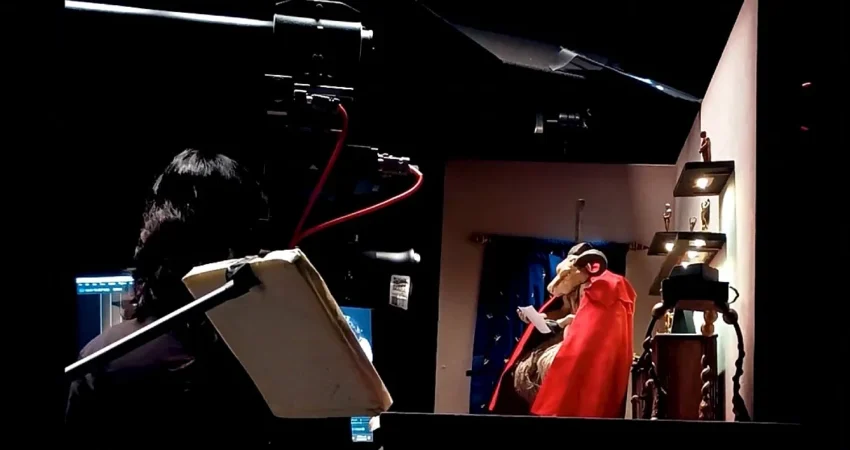
The International Animation Center, widely known as El Taller del Chucho, has officially revealed the two winning projects for the third edition of Fotogramas Vivos. This specialized stop-motion residency is designed to foster high-level technical expertise, accelerate project development, and forge professional connections between emerging creators and the studio’s seasoned industry experts. After a rigorous selection process, the residency has selected "Día cinco," a Colombian short film directed by María Gutiérrez and Luis Gabriel Prada Urrea, and "El lobo y la luna," a Mexican-Romanian co-production helmed by Paulo Daniel Apodaca Mercado and Agata Tabacu. These projects represent the diverse thematic range of contemporary Latin American animation, bridging the gap between gritty social realism and universal children’s fantasy.
The selection of these two projects marks a pivotal moment for the residency, which has quickly become a cornerstone of the animation ecosystem in Guadalajara, Jalisco—a city increasingly recognized as the stop-motion capital of Latin America. "Día cinco" offers a poignant look at daily life through the lens of Colombian violence, utilizing the tactile nature of stop-motion to ground its narrative in a visceral, physical reality. Conversely, "El lobo y la luna" explores themes of love and acceptance through a fantasy framework, demonstrating the versatility of the medium in reaching younger audiences while maintaining artistic depth.
The Vision Behind Fotogramas Vivos
Angélica Lares, the Director of El Taller del Chucho, provided insights into the residency’s evolution and its core mission of nurturing new talent. Speaking on the origins of the program, Lares noted that the studio felt a profound need to listen to new voices and provide a platform for the stories they were eager to tell. While the studio had previously established a reputation for offering technical courses and workshops, the leadership identified a critical gap in the journey from a concept to a finished film. The Fotogramas Vivos residency was thus structured as a year-long program designed to provide the institutional support necessary to ensure a project reaches full completion.
The residency operates on the philosophy that technical skill must be paired with executive professionalization. By providing a structured environment for an entire year, El Taller del Chucho ensures that creators are not just learning how to move puppets, but how to manage a production pipeline, oversee budgets, and navigate the complexities of international co-productions. This holistic approach is intended to produce "finished" filmmakers, not just animators.
A Comprehensive Training and Mentorship Pipeline
The two winning projects will now enter an intensive phase of development and production within the world-class facilities of El Taller del Chucho. This phase is characterized by a series of specialized workshops covering the entire lifecycle of a stop-motion production: pre-production, production, and post-production. The curriculum is designed to address the unique challenges of the medium, which requires a meticulous blend of physical craftsmanship and digital precision.
The residency boasts an impressive roster of instructors and advisors, featuring some of the most prominent names in global and regional animation. The teaching panel includes:
- Juan Medina: A veteran animator and director known for his award-winning work in Mexican stop-motion.
- Melanie Coombs: An Academy Award-winning producer (notably for Mary and Max and her work on Guillermo del Toro’s Pinocchio) who brings an international perspective on production management.
- Jorge Villalobos and Cecilia Andalón: Experts in visual storytelling and art direction.
- Paola Chaurand: A specialist in production logistics and management.
Furthermore, the projects will benefit from high-level advisorship provided by León Fernández, Carlos Carrera, and Rita Basulto. Carrera, the director of the landmark animated feature Ana y Bruno, and Basulto, whose recent work Humo has garnered international acclaim, represent the pinnacle of Mexican cinematic artistry. Their involvement ensures that the residents receive guidance that is both technically sound and artistically ambitious.
Regional Diversity and Collaborative Opportunities
While "Día cinco" and "El lobo y la luna" took the top honors, the third edition of Fotogramas Vivos saw a rich array of talent from across the Spanish-speaking world. During the first phase of the residency, five other projects were developed, showcasing the geographic breadth of the initiative:
- Mexico: "Al amanecer" by Santiago Amorelli Mejía and "El corazón del Tastoán" by Axel Francisco Noguez Merino.
- Colombia: "Bekaura. Resguardo indígena de Karmata Rúa" by Irati Dojura Landa Yagarí, focusing on indigenous narratives.
- Chile: "Loreal, tormenta solar" by Eduardo Andrés Elli.
- Argentina: "Menú del día" by Valentina Aylín Arteaga Nova.
A unique feature of the Fotogramas Vivos residency is its collaborative structure. The creators behind these five projects are not excluded from the process; instead, they are invited to participate in the production of the two winning works. This model fosters a community of practice, allowing all participants to gain hands-on experience in a professional studio environment, regardless of whether their specific project was chosen for final production. It creates a "rising tide lifts all boats" scenario, strengthening the regional network of stop-motion professionals.
Addressing the Challenges of Emerging Animation
The stop-motion industry is notoriously difficult to enter due to its high barrier of entry. Angélica Lares emphasized that professionalization in the areas of production and executive management remains one of the primary hurdles for emerging creators in Latin America. Unlike 2D or 3D animation, which can often be produced with a computer and specialized software, stop-motion is a capital-intensive physical craft.
"Stop motion is a technique that requires large teams and considerable budgets for the construction of sets, puppets, and props," Lares explained. The physical infrastructure—lighting rigs, motion control systems, and workshop spaces for silicone casting and armature fabrication—requires significant investment. By providing these resources through the residency, El Taller del Chucho mitigates the financial risks for emerging directors, allowing them to focus on the creative execution of their vision.
Furthermore, the residency addresses the "executive" side of filmmaking. Many talented artists struggle to secure funding or manage the logistical complexities of a multi-year production. By embedding these creators within a professional studio, the residency teaches them how to pitch to international markets, manage labor costs, and adhere to the strict timelines required by global distributors.
A Proven Track Record of Success
The effectiveness of the Fotogramas Vivos residency is already evident in the success of its alumni. One of the most notable examples is "Teatro secreto" by Diego Martínez Gutiérrez. A co-production between Mexico and Spain, the short film was developed during a previous edition of the residency and went on to have its world premiere at the prestigious Annecy International Animation Film Festival in 2025. The film is currently a contender for the Ariel Award for Best Animated Short Film, Mexico’s highest cinematic honor.
Other successful projects born from the program include "El valle de los hombres sin rostro" and "Munstro" (also spelled "Munstruo") by Jaime Eduardo Rodríguez Morales. These films serve as a testament to the residency’s ability to produce work that is not only technically proficient but also competitive on the international festival circuit. The consistent quality of the output has solidified El Taller del Chucho’s reputation as a premiere incubator for animation talent.
The Broader Impact on the Global Animation Landscape
The rise of El Taller del Chucho and the success of Fotogramas Vivos cannot be viewed in isolation. The studio was founded with the support of the University of Guadalajara and acclaimed filmmaker Guillermo del Toro, who has been a vocal advocate for stop-motion as a medium of artistic resistance. Del Toro’s Pinocchio, which won the Academy Award for Best Animated Feature, saw a significant portion of its production take place at El Taller del Chucho, proving that Latin American studios can meet and exceed Hollywood standards.
The residency program is a strategic effort to maintain this momentum. By training the next generation of animators and producers, the studio is ensuring that the infrastructure built for Pinocchio remains active and continues to evolve. This contributes to a sustainable industry in Jalisco, attracting international co-productions and positioning the region as a global hub for high-end stop-motion.
As "Día cinco" and "El lobo y la luna" begin their journey through the residency, they carry the weight of this legacy. The stories of Colombian social strife and fantasy-driven acceptance will soon be brought to life frame by frame, contributing to the rich tapestry of Latin American cinema. Through Fotogramas Vivos, El Taller del Chucho continues to prove that with the right combination of mentorship, resources, and artistic freedom, the region’s animation industry is poised for an unprecedented era of growth and international influence.

0 Comments