

The landscape of home entertainment in Mexico is undergoing a profound transformation, driven by the proliferation of streaming services and a fundamental shift in consumer habits. For decades, the traditional television model remained the undisputed king of the living room, but the arrival of global giants like Netflix, Disney+, and Amazon Prime Video promised to rewrite the rules of engagement. While these platforms have successfully decoupled movies and series from traditional cable packages, the latest market data reveals a complex reality: although the pay TV industry is losing users at an accelerating rate, Grupo Televisa continues to exert a dominant grip on the sector, controlling more than half of all active subscriptions in the country.
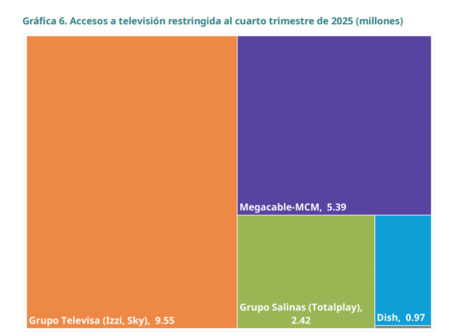
According to the latest year-end report from the Telecommunications Regulatory Commission (CRT), Mexico concluded the fourth quarter of 2025 with approximately 18.4 million pay TV accesses. Within this landscape, Grupo Televisa remains the undisputed leader, accounting for 9,813,617 of those connections. This figure represents a staggering 53.33% of the total market share, illustrating a level of concentration that places the media conglomerate far ahead of its nearest rivals. Despite the encroaching threat of digital-only platforms, the traditional infrastructure of cable and satellite television remains a cornerstone of Televisa’s business model, even as the broader industry faces its most significant headwinds in decades.
A Fragmented Competitive Landscape
The CRT data highlights the immense gulf between Televisa and the rest of the players in the Mexican market. Trailing behind the leader is Megacable-MCM, which recorded 5,394,420 accesses, and Grupo Salinas, operating through its Totalplay brand, which reached 2,365,843 subscriptions. The remaining portion of the market is divided among smaller entities, including Dish, which holds 811,244 accesses, and a collective group of 12 smaller providers that together account for a mere 16,010 connections.
The scale of Televisa’s dominance is perhaps best understood through a cumulative comparison. If the subscriber bases of all major competitors—Megacable, Totalplay, Dish, and the various independent providers—were combined, they would total approximately 8.59 million accesses. This combined figure still falls short of Televisa’s individual total of 9.81 million, underscoring the company’s structural advantage in the telecommunications space.
Televisa’s market share is the result of a multi-brand strategy that spans different technologies and demographics. The 9.81 million total is not derived from a single operation but is the sum of its two primary subsidiaries: Izzi and Sky. Izzi, which focuses on cable and fiber-optic delivery, accounts for the lion’s share with 5,851,182 accesses. Meanwhile, Sky, the group’s satellite television arm, maintains a robust presence with 3,958,818 accesses. Together, these two entities provide the foundational strength that allows Televisa to maintain its leadership, even as consumer preferences pivot toward on-demand content.
The Pay TV Crisis: A Five-Year Decline
While Televisa’s market share remains high, the industry as a whole is grappling with a sustained contraction. Holding a large piece of a shrinking pie presents a significant strategic challenge. Data from The CIU (The Strategic Digital Intelligence Unit) indicates that the pay TV sector closed 2025 with 15.1 million total subscriptions, representing a sharp 9.3% annual decline. This downward trend is part of a longer trajectory; in 2020, the market boasted 19.8 million users. In just half a decade, the industry has shed nearly five million subscribers, a phenomenon often referred to as "cord-cutting."
Several factors contribute to this exodus. Chief among them is the economic burden placed on households. Research shows that 37% of consumers who canceled their pay TV service cited high costs as the primary reason. As inflation impacts disposable income, many Mexican families are opting to replace expensive traditional TV bundles with one or two streaming services that offer more flexibility at a lower price point. Furthermore, the "streaming fatigue" caused by the fragmentation of content across numerous platforms has led consumers to scrutinize their monthly entertainment spending more closely than ever before.
The Shift to Connectivity: Internet as the New Anchor
In response to the decline of traditional television, telecommunications operators have pivoted their strategies to focus on fixed internet as the primary driver of growth and customer retention. The industry has moved away from selling television as a standalone product, instead positioning it as a value-added component of "Triple Play" or "Quadruple Play" bundles that include high-speed internet, telephony, and integrated streaming access.
This shift is reflected in the growth of the fixed internet market. By the end of 2025, Mexico reached 29.3 million fixed internet accesses. However, the hierarchy in this segment differs significantly from that of pay TV. In the realm of connectivity, América Móvil (Telmex) remains the dominant force, commanding 40.95% of the market. Grupo Televisa, despite its TV dominance, holds only a 19.78% share of the internet market, placing it in a virtual dead heat with Megacable-MCM (19.72%) and closely followed by Grupo Salinas’ Totalplay (18.92%).
This data reveals a critical vulnerability for Televisa. While it remains the king of the "old world" of television, it is fighting a much more competitive and balanced battle in the "new world" of connectivity. Operators like Totalplay and Megacable have been particularly aggressive in deploying fiber-optic networks, allowing them to capture a larger share of the growing demand for high-bandwidth home internet, which is essential for the very streaming services that are cannibalizing the pay TV market.
Consumer Habits and the Rise of Digital Content
The evolution of the market is a direct reflection of changing Mexican consumer behavior. The 2024 National Survey of Audiovisual Content Consumption (ENCCA) found that 55% of Mexicans now consume audiovisual content primarily via the internet. This shift is driven by the ubiquity of smartphones and the increasing availability of affordable mobile data, alongside the expansion of fixed broadband.
Social media and short-form video platforms have also disrupted traditional viewing patterns. Younger demographics, in particular, are moving away from scheduled programming in favor of algorithmic feeds on platforms like TikTok, YouTube, and Instagram. For these users, the concept of a "channel" is becoming obsolete, replaced by "creators" and "on-demand libraries."
To stay relevant, traditional broadcasters have had to innovate. Televisa, for instance, has doubled down on its Vix streaming platform, attempting to bridge the gap between its massive library of legacy content and the modern digital consumer. The company has also begun leveraging artificial intelligence to dub its telenovelas into multiple languages, seeking to monetize its intellectual property in international markets where traditional broadcast models may still hold more sway than in the domestic Mexican market.
The Regulatory Environment and Future Implications
The dominance of Grupo Televisa in the pay TV sector has long been a subject of scrutiny for Mexican regulators. The Federal Telecommunications Institute (IFT) and the CRT have frequently evaluated whether the company’s market share constitutes a "preponderant" position that stifles competition. While Televisa has managed to navigate these regulatory waters, the continued decline of the pay TV market may paradoxically lessen the pressure of such designations, as the "relevant market" shifts from television to general internet connectivity.

The industry’s future likely lies in the total convergence of services. We are entering an era where the distinction between a "cable company" and an "internet provider" is disappearing. Success will be defined by which company can provide the most reliable "pipe" into the home and the most seamless user interface to navigate an increasingly cluttered world of content.
For Televisa, the challenge will be to translate its massive TV subscriber base into long-term internet loyalty. As the CRT data shows, the company is currently losing relevance as consumers move from the television screen to the multi-device connectivity of the modern home. While it still holds the crown in pay TV, the crown itself is being forged from a different material in the digital age.
Chronology of a Changing Industry
The transition of the Mexican media landscape can be traced through several key milestones over the last decade:
- 2014: The Federal Telecommunications and Broadcasting Law is enacted, aiming to increase competition in a market dominated by América Móvil and Televisa.
- 2015-2018: Rapid expansion of "Triple Play" bundles. Televisa rebrands its cable operations under the "Izzi" name to compete more effectively in the internet space.
- 2020: The COVID-19 pandemic leads to a temporary surge in pay TV and internet demand as millions are confined to their homes. Subscriptions hit a peak of 19.8 million.
- 2022-2023: The "Streaming Wars" intensify in Mexico with the launch of several localized platforms. Cord-cutting begins to accelerate as inflation rises.
- 2024: The National Survey of Audiovisual Content Consumption confirms for the first time that more than half of the population consumes content via the internet.
- 2025: CRT reports a 9.3% annual drop in pay TV subscriptions, while Televisa retains a 53.33% market share despite the shrinking total volume.
Conclusion: A Bifurcated Market
As Mexico moves deeper into the 2020s, the telecommunications sector remains a study in contrasts. On one hand, Grupo Televisa maintains a historical hegemony over pay TV that seems almost immune to the competitive pressures of other cable providers. On the other hand, the very foundation of that dominance is eroding as consumers prioritize internet speed over channel counts.
The battle for the Mexican household is no longer about who can provide the most channels, but about who can provide the most stable connection to the digital world. While Televisa continues to lead in the former, the data suggests it must work significantly harder to achieve similar status in the latter. For now, the "King of TV" remains on its throne, but the kingdom it rules is rapidly migrating to a digital frontier where the rules of engagement are being written by bandwidth, latency, and algorithmic discovery.

0 Comments