
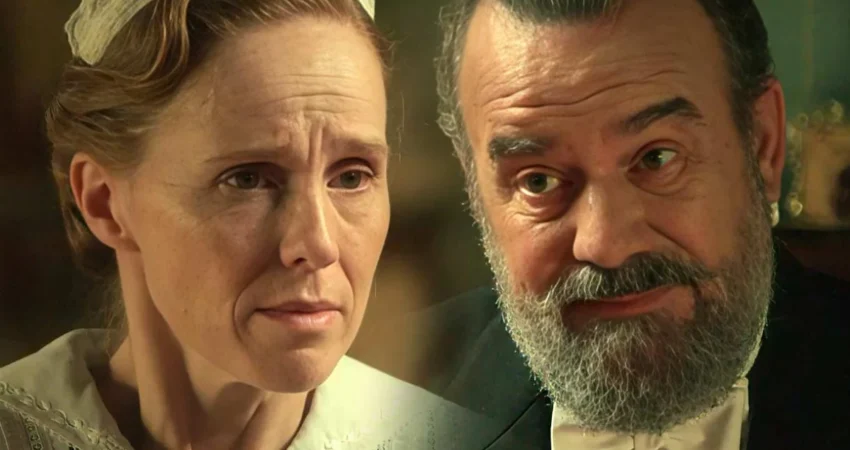
Tensions are escalating within the hallowed halls of La Promesa as the wedding preparations for Curro and Ángela enter a critical phase, a development that has precipitated a significant rift between key figures within the estate. The Duke ofrón, Alonso, has found himself compelled to engage in a delicate yet urgent conversation with Pía Adarve, the estate’s administrator, concerning Curro’s controversial choice of godmother for his upcoming nuptials. This decision has sent shockwaves through the aristocratic household, highlighting a growing disconnect between the younger generation’s aspirations and the established social order.
The Unforeseen Alliance: Alonso and Pía Confront a Familial Disconnect
The core of the current discord stems from Curro’s decision to appoint Pía, a respected member of the household staff, as his godmother. This choice, while perhaps born of genuine affection and respect, has been perceived by Alonso as a disregard for societal conventions and Curro’s own standing within his aristocratic lineage. Alonso, a figure of authority and tradition, views Curro’s actions as a failure to grasp his designated place within the social hierarchy. His conversation with Pía, therefore, was not merely a discussion but an attempt to align their perspectives and present a united front in navigating this delicate situation.
Alonso initiated the dialogue by expressing his disappointment, stating, "Curro continues to fail to understand that his place in society is elsewhere." He conveyed his hope that Pía, a woman known for her pragmatism and grounded nature, would share his concerns and act as a stabilizing influence. His trust in Pía’s judgment proved to be well-placed, as she was quick to clarify her own position on the matter, assuring Alonso that she had not encouraged this development.
Pía’s immediate response was to distance herself from the proposal, explaining, "I tried to tell him as soon as he proposed it, that I rejected it when Curro suggested it to me." She emphasized that her stance had been one of clear opposition from the outset, a clarification that brought a measure of relief to Alonso. He acknowledged her straightforwardness, remarking, "I took that for granted. I know you are a sensible person who has her feet on the ground." This exchange revealed an underlying, albeit uneasy, complicity between the two, bound by a shared concern for Curro and a mutual understanding of the need to temper his often impulsive decisions.
Navigating Curro’s Impulsivity: A Shared Burden
The conversation delved deeper into the intricacies of Curro’s character. Pía admitted that her initial refusal had not been met with immediate insistence from Curro, leading her to believe that the matter might be dropped. "Since he didn’t say anything else about it, I thought he would end up forgetting about it," she confessed, expressing regret for not being more forceful in her rejection. Her admission underscored the challenge of managing Curro’s youthful exuberance and his tendency to follow his heart, sometimes without full consideration of the consequences.
Alonso, however, was not inclined to assign blame. He recognized that Curro’s actions often stem from his emotional impulses rather than malice. "No, I don’t blame you. We already know what Curro is like. He always moves by his heart," Alonso conceded, his tone a mixture of paternal fondness and resigned acceptance of his nephew’s nature. His primary objective was not to find fault but to secure an ally in his efforts to guide Curro towards a more conventional path.
A Strategic Alliance Forged: The Path Forward
With Pía’s commitment secured, Alonso articulated his core objective: "I just want to confirm that you are trying to stop this nonsense." Pía, in turn, pledged her full support, assuring him that she would "do everything possible to convince him to desist in his purpose." This marked the formation of a tacit alliance between the Duke and the administrator, a strategic partnership aimed at influencing Curro’s decisions.
Their plan of action involved approaching Curro from their respective positions of influence. Alonso would leverage his authority as the lord of the estate, while Pía would utilize her personal connection and rapport with Curro. The conversation concluded with a brief exchange of thanks and a shared resolve to act swiftly, recognizing the diminishing window of opportunity to avert potential social repercussions.

The Unseen Depths of Pía’s Burden: A Looming Secret
What Alonso remains unaware of is the profound personal turmoil Pía is currently enduring. Beyond the immediate pressure of the impending wedding and Curro’s unconventional choices, Pía is harboring a devastating secret concerning Leocadia, a secret that possesses the potential to shatter the very foundations of the family. This hidden burden casts a long shadow over her interactions, imbuing every measured word and restrained gesture with a significance far greater than Alonso can perceive. Her outward composure masks a complex internal struggle, where the demands of her role at La Promesa intersect with a deeply personal crisis.
A Confluence of Conflicts: Leocadia’s Maneuvers and Curro’s Resolve
As Pía strives to maintain a low profile and manage her personal affairs discreetly, the machinations of Leocadia and the unwavering determination of Curro are inexorably drawing her into the vortex of a brewing conflict. The approaching wedding serves as a catalyst, intensifying these pressures and threatening to engulf the estate in a scandal that could erupt before the nuptials even take place. The delicate balance of power and personal relationships within La Promesa is being tested, with Pía caught at the epicenter of these converging forces.
Historical Context and Societal Norms at La Promesa
The estate of La Promesa, a grand aristocratic residence, operates under a strict set of social codes and expectations that have been in place for generations. The year is 1958, a period in Spain marked by a lingering adherence to traditional values, particularly within the upper echelons of society. Marriage, for families like the Marqués de Luján, is not merely a personal union but a strategic alliance, often influenced by considerations of lineage, wealth, and social standing.
Curro’s appointment of Pía as his godmother, while seemingly a gesture of personal regard, directly challenges these deeply ingrained norms. In such a context, a godparent typically holds a position of significant social standing, often representing the groom’s family or acting as a proxy for their esteemed lineage. Pía, while a trusted and respected member of the household staff, does not belong to the same aristocratic stratum as Curro’s family. Her role as administrator, though vital to the functioning of the estate, is inherently a position of service rather than one of familial or social parity.
The Significance of the Godparent Role
The role of a godparent in a wedding ceremony, particularly within aristocratic circles, carries considerable weight. Historically, godparents were chosen for their moral authority, their ability to guide and support the couple, and their standing within the community. They often served as witnesses to the union and were expected to offer counsel and assistance throughout the marriage. Curro’s selection of Pía, therefore, can be interpreted in several ways: as a genuine sign of affection and trust in her wisdom, as a subtle act of defiance against societal expectations, or perhaps even as an attempt to imbue his union with a sense of genuine, unpretentious connection.
Alonso’s Perspective: Upholding Tradition and Legacy
Marqués Alonso, as the patriarch and guardian of the family’s reputation, is deeply invested in maintaining the established order. His concern for Curro’s "place in society" reflects a broader anxiety about the potential erosion of aristocratic values and the consequences of blurring class lines. For Alonso, Curro’s marriage to Ángela, itself a union that may have its own complex dynamics, is already a significant event. The choice of godmother adds another layer of complication, potentially undermining the social prestige associated with the occasion and setting a precedent that could be perceived as destabilizing to the family’s long-held status. His conversation with Pía is thus an attempt to safeguard not only Curro’s immediate social standing but also the enduring legacy and traditions of the Luján family.
Pía’s Dilemma: Duty, Loyalty, and a Hidden Truth
Pía’s position is one of profound complexity. As the administrator of La Promesa, she is bound by her duty to the Marqués and the estate. She is also a figure of authority in her own right, respected for her competence and integrity. However, her personal connection to Curro, and the unspoken secret she carries concerning Leocadia, creates a dangerous tightrope walk. Her efforts to advise Curro are complicated by the need to protect her own position and, more importantly, to manage the fallout from the devastating secret she holds. This secret, if revealed, could have far-reaching consequences for the entire Luján family, potentially eclipsing the current concerns about wedding arrangements. Her ability to navigate these intertwined crises will undoubtedly shape the future of La Promesa and its inhabitants.
The Broader Impact: A Shifting Social Landscape
The events unfolding at La Promesa can be seen as a microcosm of the broader societal shifts occurring in mid-20th century Spain. While traditional hierarchies and expectations remained powerful, there were also nascent signs of change, with individuals increasingly seeking personal fulfillment and challenging established norms. Curro’s actions, though perhaps impulsive, hint at a generation grappling with these evolving dynamics. The tension between tradition and modernity, between duty and personal desire, is palpable within the aristocratic household, foreshadowing a period of significant transformation for both the family and the society in which they exist. The coming weeks, leading up to the wedding, are likely to be a period of intense scrutiny and potential upheaval for all involved.

0 Comments