
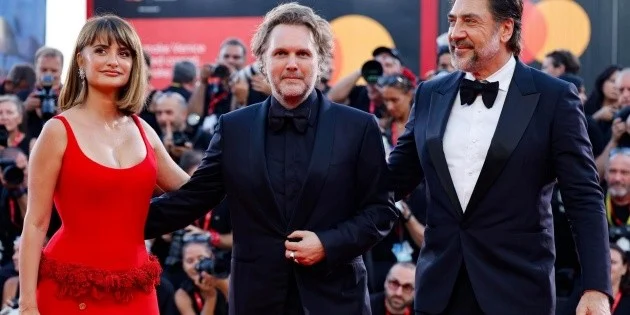
The acclaimed Spanish actors Penélope Cruz and Javier Bardem are set to captivate audiences once again with their joint return to the silver screen in "Bunker," the highly anticipated psychological thriller from French filmmaker Florian Zeller. The film made its world premiere at the prestigious Venice Biennale and is poised for its North American debut at the Toronto International Film Festival (TIFF) this Monday, marking a significant moment in the international film circuit. This collaboration not only reunites two of Spain’s most celebrated cinematic figures but also places them at the heart of a narrative deeply rooted in contemporary societal anxieties, under the direction of an auteur known for his profound character studies.
A Deep Dive into the Narrative: Moral Dilemmas and Societal Collapse
"Bunker" thrusts viewers into a world teetering on the edge, seen through the eyes of Miguel, a character brought to life by Javier Bardem. Miguel is introduced as a distinguished Spanish architect, a luminary in his field, who has established a successful career in London. His professional trajectory takes an unexpected and morally challenging turn when he receives a commission of extraordinary scope and financial allure: designing an opulent, state-of-the-art luxury refuge. This isn’t just any architectural project; it’s a meticulously crafted sanctuary for a powerful technology magnate, convinced that society is on an irreversible path towards collapse and that elaborate preparations are essential for survival.
The proposition, while professionally lucrative, quickly morphs into a profound moral quandary for Miguel. The very act of designing such an exclusive haven for the ultra-rich, predicated on the dystopian vision of societal breakdown, forces him to confront his own values and ethical boundaries. This internal conflict inevitably spills over into his personal life, casting a shadow over his relationship with his wife, Sofía, portrayed with characteristic intensity and nuance by Penélope Cruz. Sofía finds herself increasingly entangled in Miguel’s professional and moral turmoil, as the project’s implications begin to erode the foundations of their shared life. The film masterfully explores how external pressures and ideological clashes can strain the most intimate of bonds, questioning the price of ambition and the true cost of security in an uncertain world.
The Festival Circuit: From Venice Premiere to Toronto Gala
"Bunker" has embarked on a distinguished journey through the international film festival circuit, commencing with its world premiere at the Venice Biennale, a festival renowned for showcasing groundbreaking cinema and launching Oscar contenders. Following its successful debut in Italy, the film secured a coveted spot in TIFF’s "Galas" program. The "Galas" section at TIFF is reserved for high-profile films, often featuring prominent actors and directors, and serves as a significant platform for North American premieres. This inclusion underscores the film’s anticipated impact and critical reception, positioning it as a must-see event for industry professionals, critics, and cinephiles alike.
The selection for both Venice and TIFF’s prestigious programs is a strong indicator of the film’s artistic merit and its potential to resonate widely. These festivals are not merely showcases but vital launchpads that generate significant buzz, influence awards season narratives, and secure international distribution deals. For "Bunker," its presentation at TIFF provides a crucial opportunity to capture the attention of North American distributors and audiences, setting the stage for its broader theatrical release. The dual premiere strategy allows the film to leverage the distinct strengths of both festivals: Venice’s European prestige and TIFF’s robust industry presence and audience engagement.
Florian Zeller: A Master of Psychological Depth
French filmmaker Florian Zeller has rapidly established himself as a formidable voice in contemporary cinema, particularly noted for his profound exploration of human psychology and complex family dynamics. His previous works, "The Father" (2020) and "The Son" (2022), garnered significant critical acclaim and numerous accolades. "The Father," starring Anthony Hopkins and Olivia Colman, was a critical darling, earning Hopkins an Academy Award for Best Actor and Zeller an Oscar for Best Adapted Screenplay. The film’s searing portrayal of dementia from the perspective of the afflicted was lauded for its innovative narrative structure and emotional depth. "The Son," featuring Hugh Jackman, Laura Dern, and Vanessa Kirby, continued Zeller’s exploration of mental health within a family context, focusing on the challenges of depression and parental responsibility.
Zeller’s distinctive directorial style is characterized by an intimate, often claustrophobic focus on his characters’ inner lives, employing narrative techniques that immerse the audience in their subjective experiences. He consistently tackles weighty, universal themes with sensitivity and intellectual rigor. For "Bunker," Zeller’s inspiration stemmed from an article about a billionaire constructing a personal bunker in Hawaii. This real-world phenomenon sparked his interest in the inherent contradiction of tech magnates—individuals who have amassed fortunes by connecting people globally—yet simultaneously retreating into private, isolated fortresses to escape the very society they helped shape. Through the marriage of Miguel and Sofía, Zeller masterfully weaves a narrative that dissects contemporary issues such as escalating inequality, profound societal isolation, looming environmental threats, and the disproportionate power wielded by a select few tech oligarchs. This thematic richness is a hallmark of Zeller’s work, promising a film that is not only thrilling but also deeply thought-provoking.
The Enduring Chemistry of Cruz and Bardem
The reunion of Penélope Cruz and Javier Bardem on screen is always a cinematic event. As one of the most celebrated real-life acting couples, their on-screen collaborations are imbued with an undeniable chemistry and depth that few can replicate. Their shared filmography includes iconic titles like Woody Allen’s "Vicky Cristina Barcelona" (for which Cruz won an Oscar), Asghar Farhadi’s "Everybody Knows," and Fernando León de Aranoa’s "Loving Pablo." Each performance from the duo, whether together or individually, consistently showcases their immense talent and versatility.
In "Bunker," their dynamic as Miguel and Sofía is central to the film’s emotional core. Their ability to convey complex emotions and navigate the intricate landscape of a deteriorating relationship promises to elevate the psychological tension. Critics and audiences alike often anticipate their joint projects not just for their individual performances, but for the synergistic energy they bring to their roles, often playing characters with intense, complicated relationships. Their presence alone guarantees a certain gravitas and authenticity, drawing viewers deeper into the moral quandaries faced by their characters. For "Bunker," their portrayal of a couple grappling with an ethical crisis in a world of extremes is expected to be a powerful and memorable highlight.
An International Ensemble and Production
Beyond its leading duo, "Bunker" boasts a formidable international ensemble cast, further solidifying its global appeal. Notable names include Stephen Graham, known for his intense performances in films like "The Irishman" and "Boiling Point"; Paul Dano, celebrated for his versatile roles in "There Will Be Blood," "The Batman," and "Little Miss Sunshine"; and Patrick Schwarzenegger, who has been steadily building a diverse filmography. The presence of such a talented supporting cast ensures a rich tapestry of performances that will complement the central narrative.
The production itself is a testament to international collaboration, being a joint venture between France and Spain. This cross-border collaboration is increasingly common in European cinema, pooling resources, talent, and creative perspectives to produce films with broader appeal and production values. The decision to shoot the film in both English and Spanish further underscores its ambition to reach a wide global audience, reflecting the linguistic versatility of its cast and the multicultural nature of its themes. This multilingual approach also allows for a more authentic representation of the characters’ backgrounds and the international setting of the story. The integration of different cultural and cinematic traditions often leads to a more nuanced and richly textured final product, and "Bunker" is poised to benefit from this collaborative spirit.
Thematic Resonance in a Disconnected World
"Bunker" arrives at a moment when its core themes resonate with particular urgency. The film’s exploration of societal inequality, isolation, environmental threats, and the unchecked power of technological magnates speaks directly to contemporary anxieties. The idea of a privileged few preparing for a societal collapse while the majority remains vulnerable highlights stark economic disparities and ethical questions surrounding wealth accumulation and responsibility. This narrative serves as a potent commentary on the growing chasm between the ultra-rich and the rest of society, a theme increasingly explored in modern cinema and literature.
Furthermore, Zeller’s interest in the paradox of tech leaders—individuals who foster global connectivity yet seek personal isolation—is particularly timely. In an era dominated by social media and digital platforms, the concept of genuine connection versus curated detachment is a constant societal debate. The film implicitly critiques a system where technological advancement, initially promising greater unity, can paradoxically lead to greater fragmentation and a sense of impending doom. By setting the story against a backdrop of environmental concerns, "Bunker" also taps into widespread anxieties about climate change and humanity’s collective future, suggesting that even immense wealth cannot insulate one from global crises without profound moral compromise.
Industry Context and Anticipated Impact
Psychological thrillers have long held a significant place in cinematic history, captivating audiences with their intricate plots, moral ambiguities, and intense character studies. "Bunker" fits squarely within this esteemed genre, promising to deliver the tension and intellectual engagement expected from a film of this caliber. Given Florian Zeller’s track record of critically acclaimed, thought-provoking dramas, "Bunker" is anticipated to be more than just a suspenseful ride; it is expected to be a profound cinematic experience that encourages introspection and discussion.
The film’s trajectory through major festivals, coupled with the star power of Cruz and Bardem and Zeller’s established reputation, suggests a strong awards season contender. Its themes are particularly resonant with current global conversations, making it a timely and relevant piece of cinema. The international co-production model also positions "Bunker" for a wide global release, appealing to diverse audiences across continents. As the film moves beyond its festival premieres towards a broader theatrical distribution, its impact will be measured not only by box office success but also by its contribution to ongoing dialogues about ethics, power, and the future of humanity. "Bunker" stands as a significant cinematic offering, promising to challenge, entertain, and provoke thought long after the credits roll.

0 Comments