
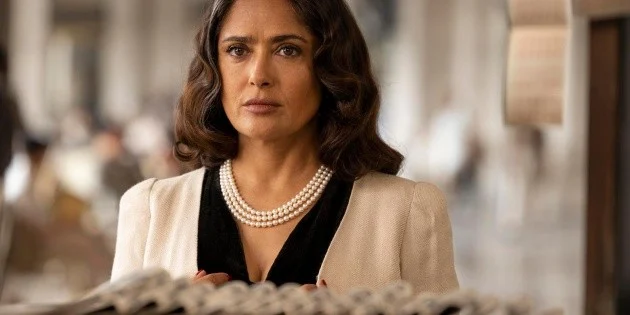
Mexican actress Salma Hayek has expressed her profound hope that her latest film, "Without Blood," a poignant war drama helmed by Angelina Jolie, will catalyze essential reflection on the diminishing role of diplomacy in an era increasingly defined by global conflicts. The film, which premiered at the Toronto International Film Festival (TIFF) in 2024, delves into the harrowing aftermath of war and the complex journey towards healing, a theme Hayek believes is critically relevant in today’s fractured world.
"I hope the film motivates people to think about diplomacy, which is being lost, and about truly resolving conflicts instead of merely seeking publicity over who is right," Hayek articulated during a recent interview, underscoring the film’s core message. Her remarks highlight a growing concern among international observers and policymakers regarding the decline of multilateral engagement and the rise of confrontational rhetoric in addressing global challenges.
A Narrative Rooted in Trauma and Resilience
"Without Blood" casts Hayek in the central role of Nina, a character whose life is indelibly scarred by the cold-blooded murder of her family during her childhood, set against the backdrop of an unnamed country embroiled in war. The narrative arc traces Nina’s arduous path through trauma, survival, and a quest for a form of closure that transcends conventional justice. The film abstains from identifying a specific nation, allowing its themes of loss, revenge, and reconciliation to resonate universally, mirroring countless historical and contemporary conflicts across the globe.
The cinematic adaptation is based on the acclaimed novel of the same name by Italian author Alessandro Baricco, published in 2002. Baricco’s work, known for its lyrical prose and philosophical depth, explores the nature of violence and its enduring psychological scars through a fable-like structure. Angelina Jolie, who not only directed but also penned the screenplay, brings her well-documented humanitarian insights and directorial sensibilities to Baricco’s narrative. Jolie’s background as a Special Envoy for the United Nations High Commissioner for Refugees (UNHCR) for over two decades profoundly informs her approach to storytelling, particularly narratives centered on conflict, displacement, and human resilience. Her previous directorial efforts, such as "In the Land of Blood and Honey" (2011), "Unbroken" (2014), and "First They Killed My Father" (2017), consistently explore the human cost of war and political upheaval, demonstrating a consistent thematic thread that aligns perfectly with "Without Blood."
The film’s principal cast also features esteemed actors Demián Bichir as Tito, Alfredo Herrera as Manuel Roca, and Juan Minujín as Salinas, rounding out a powerful ensemble tasked with portraying the intricate emotional landscape of the story. The selection of actors known for their intense dramatic performances underscores the film’s commitment to exploring profound human experiences with gravitas.
The Genesis of a Collaboration: Jolie’s Vision and Hayek’s Hesitation
Angelina Jolie’s determination to cast Salma Hayek as Nina was evident from the outset, a decision rooted in their previous collaboration on Marvel’s "Eternals" (2021). Despite Jolie’s clear vision, Hayek initially harbored significant reservations about undertaking such an emotionally demanding role. "I didn’t want to do it; I was very scared, but [Jolie] insisted. When she gets stubborn about something, it’s very difficult to say no to her. I am very grateful to her because it has been a very important film for me," Hayek recounted, reflecting on the challenging yet ultimately rewarding experience.
Hayek characterizes Nina as an "extremely complex character who suffers a great deal," emphasizing the intricate process of imbuing her portrayal with "different colors and nuances to her suffering." This artistic challenge resonated deeply with Hayek, known for her ability to convey vulnerability and strength simultaneously. The collaborative dynamic between Hayek and Jolie was further enhanced by their mutual understanding and trust. Hayek praised Jolie’s directorial acumen, noting, "She knows me very well, and I have the confidence to tell her anything that crosses my mind. She is a wonderful director and also an actress, so she understands the processes, and she was very generous with Demián and me."
This shared artistic journey extended beyond individual performances, aiming for a broader representation. "We intended to represent all women who have suffered injustices," Hayek stressed. "In every scene, we held hands, and that also helped me get more into the character, because although it is fictional, it reflects the reality of many." This collective approach underscores the film’s ambition to transcend individual storytelling and speak to a universal experience of resilience in the face of adversity.
The Broader Context: Diplomacy in a Turbulent World
Hayek’s comments about the loss of diplomacy resonate with a global landscape marked by escalating conflicts and geopolitical tensions. The 21st century has witnessed a proliferation of both interstate and intrastate conflicts, from protracted civil wars in Syria and Yemen to the resurgence of large-scale military engagements in Eastern Europe. The UN Secretary-General António Guterres has repeatedly warned about the erosion of trust and the weakening of international norms, making diplomatic solutions increasingly elusive.
Films like "Without Blood" play a crucial role in public discourse by humanizing the abstract concept of war and its consequences. By focusing on individual trauma and the arduous journey toward healing, the film offers a powerful counter-narrative to the often-dehumanizing portrayal of conflict in news cycles. It compels audiences to consider the long-term psychological and social ramifications of violence, prompting a deeper understanding of why diplomacy and conflict resolution are not merely political tools but essential components of human well-being. The concept of "closure," as referenced by Hayek, is not just individual but societal, implying a collective healing process that diplomacy aims to facilitate.
Salma Hayek: A Career Defined by Resilience and Advocacy
Beyond her compelling performance in "Without Blood," Salma Hayek’s career stands as a testament to perseverance and a commitment to social causes. Born in Coatzacoalcos, Veracruz, Mexico, Hayek faced considerable challenges at the outset of her Hollywood career. Her limited English proficiency and distinct accent were initially perceived as obstacles in an industry that, for decades, offered limited opportunities for Latina actresses.
"It was difficult, but I made it. Here we are, and I am enjoying every second," she affirmed with pride during the interview. Her journey from Mexican telenovelas to an Oscar nomination for her transformative portrayal of Frida Kahlo in "Frida" (2002) is a powerful narrative of defying stereotypes and breaking barriers. "Frida" not only garnered critical acclaim and commercial success but also brought a nuanced portrayal of a complex Mexican artist to a global audience, solidifying Hayek’s status as a formidable talent and a cultural ambassador.
Hayek has consistently leveraged her platform to advocate for various social causes, particularly those impacting women. Her activism spans issues from gender equality and violence against women to immigrant rights and environmental protection. She has been a vocal critic of the systemic inequalities within Hollywood, contributing to the broader dialogue about diversity and representation.
Evolving Landscapes: Hollywood and Global Cinema
Reflecting on the changes within the film industry over her nearly four-decade career, Hayek observes significant shifts. "The film industry has changed in many ways: there is much more programming, and it is also expanding with diversity. Perhaps we are still in the same place, only there is more work because there is more product… But it is better than when I arrived, definitely."
This assessment resonates with broader trends in global entertainment. The advent of streaming platforms has dramatically increased the demand for content, creating more opportunities for diverse voices and stories. While challenges related to equitable representation and systemic biases persist, there has been a noticeable shift towards greater inclusivity, both in front of and behind the camera. The success of international productions and the rising prominence of non-English language films on global stages underscore a more interconnected and diverse cinematic landscape than ever before.
Looking ahead, Hayek is poised to embark on a new chapter in her illustrious career: her directorial debut with the film "Arena." The project, which will reportedly star Yura Borisov and actress-model Cara Delevingne, marks a significant milestone for Hayek, allowing her to further explore her creative vision from a new vantage point. This transition reflects a broader trend among established actors, particularly women, who are increasingly stepping into directorial roles to tell stories that resonate with their experiences and perspectives.
"Without Blood" not only represents a significant artistic collaboration between two of Hollywood’s most influential women but also serves as a potent cultural commentary. Through its unflinching exploration of war’s aftermath and the urgent plea for diplomacy, the film aims to contribute meaningfully to contemporary conversations about conflict resolution, healing, and the enduring power of human resilience in a world yearning for peace. Its premiere at TIFF 2024 positions it as a significant entry in the global cinematic discourse, inviting audiences worldwide to engage with its timely and universal message.

0 Comments