
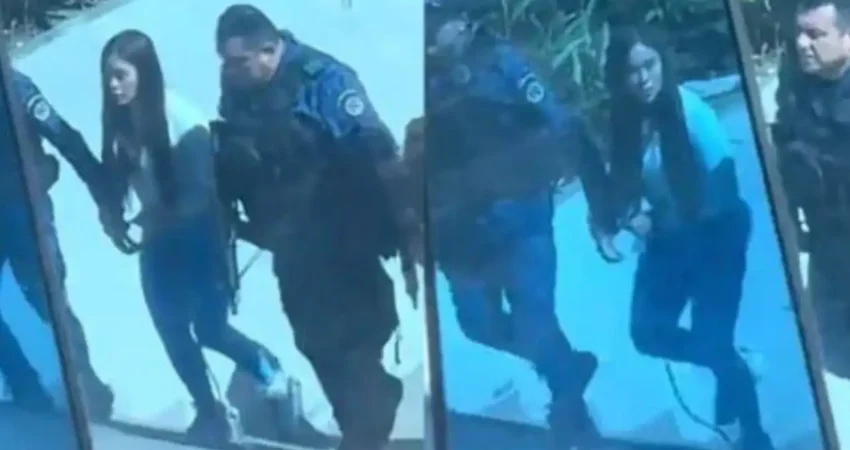
Daneidy Barrera Rojas, widely recognized as "Epa Colombia," was transported under heavy security from Picaleña prison to the Ibagué courts for a crucial judicial hearing. The images of her escorted movement, with hands cuffed and feet restrained, quickly circulated across social media platforms, drawing significant public attention and sparking widespread commentary regarding the security measures employed. This transfer underscores the ongoing legal proceedings against the Colombian social media personality and businesswoman.
The Journey from Picaleña to the Courtroom
The visual evidence of Epa Colombia’s departure from the Complejo Carcelario y Penitenciario de Ibagué, Picaleña, depicted a stark contrast to her often flamboyant public persona. Shackled and accompanied by officials from the National Penitentiary and Prison Institute (Inpec), her journey to the Los Arrayanes sector of Ibagué for the scheduled audience highlighted the gravity of her current legal situation. The use of restraints, including handcuffs and leg shackles, is standard protocol for transporting individuals deemed at risk of escape or posing a security threat, reflecting the seriousness with which the authorities are handling her case.
This specific transfer was necessitated by a judicial proceeding directly related to her ongoing legal process. While incarcerated, any requirement to attend court sessions mandates such secure transportation by Inpec. The visibility of these security measures served as a potent reminder of her confinement and the legal framework governing her current status.
A Glimpse into Epa Colombia’s Legal Entanglements
Epa Colombia’s current incarceration stems from a conviction for inciting to commit crimes with terrorist purposes, aggravated damage to another person’s property, and disturbing public transport services. The sentence, a significant 63 months and 15 days of imprisonment, is directly linked to acts of vandalism committed during the 2019 national protests. At that time, Barrera Rojas vandalized a TransMilenio station and subsequently shared the footage of her actions on social media, an act that brought her to the attention of legal authorities and ultimately led to her conviction.
Her period of pre-trial detention and subsequent imprisonment has seen her moved between several correctional facilities. Prior to her current stay at Picaleña, she was held at the Escuela de Carabineros in Bogotá. Before that, she had also been imprisoned at the El Buen Pastor prison. Each transfer signifies a stage in the judicial process, from investigation and trial to sentencing and the enforcement of that sentence. The relocation to Picaleña was a significant shift in her custodial arrangements, indicating a decision by the judicial system regarding the appropriate facility for her detention.
The Background of the 2019 Protests and Vandalism
The events that led to Epa Colombia’s conviction occurred during a period of intense social unrest in Colombia in late 2019. Widespread protests, initially sparked by government economic policies and tax reforms, quickly evolved into broader expressions of discontent regarding inequality, police brutality, and social justice issues. These demonstrations, while largely peaceful, were marred by instances of vandalism, looting, and confrontations between protesters and security forces.
The specific act attributed to Barrera Rojas involved the destruction of property within a TransMilenio public transportation station. The public dissemination of these images on social media amplified the incident, drawing widespread condemnation from various sectors of society and the government. The authorities’ decision to prosecute her for these actions, particularly the charges of inciting to commit crimes with terrorist purposes, underscored the perceived severity of her actions in the context of the national unrest. The legal interpretation at the time viewed such acts not merely as petty vandalism but as potentially destabilizing actions that could incite further disorder and violence.
Chronology of Epa Colombia’s Legal Journey
To fully comprehend the current situation, a chronological overview of key events is beneficial:
- Late 2019: During national protests, Daneidy Barrera Rojas, "Epa Colombia," vandalizes a TransMilenio station and posts videos of the act on social media.
- Following the Incident: Investigations are initiated, and charges are eventually filed against Barrera Rojas.
- Pre-Trial Detention: Epa Colombia is initially detained, with periods spent in facilities such as El Buen Pastor prison.
- Transfer to Escuela de Carabineros: For reasons related to her legal process or facility capacity, she is transferred to the Escuela de Carabineros in Bogotá.
- Conviction and Sentencing: A judicial ruling finds her guilty of instigating crime with terrorist intent, aggravated property damage, and disturbing public transport services, resulting in a sentence of 63 months and 15 days.
- Transfer to Picaleña Prison: Following her sentencing or a subsequent judicial decision, she is transferred to the Picaleña prison complex in Ibagué.
- Current Judicial Hearing (September 11, 2026): Epa Colombia is transported from Picaleña to the Ibagué courts for a specific judicial hearing related to her ongoing legal case.
This timeline illustrates a protracted legal battle that has spanned several years, involving multiple stages of detention and judicial proceedings.
Supporting Data and Legal Precedents
The conviction of Epa Colombia for acts committed during protests raises broader questions about freedom of expression versus the preservation of public order and property. While the right to protest is constitutionally protected, actions that involve destruction of public or private property, or incitement to violence, can fall outside the scope of protected speech.
The charges of "incitación a delinquir con fines terroristas" (incitement to commit crimes with terrorist purposes) are particularly serious. In Colombia, these charges are often applied in cases where acts of vandalism or violence are perceived to be part of a broader strategy to destabilize the government or society, even if the individual actor’s direct intent is not overtly "terrorist" in the conventional sense. The prosecution likely argued that her actions, amplified through social media, contributed to an environment of unrest and encouraged further destructive behavior.
The sentence of over five years (63 months and 15 days) is substantial and reflects the judiciary’s assessment of the severity of her offenses. Such sentences aim to serve as a deterrent to others considering similar actions and to convey the state’s commitment to maintaining order.
Official Responses and Public Reactions
While specific official statements directly commenting on Epa Colombia’s transfer have not been detailed in the original report, the actions of the Inpec in executing the transfer speak volumes. Their adherence to security protocols, including the use of restraints, is a reflection of their mandate to ensure the safe and secure custody of inmates, particularly when they are being moved between facilities or to court.
The public reaction, as noted in the original article, was significant, with social media users commenting extensively on the security measures. These reactions likely ranged from expressions of sympathy and solidarity from her supporters to condemnation and calls for accountability from those who view her actions as criminal and deserving of the sentence she is serving. The visibility of her arrest and subsequent legal troubles has made her a polarizing figure, eliciting strong opinions from various segments of the Colombian public.
Broader Implications and Analysis
Epa Colombia’s case has several broader implications:
- The intersection of social media and the law: Her reliance on social media to disseminate her actions turned her into a public figure whose alleged crimes were amplified. This highlights the growing challenge for legal systems in managing conduct that occurs and is broadcast online.
- Freedom of expression versus public order: The case navigates the delicate balance between the right to protest and express dissent, and the need to maintain public order and protect property. The legal interpretation of what constitutes incitement or aggravated damage during a period of social unrest is a critical aspect.
- The consequences of online actions: The case serves as a stark reminder that actions, even those seemingly amplified by online fame, have real-world legal consequences. The viral nature of her vandalism contributed to her notoriety and, subsequently, her legal predicament.
- The correctional system and public perception: The visible security measures during her transfer can shape public perception of the correctional system’s handling of high-profile cases. It can be seen as either a necessary enforcement of the law or as an unnecessarily harsh display.
As Epa Colombia continues to navigate her legal challenges while serving her sentence, her case remains a focal point for discussions about justice, social media influence, and the boundaries of protest in Colombia. The upcoming judicial hearings will undoubtedly continue to be closely watched, with the public eager to understand the further developments in this high-profile legal saga. The continued requirement for secure transfers underscores the ongoing nature of her legal obligations and the serious legal framework within which she is currently operating. Her journey from a viral social media sensation to an incarcerated individual serving a lengthy sentence offers a complex narrative of fame, law, and consequence.

0 Comments