
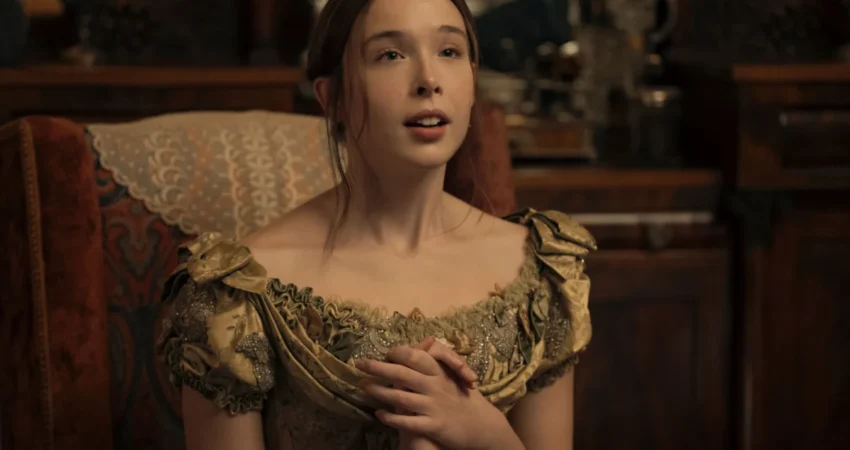
Netflix premiered the fourth installment of its acclaimed true-crime anthology series, Monstruo: La historia de Lizzie Borden, on September 17, 2026. Created by the prolific duo Ryan Murphy and Ian Brennan, this latest season follows the massive commercial success of previous iterations focusing on Jeffrey Dahmer, Lyle and Erik Menendez, and Ed Gein. However, this eighth-episode series represents a significant pivot for the franchise, transitioning from contemporary American horrors to the rigid, claustrophobic atmosphere of the late 19th century. By centering on a female protagonist for the first time in the anthology’s history, the production explores the intersections of domestic repression, Victorian social structures, and one of the most enduring legal mysteries in United States history.
The series features Ella Beatty in the titular role of Lizzie Borden, a performance that has garnered immediate critical attention for its nuanced portrayal of a woman pushed to the brink of psychological collapse. Supporting Beatty are Charlie Hunnam as Andrew Borden, the stern and wealthy patriarch, and Rebecca Hall as Abby Borden, Lizzie’s stepmother. Through eight episodes, each exceeding 40 minutes in duration, the narrative reconstructs the events leading up to and following the grisly hatchet murders that occurred in Fall River, Massachusetts, in 1892.
The Historical Framework: The Case of the Century
To understand the impact of the Netflix series, it is necessary to examine the historical reality that serves as its foundation. On August 4, 1892, the bodies of Andrew and Abby Borden were discovered in their home. Andrew, a successful property developer and businessman, was found on the living room sofa, his face nearly unrecognizable after being struck 11 times with a sharp object. Abby was found in an upstairs guest room, having sustained 19 blows.
Lizzie Borden, the younger of Andrew’s two daughters, became the primary suspect almost immediately. The investigation highlighted several incriminating factors, including Lizzie’s attempt to purchase prussic acid (a lethal poison) shortly before the murders and her subsequent burning of a blue dress, which she claimed was stained with paint but which investigators suspected was covered in blood. Despite the circumstantial evidence, the 1893 trial resulted in an acquittal—a verdict that many historians attribute to the Victorian-era belief that a "well-bred lady" was physically and temperamentally incapable of such extreme violence.

The Netflix production delves into these factual details while simultaneously exploring the "gray areas" of the case. While the legal verdict remains "not guilty," the series treats the ambiguity as a canvas to explore themes of female agency and the consequences of systemic repression.
Chronology of the Borden Murders and Legal Proceedings
The series meticulously maps out the timeline of the events, providing viewers with a chronological understanding of the tragedy:
- August 3, 1892: The Borden family and their domestic servant, Bridget Sullivan, suffer from a violent bout of food poisoning, which some later suspected was an early attempt at murder.
- August 4, 1892 (Morning): Abby Borden is murdered in the guest room while making the bed. Roughly 90 minutes later, Andrew Borden is killed while napping on the sofa.
- August 4, 1892 (Afternoon): Lizzie Borden "discovers" her father’s body and alerts Bridget Sullivan. Police begin their initial inquiry.
- August 11, 1892: Lizzie Borden is officially arrested following an inquest where her testimony was deemed inconsistent and contradictory.
- June 5, 1893: The trial begins in New Bedford, Massachusetts. It becomes a media sensation, often cited as one of the first examples of "trial by media" in the United States.
- June 20, 1893: After only 90 minutes of deliberation, the jury returns a verdict of not guilty.
Creative Liberties and the Role of Bridget Sullivan
While Monstruo: La historia de Lizzie Borden adheres to the broad strokes of history, Ian Brennan and Ryan Murphy have incorporated significant creative liberties to sharpen the show’s social commentary. A central figure in this reimagining is Bridget Sullivan, portrayed by Vicky Krieps. In the historical record, Sullivan was the Irish domestic worker who testified that she was resting in her room during the time of the murders and saw nothing suspicious.
In the series, however, the relationship between Lizzie and Bridget is expanded into a clandestine romantic affair. This narrative choice serves to illustrate the "cage" mentioned by Brennan in promotional interviews—a metaphor for the limited options available to women of the era. The show depicts the two women as co-conspirators, not just in the potential crime, but in a rebellion against the patriarchal authority represented by Andrew Borden.
"The work of the program was to contrast this cage that any woman living in that time and place would have felt," Brennan stated during a Netflix press event. By framing the murders as an act of liberation, the series moves away from traditional true-crime procedural tropes and toward a psychological study of "female fury."

Parallel Narratives: Báthory and Wuornos
A distinctive element of this fourth season is its use of temporal jumps to connect Lizzie Borden’s story with two other infamous female figures: Erzsébet Báthory and Aileen Wuornos. This narrative structure suggests a "generational wound" and a legacy of violence born from systemic abuse.
Vicky Krieps pulls double duty, also portraying Erzsébet Báthory, the 17th-century Hungarian countess known as the "Blood Countess." Historical legend suggests Báthory tortured and murdered hundreds of young women, allegedly bathing in their blood to preserve her youth. The series utilizes Báthory as a spectral influence or a psychological archetype that Lizzie draws upon to find the "energy" required for her own acts of violence.
Simultaneously, the series introduces Aileen Wuornos, played by franchise veteran Sarah Paulson. Wuornos was a serial killer executed in 2002 for the murder of seven men in Florida. Unlike the affluent Lizzie Borden, Wuornos lived on the margins of society, and her defense famously argued that her crimes were a reaction to a lifetime of sexual physical abuse. By weaving these three stories together, the series contrasts how the legal system treats female violence across different centuries: from the 19th-century acquittal of a "lady" to the 21st-century execution of a woman the system failed to protect.
Analytical Implications: The Legal System and the "Male Gaze"
From a journalistic and analytical perspective, Monstruo: La historia de Lizzie Borden functions as a critique of the "male gaze" within the judicial system. The show highlights how Lizzie’s acquittal was not necessarily a triumph of justice, but a byproduct of a society that refused to acknowledge female complexity. If a woman was seen as a "monster," she had to be an anomaly; if she was seen as a "lady," she had to be innocent.
This stands in stark contrast to the portrayal of Aileen Wuornos. The series posits that while Lizzie used the period’s gender biases to escape punishment, Wuornos was condemned by a system that refused to consider the mitigating circumstances of her trauma. Ella Beatty emphasized this connection in her statements to the press, noting that the series seeks to map the "legacy of female rage" and the varying societal reactions to it.

Production Context and Streaming Strategy
The release of this series comes at a time when Netflix is doubling down on its "Monster" brand. Following the controversy surrounding the Dahmer season—which faced criticism for its impact on victims’ families—the producers have shifted toward historical cases where the distance of time allows for more aggressive thematic experimentation.
The casting of Ella Beatty, daughter of Hollywood royalty Warren Beatty and Annette Bening, represents a significant "breakout" strategy for the network. Furthermore, the inclusion of high-caliber actors like Charlie Hunnam and Rebecca Hall signals Netflix’s intent to maintain the prestige status of the anthology, despite the inherently sensationalist nature of the subject matter.
The Aftermath and Legacy of Lizzie Borden
The series concludes by examining Lizzie Borden’s life after the trial, a period often overlooked in popular dramatizations. Despite being legally exonerated, Borden remained a pariah in Fall River. She and her sister, Emma, used their significant inheritance to purchase a large Victorian mansion they named "Maplecroft."
Lizzie lived a relatively isolated life, eventually changing her name to Lisbeth Borden. Her only notable social connection was with the actress Nance O’Neil, a relationship that the series explores as a continuation of Lizzie’s search for a life outside traditional domesticity. Lizzie Borden died in 1927 at the age of 66, taking the secrets of August 4, 1892, to her grave.
By modernizing the discourse around this 134-year-old case, Monstruo: La historia de Lizzie Borden ensures that the "Monster" franchise remains a central pillar of the true-crime genre. The series does not merely recount a crime; it interrogates the social conditions that create the "monsters" it depicts, offering a grim reflection on how little, or how much, the world’s perception of female violence has changed.

0 Comments