
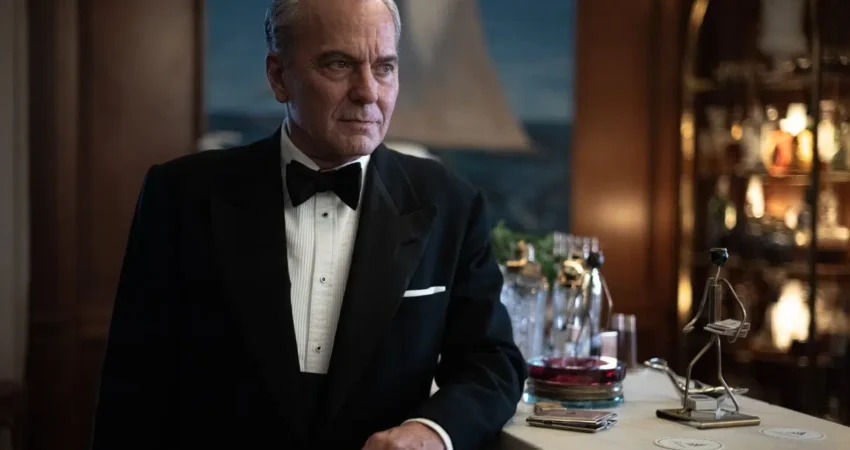
The Spanish miniseries "El problema final," released on Netflix on September 25th, presents a classic murder mystery premise: a secluded island hotel, a fierce storm cutting off all escape routes, thirteen suspects, and a tourist found dead in a locked room. Despite the inherent appeal of such a setup, the four-episode adaptation of Arturo Pérez-Reverte’s 2023 novel, directed by Félix Viscarret, ultimately falls short of delivering the thrilling and engaging experience its promising foundation suggests. While visually polished and featuring a strong central performance, the series struggles to translate the novel’s intellectual depth and meta-fictional nuances to the screen, resulting in a narrative that, while competent, lacks the emotional resonance and suspense it could have achieved.
The Genesis of the Mystery: From Novel to Screen
Arturo Pérez-Reverte, a titan of Spanish literature known for his historical fiction and intricate plots, penned "El problema final" with the explicit intention of engaging readers in a cerebral duel. The novel, released in 2023, was conceived as a deliberate homage to the golden age of detective fiction, particularly to the enduring legacy of Sherlock Holmes. Pérez-Reverte envisioned a story that would challenge the reader as much as the characters within the narrative, a "contest of wits" rather than a straightforward confrontation between detective and criminal.
The transition from page to screen involved several key adaptations. While the novel was set in June 1960 on the fictional Greek island of Utakos, with a smaller cast of nine trapped individuals and a victim named Edith, the series shifts the setting to the spring of 1959 on a small island off the coast of Mallorca, Spain. The number of suspects is increased to thirteen, and the victim is identified as Elisa Mander, a discreet British guest. These geographical and numerical alterations, while legitimate creative choices for an adaptation, do not fundamentally elevate the narrative as much as one might expect. The screenwriters—Marisol Ferré, Alberto Macías, and Carlos Molinero—along with cinematographer Daniel Sosa and composer Vicente Ortiz Gimeno, were tasked with bringing this meticulously crafted mystery to life.
A Locked-Room Enigma on a Storm-Tossed Isle
The narrative unfolds in a secluded hotel on a small island, a picturesque yet isolating location rendered even more formidable by a tempestuous storm that effectively severs all ties to the mainland. This atmospheric setting immediately establishes a sense of claustrophobia and heightened tension. The tranquility of the island retreat is shattered with the discovery of Elisa Mander, a British tourist of seemingly unremarkable background, dead in her room, the door bolted from the inside. What initially appears to be a tragic suicide swiftly unravels into a complex murder investigation. With no means of escape and the perpetrator lurking among them, the remaining guests and hotel staff become entangled in a web of suspicion.

The core concept of the series hinges on its protagonist, Basil, a retired actor whose career was defined by his iconic portrayal of Sherlock Holmes in cinema. The meta-narrative conceit is that Basil, intimately familiar with the deductive methods of the world’s most famous detective through countless scripts and performances, finds himself in a real-life mystery where the stakes are far higher and the guidance of a script is absent. This internal conflict—the actor versus the myth, the vanity of the performer against the fear of inadequacy in a genuine crisis—is presented as the series’ central dramatic engine.
José Coronado’s Performance: A Solitary Beacon
The weight of "El problema final" rests heavily on the shoulders of José Coronado, who delivers a compelling performance as Basil. Coronado imbues the character with a palpable sense of twilight weariness, a dry wit, and an innate authority that lends credibility to his accidental role as an investigator. His portrayal captures the essence of a man grappling with his past persona while navigating an unforeseen reality. Coronado himself has acknowledged the difficulty of truly observing and deducing, and his meticulous work in embodying Basil is evident. When Coronado is on screen, the series gains a much-needed sense of vitality and focus. His presence is the primary anchor, providing moments of genuine engagement and intellectual engagement.
However, the series struggles to maintain this momentum when Basil is not the central figure. The supporting cast, while featuring prominent Spanish actors, often finds their characters relegated to mere pawns in the game. Maribel Verdú as Raquel Auslender, María Valverde as Adela Figueroa, and Martiño Rivas as Francisco Foxá, Basil’s investigative partner, are all talented performers. Yet, their roles, along with those played by Gonzalo de Castro, Pepón Nieto, Cristina Kovani, José Condessa, Yaiza Guimaré, and Michael Stobbe, are largely underdeveloped. They exist primarily to be potential suspects, their individual motivations and backstories seldom explored with enough depth to make them compelling figures in their own right. While Verdú and Valverde offer glimpses of hidden complexities through their nuanced performances, the script fails to provide them with the necessary space to develop these characters beyond their archetypal roles. This lack of depth in the ensemble is a significant drawback in a genre that thrives on the intricate inner lives and secrets of its characters.
A Palpable Lack of Suspense and Intellectual Engagement
Despite its Agatha Christie-esque setup and nods to "Knives Out" in its packaging, "El problema final" appears to be more of a superficial imitation than a truly original creation. The familiar tropes—the isolated island, the wealthy inhabitants, the discovered corpse, the killer among us—are present, but they lack the spark of innovation that would give the series a distinct identity. Everything seems meticulously placed to fit a pre-defined mold, adhering strictly to genre conventions without venturing into new territory.
The investigation itself, a crucial element for any mystery series, proves equally underwhelming. While some clues offer moments of intrigue, many feel like red herrings, deliberately placed to mislead the viewer rather than to organically advance the plot. The script seems more concerned with preserving the enigma than with constructing a compelling narrative that actively invites the audience to participate in the deduction process. The mechanics of the mystery become too visible, detracting from the immersive experience. Pérez-Reverte’s original intent—a mental sparring match with the reader—is largely lost in translation. The viewer is presented with the deductions rather than being a genuine participant in the intellectual journey.

The Dilution of Meta-Fictional Playfulness
The meta-fictional element, which provided much of the novel’s unique charm and personality—the constant dialogue with detective fiction and the figure of Holmes—is significantly diluted in the adaptation. What was the essence of the book on paper is reduced to mere decoration on screen, confined to a few knowing winks for the initiated. This loss of depth means that the series fails to capture the self-aware wit and literary commentary that distinguished the source material.
The production design, while meticulous in its recreation of late 1950s Spain, contributes to this sense of polished superficiality. The costumes are elegant, and the contrast between the beautiful Mediterranean landscape and the characters’ confinement is effectively utilized, with the sea transforming from a postcard view into an inescapable barrier. However, the overall presentation is so pristine that it borders on the sterile. Director Félix Viscarret handles the material with technical competence but without a distinctive directorial vision or a willingness to take creative risks. The result is a visually appealing series that is ultimately forgettable.
Pacing Problems and an Anticlimactic Conclusion
The pacing of the four-episode miniseries also proves problematic. With a limited number of installments, one would expect a tightly wound narrative, free of extraneous content. Instead, there are stretches where the suspense falters, bogged down by repetitive conversations that rehash already established suspicions. The sense of claustrophobia, which should ideally intensify with each episode, remains frustratingly static, never quite reaching its full potential.
The conclusion is perhaps the most contentious aspect of the series. It functions more as a puzzle piece falling into place rather than a revelation that forces a re-evaluation of what has been seen. For a story that purports to engage with the legacy of Sherlock Holmes, the resolution feels decidedly anticlimactic. While the final episode does cleverly utilize the established setting to resolve the case, by that point, a significant portion of the audience’s investment in the mystery has likely waned.
A Respectful but Ultimately Uninspired Adaptation
Arturo Pérez-Reverte himself, according to José Coronado, was moved to tears upon viewing the series, a testament to the adaptation’s respectful treatment of his novel. This respect, however, might have been too much of a guiding principle, leading to an approach that is perhaps overly faithful and consequently lacking in bold interpretive choices. "El problema final" can be watched in a single sitting and will entertain those seeking a straightforward, uncomplicated mystery. However, it prioritizes craftsmanship over personality and elegance over genuine tension. With such a well-portrayed central character in Basil, what is ultimately missing is a mystery worthy of his talents, a puzzle that truly challenges the audience and delivers the intellectual thrill that the premise promised. The series is a technically proficient but emotionally distant rendition of a potentially captivating narrative, leaving viewers with a sense of what could have been.

0 Comments