
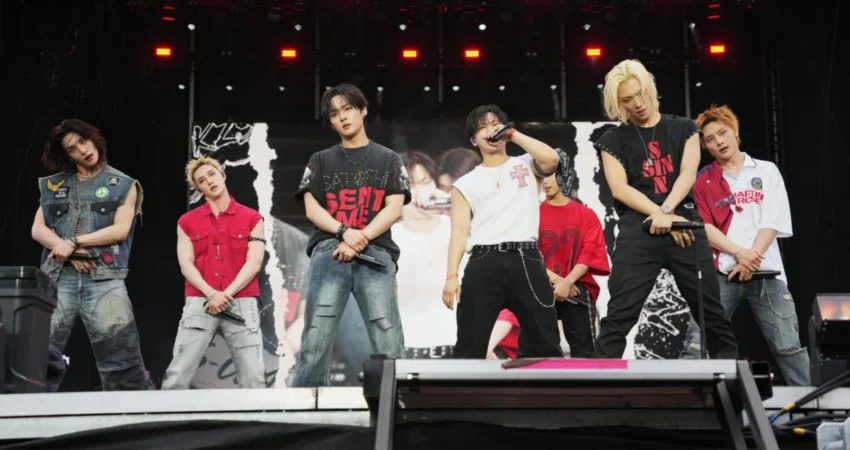
Mexican President Claudia Sheinbaum’s candid admission on Thursday, September 24th, regarding her expectation that K-pop sensation Stray Kids would accompany South Korean President Lee Jae Myung during his official visit to the National Palace, has sparked considerable discussion. The highly anticipated appearance of the popular K-pop group at the presidential headquarters did not materialize as initially suggested by the President, leading to a notable moment of diplomatic and cultural convergence that underscores the immense global reach of South Korean popular culture. Stray Kids, known for their electrifying performances and dedicated fanbase, were scheduled to hold two concerts at the prestigious GNP Seguros Stadium in Mexico City on September 25th and 26th, a fact that likely fueled the President’s initial assumption of their presence.
A Presidential Misunderstanding and Fan Anticipation
The situation unfolded when President Sheinbaum, in a video shared on her official TikTok account on Thursday evening, stated, "We are seeing off the president of the Republic of Korea, Lee Jae Myung. We thought perhaps he was coming with the group Stray Kids. They are performing tomorrow at one of Mexico City’s most important venues. And we have already invited them to come to our country on another occasion." This statement came after a morning press conference where the President had publicly announced Stray Kids’ participation alongside President Lee. During that earlier briefing, she described the group as "kind of like BTS, but younger," noting, "I don’t know if they’re boys and girls – they’re young, younger than the members of BTS." This comparison, while intended to provide context for a broader audience, also highlighted the significant cultural capital that K-pop groups now wield, capable of drawing international attention even into the realm of state visits.
The age difference she pointed out is indeed notable: Stray Kids members range from 25 to 28 years old, while BTS members are between 29 and 33. This distinction, while perhaps minor in the grand scheme of international diplomacy, speaks to the generational appeal and evolving landscape of K-pop. President Sheinbaum’s remarks, however, had a tangible impact. Dozens of Stray Kids’ devoted fans, often referred to as "STAYs," gathered outside the National Palace in anticipation of seeing the group alongside their nation’s leader. Their presence underscored the deep emotional connection fans have with their idols and the significant influence these artists have on their followers’ lives. The sight of fans congregating in the Zócalo, the historic main square of Mexico City, was a testament to the power of K-pop fandom.
The Reality on the Ground
Despite the President’s initial announcement and the fans’ hopeful vigil, only President Sheinbaum and President Lee Jae Myung appeared on the presidential balcony and greeted the gathered crowd at the National Palace entrance. Viral videos circulating on social media captured this moment, showcasing the anticipation of the fans and the official reception for the South Korean delegation. The absence of Stray Kids was apparent, leading to the President’s subsequent clarification. This incident, while perhaps initially embarrassing for the administration, has also served to highlight the growing cultural diplomacy of South Korea, where its popular music and entertainment industries are increasingly seen as valuable tools for soft power and international engagement.
A Precedent Set by BTS
The Stray Kids situation also draws a parallel to a similar high-profile event involving another K-pop giant, BTS, in May of the same year. During BTS’s visit, the members did indeed meet with President Sheinbaum, appearing on one of the balconies of the presidential residence. They waved to an estimated 50,000 members of ARMY, BTS’s global fanbase, who had gathered in the Zócalo. According to figures released by the Mexico City government, this massive turnout demonstrated the immense popularity of BTS and their ability to mobilize significant public attention. The comparison between the two events is telling: while BTS’s appearance was a confirmed and widely publicized event, Stray Kids’ expected presence was a misunderstanding that, in hindsight, underscores the evolving dynamics of celebrity engagement in official capacities. The fact that Stray Kids were performing in Mexico City shortly after BTS had done so further emphasizes the country’s significant market for K-pop and its growing role as a destination for global music tours.
The Broader Impact of K-Pop in Mexico
Stray Kids’ upcoming concerts at the GNP Seguros Stadium represent a significant cultural and economic event for Mexico City. The group’s global popularity, fueled by hits like "God’s Menu," "Thunderous," and "MANIAC," has garnered them a massive international following, including a substantial fanbase in Latin America. Their performances are expected to draw thousands of attendees, not only from Mexico but also from neighboring countries, contributing to the local economy through tourism, hospitality, and merchandise sales. The continued success of K-pop groups like Stray Kids in Mexico reflects a broader trend of the genre’s expansion beyond its traditional Asian markets and its firm establishment as a global phenomenon. This cultural exchange fosters a deeper understanding and appreciation between nations, even when facilitated by unexpected circumstances like a presidential mix-up.
Cultural Diplomacy and the Power of Fandom
The incident involving President Sheinbaum and Stray Kids can be viewed through the lens of cultural diplomacy, a practice where governments utilize cultural exchanges to build relationships and foster goodwill. South Korea has been particularly adept at leveraging its "Hallyu" (Korean Wave) – the surge in global popularity of its popular culture – as a tool of soft power. K-pop groups, with their meticulously crafted performances, engaging personalities, and extensive social media presence, have become powerful ambassadors for South Korean culture. Their ability to connect with diverse audiences across geographical and cultural divides is unprecedented.
The passionate and organized nature of K-pop fandoms, such as STAYs and ARMY, is also a critical component of this phenomenon. These fan bases are not merely passive consumers; they actively engage in promoting their idols, organizing events, and even contributing to social causes in their artists’ names. The gathering of STAYs outside the National Palace, driven by the President’s announcement, exemplifies this active engagement. While the initial reason for their presence was based on a misunderstanding, their dedication and enthusiasm were genuine, reflecting the deep impact Stray Kids have on their followers.
Analyzing the Implications
The Mexican President’s candid admission, rather than diminishing her stature, has arguably humanized her and sparked a conversation about the intersection of celebrity, politics, and global culture. It highlights the immense influence that K-pop artists now wield, capable of capturing the attention of world leaders and mobilizing large groups of people. The incident also underscores the importance of clear communication in diplomatic settings, particularly when dealing with high-profile international figures and their entourage.
For Stray Kids, the unexpected mention by a head of state, even in a context of confusion, has undoubtedly amplified their visibility in Mexico and across Latin America. It serves as a testament to their status as global music icons. The group’s upcoming performances are now imbued with an added layer of significance, marking not just a musical event but a moment where the worlds of pop culture and international politics briefly, and somewhat comically, intersected. The long-term implications of this episode might include a more strategic approach by governments to engaging with international cultural phenomena and a greater understanding of the power of K-pop as a force in global soft power diplomacy. The continued success of K-pop in Mexico and beyond suggests that this trend is likely to persist, shaping cultural exchange and international relations in the years to come. The fact that the President herself acknowledged the group, even in error, signifies their undeniable cultural footprint on a global scale, reaching even the highest levels of political discourse.

0 Comments