
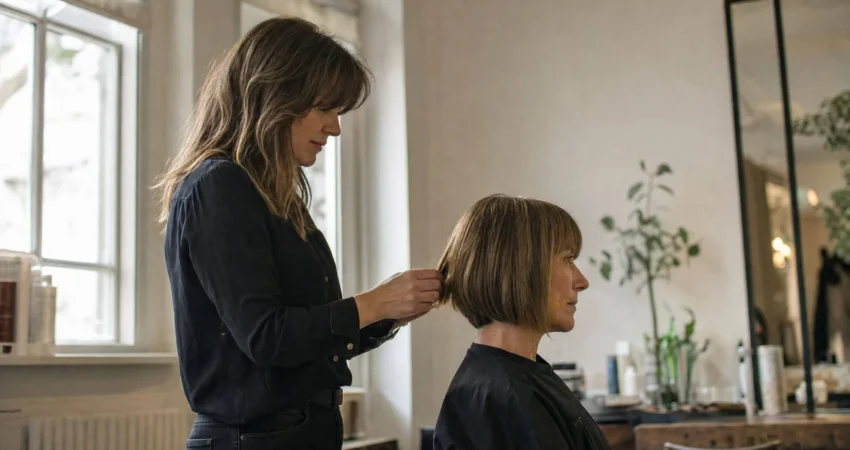
The contemporary beauty industry is witnessing a significant shift in how stylists approach the perennial challenge of fine hair, moving away from traditional layering techniques toward a philosophy centered on structural weight and architectural integrity. For decades, the standard response to thin or fine hair was to introduce layers in an attempt to create the illusion of volume through movement. However, modern hair professionals are increasingly advocating for a "compact base" strategy—a technique that prioritizes the retention of weight at the ends of the hair to maximize visual density. This shift represents a fundamental change in the "geometry of the haircut," where the goal is no longer just to add "bounce," but to reinforce the hair’s perimeter, ensuring that the silhouette remains solid and the hair appears as thick as biologically possible.
The Technical Evolution: From Voluminous Layers to Compact Bases
The history of hairstyling for fine hair has undergone several distinct phases. In the 1980s and early 1990s, the prevailing trend was the use of heavy texturizing and "shattered" layers, often supported by chemical perms or intensive heat styling to create height. While these methods provided temporary volume, they often left the ends of fine hair looking translucent or "wispy," a result that many modern consumers find undesirable.
By the early 2000s, the influence of the "shag" and the "Rachel" cut popularized heavily feathered ends. However, for individuals with low hair density, these techniques often removed too much "bulk" from the bottom third of the hair, leading to a collapsed silhouette shortly after leaving the salon. The current era, beginning in the late 2010s and solidifying in the 2020s, has seen a return to minimalism. The rise of the "Blunt Bob" and the "Glass Hair" trend signaled a move toward sharp, clean lines. Stylists now recognize that for fine hair, every millimeter of thickness counts. By keeping the base line straight and dense, the hair maintains a "curtain" effect that reflects light more uniformly, creating a psychological and visual perception of health and abundance.

Distinguishing Between Fine Hair and Low Density
A critical component of this new professional approach is the education of the consumer regarding the biological reality of their hair. In a professional salon environment, "fine" and "thin" are not interchangeable terms. Fine hair refers to the diameter of the individual hair shaft; a person can have thousands of hairs (high density), but if each strand is narrow, the overall ponytail will feel small. Conversely, "thin hair" refers to low density—the number of follicles per square centimeter on the scalp.
A landmark 2016 study published in the International Journal of Cosmetic Science by Bouabbache and colleagues utilized a cohort of 151 women to analyze the perception of "fineness." The research identified four key dimensions that contribute to the "fine hair" experience: quantity (density), thickness (diameter), resistance (strength), and volume (the space the hair occupies). The study concluded that what consumers perceive as "problematic" fine hair is usually a combination of at least two of these factors.
For the stylist, this data is transformative. If a client has fine hair but high density, some internal layering may be permissible to manage weight. However, if the client has low density, any form of traditional layering or "thinning out" is counterproductive. The modern "compact base" cut is designed specifically to address the "transparency" that occurs when low-density hair is cut with too many elevation changes.
The Strategy of the Modern Cut: Bob, Lob, and Clavicut
To achieve the desired density, stylists are increasingly recommending three specific variations of the blunt cut, tailored to the client’s facial structure and maintenance capacity:

- The Classic Bob: Ending at the jawline, this cut is the gold standard for maximizing the appearance of thickness. By removing the weight of long hair, the natural lift at the root is increased, and the blunt perimeter creates a solid "wall" of hair.
- The Long Bob (Lob): Falling between the chin and the collarbone, the lob offers versatility while maintaining a thick base. It is particularly effective for those with straight-to-wavy textures.
- The Clavicut: Terminating exactly at the clavicle (collarbone), this length is widely considered the most universally flattering. It provides enough length for updos while ensuring the ends do not become "stringy" due to friction against clothing.
The innovation in these cuts lies in "internal movement." Rather than cutting layers into the visible surface of the hair, stylists use "point cutting" or "channeling" on the interior sections. This removes just enough weight to allow for movement without compromising the solid line at the bottom.
Texture-Specific Adaptations: Straight, Wavy, and Curly
The "no-layer" rule is not a one-size-fits-all mandate; it must be calibrated according to the hair’s natural behavior.
- Straight Fine Hair: This texture is the most prone to looking "limp." A perfectly horizontal blunt cut is often the best solution. However, to avoid a "boxy" look, stylists may incorporate "face-framing" details—slight angles starting below the chin—to add interest without thinning the back.
- Wavy Fine Hair: The challenge here is the "triangle effect," where the bottom flares out while the top stays flat. Stylists now use "surface layers" that are extremely long and subtle, allowing the waves to stack without losing the bluntness of the ends.
- Curly Fine Hair: Because curls shrink as they dry, the "compact base" must be cut while the hair is dry or only slightly damp to account for the "bounce-back" factor. A blunt cut on curly hair provides a modern, "sculptural" look that prevents the ends from looking frayed.
Industry Response and Economic Impact
The shift toward structural cutting has had a ripple effect on the professional hair care market. According to market analysis reports, the "volumizing" segment of the global hair care industry—valued at over $100 billion—is seeing a surge in "densifying" products rather than just "lifting" products. Consumers are seeking serums and treatments that increase the diameter of the hair fiber (such as those containing filloxane or biotin) to complement their blunt haircuts.
Salons are also adjusting their service menus. "Consultation-heavy" appointments are becoming the norm, where stylists spend the first 15 minutes analyzing scalp health and hair diameter before picking up shears. This move toward "bespoke architecture" allows salons to charge a premium for technical expertise rather than just the act of cutting.

Broader Implications: The Psychology of Hair Health
Beyond the aesthetic benefits, the move toward base-heavy cuts reflects a broader cultural shift toward "hair longevity." In an era where heat damage and over-processing are frequently discussed on social media, a blunt, healthy-looking hemline has become a status symbol of sorts. It suggests a "quality over quantity" approach to beauty.
Stylists report that clients who switch from heavily layered cuts to compact bases often experience higher levels of "hair confidence." The visual elimination of split or transparent ends makes the hair look healthier, which in turn reduces the perceived need for aggressive heat styling or expensive extensions.
Conclusion: A New Standard for the Salon Chair
The "compact base" is not a miracle cure for thinning hair, but it is a triumph of styling logic over traditional habit. By treating the haircut as a piece of architecture—where the foundation must be solid to support the structure—stylists are finally providing a sustainable solution for those with fine hair.
The advice for the consumer is clear: success in the salon chair begins with a specific vocabulary. Requesting a "full base" and "localized movement" ensures that the stylist focuses on preserving density where it is most visible. As the industry continues to evolve, the focus remains on honesty; a haircut cannot create new follicles, but it can certainly make the most of the ones that exist. For the millions of individuals with fine hair, this architectural approach represents a definitive end to the "wispy" era and the beginning of a more substantial, confident aesthetic.

0 Comments