
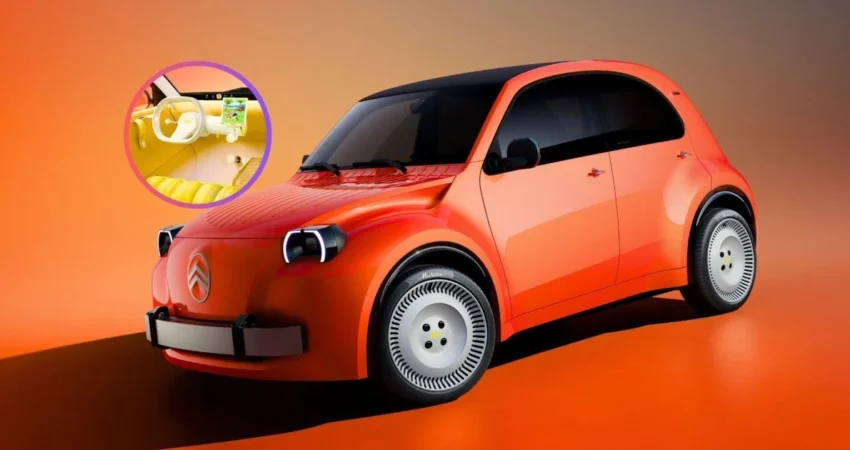
The 2026 Paris Motor Show has served as the stage for one of the most significant automotive announcements of the decade: the return of the Citroën 2 CV. Presented as a conceptual prototype, this new iteration of the "Tin Snail" seeks to bridge the gap between nostalgic design and the pressing modern need for affordable, sustainable urban mobility. Measuring 3.76 meters in length, the 2 CV Concept is a manifesto for a brand returning to its roots of simplicity, functionality, and accessibility. While it remains a study in design and engineering for now, Citroën executives have confirmed that the prototype serves as a direct precursor to a production model slated for a 2028 release, with a target entry-level price of approximately 15,000 euros.

This strategic move comes at a critical juncture for the European automotive industry, which is currently grappling with the influx of low-cost electric vehicles from international markets and a growing domestic demand for smaller, more efficient city cars. By reviving the 2 CV nameplate, Citroën is not merely capitalizing on a legendary brand asset; it is attempting to redefine what an entry-level electric vehicle (EV) should be in an era where cars have become increasingly heavy, complex, and expensive.
A Historical Legacy Reimagined for the 21st Century
To understand the significance of the 2 CV Concept, one must look back to the origins of the original Toute Petite Voiture (TPV) project. Launched in 1937 under the direction of Pierre-Jules Boulanger, the original brief was famously pragmatic: the car had to be able to carry four people and 50 kilograms of farm produce—specifically potatoes—at speeds of 60 km/h, while being able to traverse a ploughed field without breaking a single egg. When the 2 CV finally debuted at the 1948 Paris Motor Show, it was initially met with skepticism by the press but eventually became a global phenomenon, with over five million units produced until 1990.

The 2026 concept honors this legacy by prioritizing the same core values: ease of use, low maintenance, and a distinct lack of pretension. However, the context has shifted from post-war reconstruction to the green transition. The new 2 CV is designed as a "smart" essentialist vehicle. It eschews the "more is better" philosophy of modern SUVs in favor of a "just enough" approach that maximizes efficiency through weight reduction and aerodynamic simplicity.
Design Philosophy: Nostalgia Meets Modern Aerodynamics
The silhouette of the 2 CV Concept is instantly recognizable, yet thoroughly contemporary. At 3.76 meters, it is slightly shorter than the 1948 original (3.85 meters), positioning it strategically between the ultra-compact Citroën Ami and the larger C3. The design team has successfully integrated several "Easter eggs" and historical nods without making the car feel like a caricature.

The front fascia features the iconic round headlights, now updated with high-efficiency LED technology and separated from the main bodywork to reduce repair costs. The hood retains the characteristic longitudinal ribs seen on the early TPV prototypes. A particularly striking feature is the "Infra Red" exterior finish, a dynamic paint that shifts between deep red and bright yellow depending on the angle of light, symbolizing the energy of the electric powertrain.
At the rear, the concept features a large black tailgate that extends down to the bumper, providing a stark contrast to the body color. In a playful nod to the car’s international cult following, a digital screen replaces the traditional license plate area, scrolling through the various nicknames the 2 CV earned across the globe, such as "Ente" in Germany or "Citroneta" in South America.

Engineering for Efficiency: The 1,000-Kilogram Target
One of the most ambitious technical goals for the production version of the 2 CV is a curb weight of approximately 1,000 kilograms. In the world of modern electric vehicles, where batteries often push small cars toward the 1,500-kilogram mark, this target is revolutionary. Achieving such a low weight would allow Citroën to use a smaller, less expensive battery pack while maintaining a competitive range for urban and suburban commuting.
The pursuit of lightness is evident in the vehicle’s construction. The bumpers are physically separated from the body to simplify manufacturing and replacement. The exterior panels are designed with minimal complexity to streamline the assembly process at a European factory. While Citroën has not yet released specific data regarding battery chemistry or motor output, the focus on weight suggests a vehicle optimized for low energy consumption (kWh per 100km) rather than raw performance or long-distance touring capabilities.

Interior Innovation: The Return of the "Minimalist Lounge"
The interior of the 2 CV Concept represents a radical departure from the screen-heavy dashboards that dominate the current market. By removing the traditional central console and dashboard, Citroën has created an airy, open space that feels much larger than its external dimensions suggest.
Key interior features include:

- Removable Seating: The front seats utilize Citroën Advanced Comfort technology but are designed with a twist—they can be easily removed from the vehicle for use as outdoor chairs during a picnic or a rest stop.
- Simplified Storage: Traditional door handles are replaced by flexible straps, and the storage compartments consist of a 3D-printed central basket made from bio-plastics and wood.
- The "Radioën": In place of a complex integrated sound system, the concept features a removable, portable speaker called the "Radioën," allowing users to take their music with them when they leave the car.
- Manual Canvas Roof: Staying true to the original, the concept features a manually operated canvas roof that provides an open-air experience without the weight and complexity of an electric sunroof mechanism.
Technological Integration and the Michelin Partnership
Despite its minimalist aesthetic, the 2 CV Concept is not technologically primitive. It introduces the "Citroën Smart Vision" system, a heads-up display that projects essential information—speed, battery level, and navigation—directly into the driver’s line of sight. A small 8-inch square touchscreen handles secondary multimedia functions, but crucially, Citroën has retained physical tactile buttons for climate control and volume, citing safety and ease of use.
A significant technological highlight is the collaboration with Michelin on "Digital Twin" tire technology. This system monitors tire wear, pressure, and grip levels by analyzing vehicle data (such as wheel speed and torque) rather than relying on expensive internal sensors. This software-based approach aligns with the car’s goal of reducing long-term maintenance costs and improving safety through predictive alerts.

Market Positioning and Economic Impact
The target price of 15,000 euros for the production model in 2028 is perhaps the most critical aspect of the 2 CV’s return. Currently, the European EV market is bifurcated between premium models and budget offerings that often sacrifice character or build quality. Citroën aims to occupy a "premium-essential" niche—offering a vehicle that is affordable but also emotionally resonant and well-designed.
Industry analysts suggest that the success of this price point will depend heavily on Stellantis (Citroën’s parent company) leveraging its "Smart Car" platform, which is also used for the new e-C3. By manufacturing the vehicle in Europe, Citroën also aims to avoid potential tariffs on imported vehicles and appeal to environmentally conscious consumers who value localized production and a smaller carbon footprint.

Chronology of the 2 CV Evolution
- 1937: Launch of the TPV (Toute Petite Voiture) project.
- 1939: Production of 250 prototypes, most of which were destroyed or hidden during WWII.
- 1948: Official debut at the Paris Motor Show.
- 1953-1990: Era of the iconic "Tartan" seat patterns and global expansion.
- 1990: The last 2 CV rolls off the production line in Mangualde, Portugal.
- 2026: Reveal of the 2 CV Concept at the Paris Motor Show.
- 2028: Projected launch of the mass-production electric 2 CV.
Broader Implications for the Automotive Industry
The reveal of the 2 CV Concept signals a broader shift in the automotive landscape. As the "arms race" for larger batteries and faster acceleration begins to cool, manufacturers are realizing that the next phase of EV adoption requires cars that people can actually afford and enjoy using in congested urban environments.
Citroën’s strategy mirrors recent moves by competitors like Renault, which is reviving the Renault 5 and Renault 4 as electric models. This trend of "retro-futurism" serves a dual purpose: it provides a sense of continuity and trust during a period of rapid technological change, and it allows brands to leverage established design languages that are inherently more space-efficient than modern aerodynamic templates.

If Citroën can deliver on its 15,000-euro promise by 2028, the 2 CV will not just be a nostalgic tribute; it will be a cornerstone of the democratized electric mobility movement. The concept proves that a car does not need to be complex to be desirable, nor does it need to be expensive to be innovative. As the 2 CV Concept transitions toward production, it carries with it the hope of a new generation of drivers looking for a vehicle that is as practical as it is iconic.

0 Comments