
 Nila Kartika Wati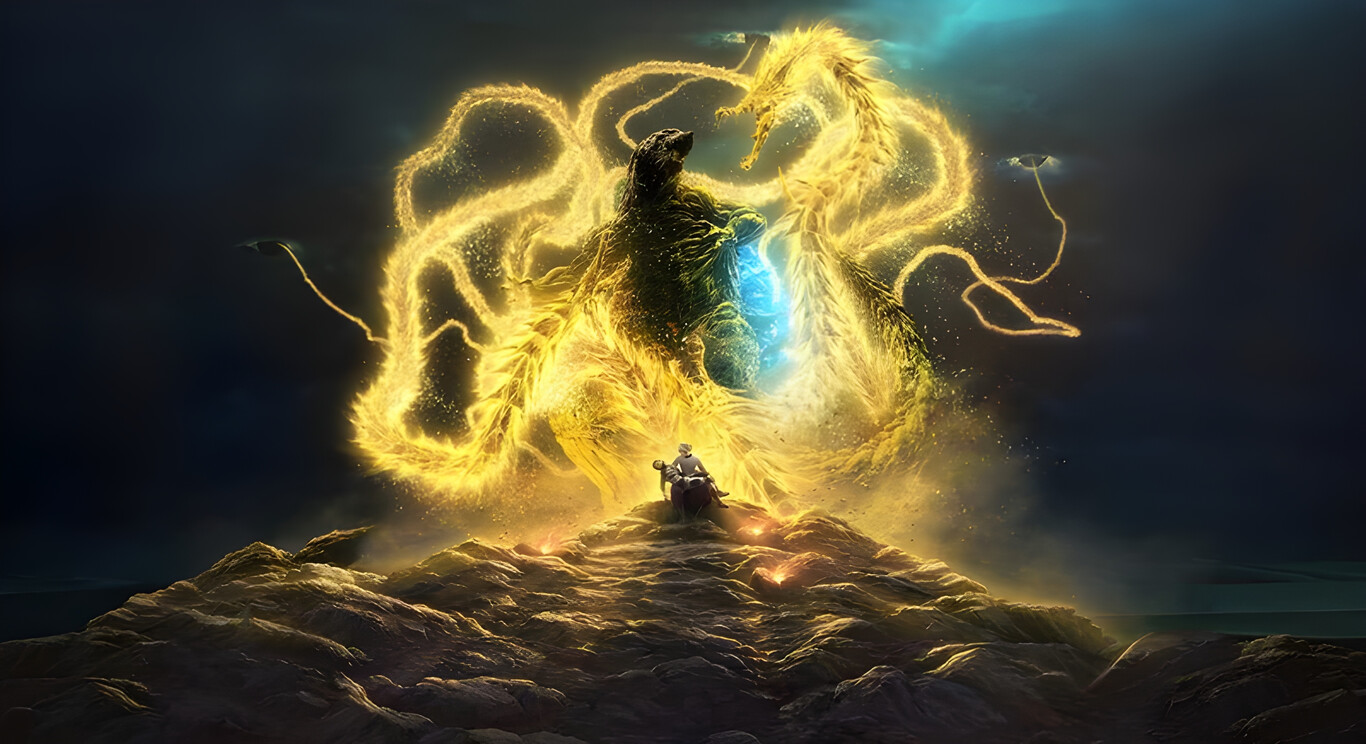
The global recognition of Godzilla as a premier icon of cinema, manga, and popular culture remains undisputed, yet within the vast library of the King of the Monsters, a specific experimental era often escapes the mainstream spotlight. While audiences are well-acquainted with the high-octane spectacle of the Hollywood MonsterVerse and the grounded, historical trauma of the Academy Award-winning Godzilla Minus One, a distinct and intellectually ambitious animated trilogy resides on Netflix. Composed of Godzilla: Planet of the Monsters (2017), Godzilla: City on the Edge of Battle (2018), and Godzilla: The Planet Eater (2018), this series represents a radical departure from traditional kaiju storytelling, pivoting toward hard science fiction, existentialism, and cosmic horror.
Produced by Toho Animation in collaboration with Polygon Pictures, the trilogy was spearheaded by acclaimed screenwriter Gen Urobuchi, known for his dark, subversive work on Psycho-Pass and Puella Magi Madoka Magica. By shifting the narrative 20,000 years into the future, the trilogy explores a haunting premise: the inevitability of human obsolescence in the face of a biological force that has not only conquered the planet but has become the very foundation of Earth’s ecosystem.
A Chronological Shift: The Fall of Humanity and the Rise of Godzilla Earth
The narrative timeline begins at the end of the 20th century, a period marked by the sudden emergence of kaijus that systematically dismantled human civilization. Unlike previous iterations where humanity finds a way to coexist or suppress the threat, this timeline posits a total defeat. By 2048, a desperate remnant of humanity, accompanied by two alien refugee races—the technologically advanced Bilusaludo and the deeply religious Exif—boarded the colony ship Aratrum to seek a new home in the Tau Ceti system.

The first film, Godzilla: Planet of the Monsters, picks up the story 20 years into their deep-space voyage. Facing the failure of their colonization efforts and dwindling resources, the survivors perform a sub-space jump back to Earth. Due to the dilation effects of relativistic travel, while only two decades passed for the crew, 20,000 years had elapsed on Earth. Upon their return, the expeditionary force, led by the vengeful Captain Haruo Sakaki, discovers an unrecognizable planet.
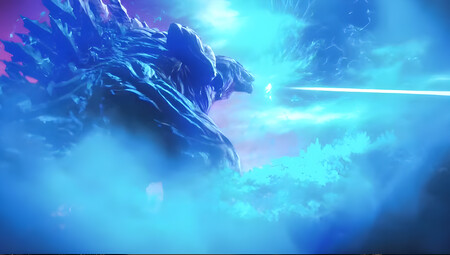
In this new era, the flora and fauna have evolved based on Godzilla’s genetic blueprint. The atmosphere is saturated with metallic particles, and the dominant life forms are the Servum, winged creatures that share Godzilla’s biological traits. The central revelation of the first installment is the sheer scale of the antagonist. While the crew successfully kills a 50-meter-tall Godzilla, they soon realize it was merely an offspring. The original entity, now known as Godzilla Earth, emerges from the ground, standing over 300 meters tall—the largest version of the creature ever depicted in franchise history.
Technical Innovation and the Polygon Pictures Aesthetic
The production of the trilogy utilized full 3D computer-generated imagery (CGI), a hallmark of Polygon Pictures. This choice was deliberate, allowing for a level of scale and environmental detail that traditional 2D animation might struggle to maintain across three feature-length films. The directors, Kobun Shizuno and Hiroyuki Seshita, focused on creating a "hard sci-fi" aesthetic, emphasizing the tactical challenges of fighting a monster that possesses an asymmetrical permeable shield and a highly sophisticated electromagnetic organ.
Supporting data from the production notes indicates that the design of Godzilla Earth was inspired by the concept of a "World Tree." Rather than being purely reptilian, this Godzilla is described as plant-based, with muscles made of metallic fibers and a hide that resembles bark. This biological shift serves the story’s theme: Godzilla is no longer an intruder in the world; he is the world.

The Technological and Moral Conflict in City on the Edge of Battle
The second chapter, City on the Edge of Battle, introduces a profound ideological rift between the human survivors and their alien allies. The discovery of "Nanometal"—a sentient, self-replicating liquid metal left behind by the destroyed Mechagodzilla facility centuries prior—provides humanity with a weapon capable of harming Godzilla Earth.
However, the film transitions from a military thriller into a cautionary tale about the cost of survival. The Bilusaludo race advocates for "fusion" with the Nanometal, arguing that to defeat a monster, humanity must abandon its biological limitations and become machines. This leads to a moral crisis for Haruo Sakaki, who must decide if preserving the human soul is more important than reclaiming the planet. The film’s climax is notable for its subversion of the "giant robot" trope; Mechagodzilla does not appear as a piloted machine but as an entire city—Mechagodzilla City—that attempts to consume the landscape to fuel its war against Godzilla.
The Metaphysical Climax: The Planet Eater and Cosmic Nihilism
The final installment, The Planet Eater, elevates the conflict from the physical and technological to the spiritual and metaphysical. As the human resistance crumbles, the Exif priest Metphies reveals the true nature of his religion. The Exif believe that all civilizations eventually create a "Godzilla"—a pinnacle of biological evolution—which then summons a higher-dimensional predator to consume the world.
This predator is King Ghidorah, reimagined here not as a three-headed dragon from space, but as a trans-dimensional entity that defies the laws of physics. Ghidorah appears as three golden serpents of pure energy, invisible to radar and immune to Godzilla’s physical attacks because it originates from a universe with different physical constants.
The film explores themes of nihilism and the "Golden Demise," suggesting that the cycle of destruction is a natural end for any civilization that prioritizes power and technology. The resolution of the trilogy is somber and contemplative, focusing on Haruo’s realization that as long as the cycle of hatred and the desire for technological dominance remain, humanity will always be at risk of total extinction.
Critical Reception and Industry Impact
Upon its release, the trilogy received a polarized response from the traditional Godzilla fanbase. Critics praised the high production values, the orchestral score by Takayuki Hattori, and the ambitious world-building. However, some viewers found the heavy emphasis on dialogue and philosophical debate to be a departure from the "monster mash" action they expected.
Industry analysts noted that the trilogy was a strategic move by Toho to diversify the Godzilla brand. By licensing the films globally to Netflix, Toho reached a younger, international demographic that consumes anime, effectively keeping the franchise relevant during the gaps between live-action releases. The trilogy also paved the way for subsequent animated projects, such as the 2021 series Godzilla Singular Point, which continued the trend of blending kaiju action with complex scientific theories like quantum physics and temporal paradoxes.
Broader Implications: Godzilla as a Constant of Nature
The Netflix anime trilogy serves as a significant case study in how a 70-year-old franchise can be reinvented for a modern audience. By removing the "humanity wins" safety net, the films force the audience to confront the reality of the Anthropocene—the current geological age where human activity is the dominant influence on climate and the environment.

In this version of the mythos, Godzilla is the Earth’s immune system, a response to the destructive nature of human civilization. The trilogy’s conclusion suggests that true peace can only be found by abandoning the path of aggressive technological expansion. This message aligns with the original 1954 film’s subtext regarding nuclear proliferation, updated for an era concerned with ecological collapse and the ethics of artificial intelligence.
Ultimately, while the anime trilogy may not be the most "popular" iteration of the character, it is arguably the most intellectually daring. It treats Godzilla not as a movie monster to be defeated, but as a cosmic truth to be understood. For fans of science fiction and deep narrative exploration, these three films offer a unique perspective on what it means to be human in a world that no longer belongs to us. As a "hidden gem" on Netflix, the trilogy continues to invite viewers to look past the spectacle and consider the deeper, darker shadows cast by the King of the Monsters.


 Raisa Andriana
 Eva Lovia
 Julia Chirkova
 Lana Rhoades
 Jia Lissa