
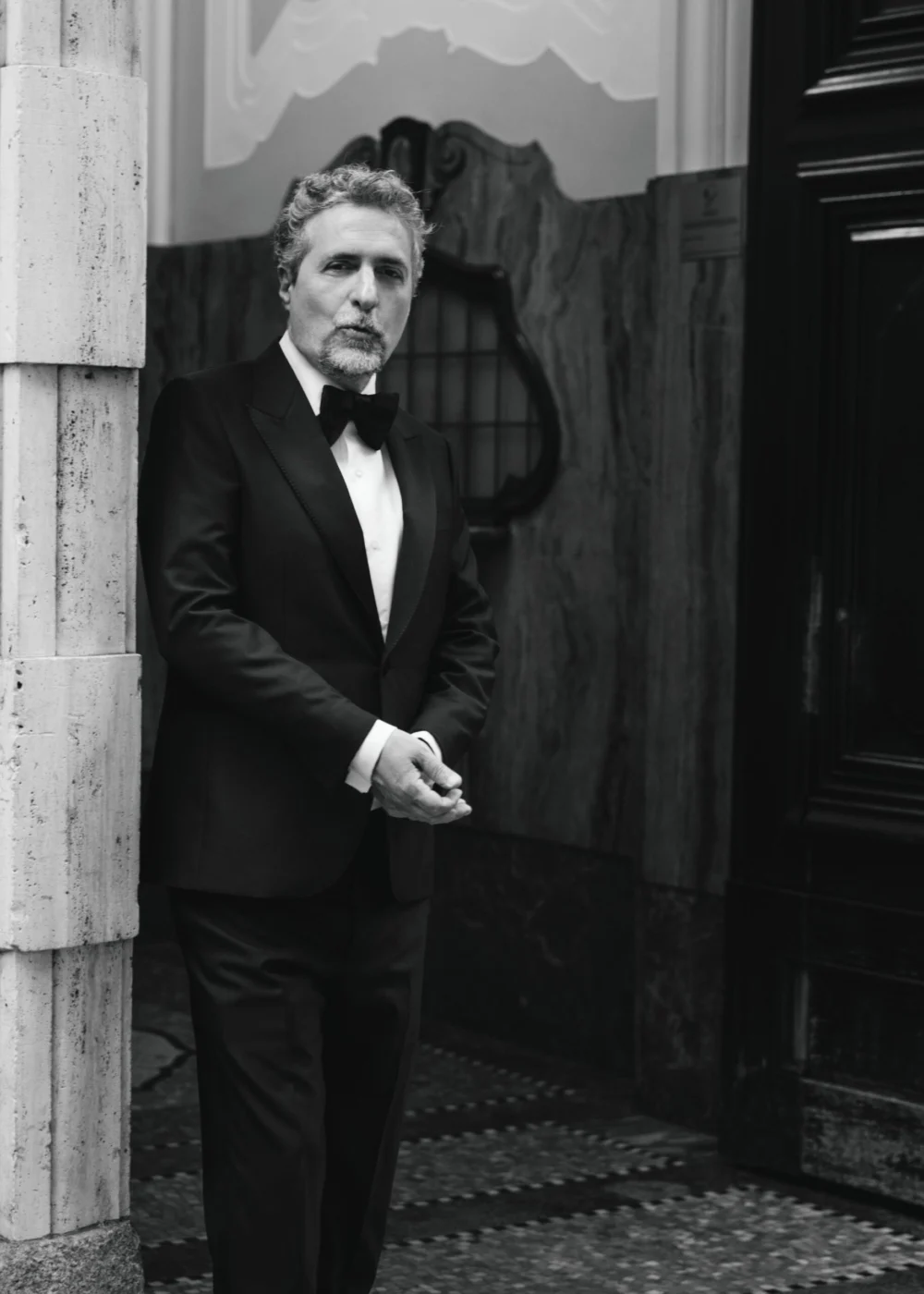
The landscape of international cinema has been significantly altered by the arrival of El Agente Secreto, the latest feature film from acclaimed Brazilian director Kleber Mendonça Filho. Following a string of critical successes, including the documentary Pictures of Ghosts (2023), Mendonça Filho has solidified his standing as a premier voice in global auteur cinema. His latest work, a tense political thriller set against the backdrop of Brazil’s military dictatorship, recently transitioned from a celebrated festival run to a dominant force in the 2026 awards circuit. The film’s momentum reached a fever pitch following its victory at the Golden Globes for Best Motion Picture – Non-English Language, a win that served as a precursor to its official nomination for the Academy Award for Best International Feature Film.
The director’s current prominence extends beyond the screen into the spheres of high fashion and cultural diplomacy. Recently seen in the front row of the Zegna Autumn/Winter 2026 show in Milan as a guest of artistic director Alessandro Sartori, Mendonça Filho has become a symbol of the modern "cultural ambassador." This intersection of film and luxury fashion underscores the film’s high-profile status. From Milan, Mendonça Filho reflected on the film’s journey, describing the production team as a "family" and emphasizing that an Oscar nomination is not merely a personal accolade but a validation of the collective effort required to reconstruct a complex chapter of Brazilian history.
Narrative Core and Historical Reconstruction
El Agente Secreto is set in the 1970s, a period defined by the peak of Brazil’s military regime. The plot follows Armando, portrayed by Wagner Moura, a man seeking refuge in the coastal city of Recife. Armando is fleeing the repercussions of a conflict with a powerful businessman closely tied to the ruling military junta. Operating under a false identity, Armando attempts to disappear into the vibrant, albeit paranoid, atmosphere of Recife during Carnival. However, the film meticulously illustrates that in a surveillance state, true anonymity is an impossibility.
The film is noted for its "sensorial" approach to period reconstruction. Mendonça Filho, a native of Recife, draws heavily from personal memory to build the film’s atmosphere. The opening sequence, set on Ash Wednesday during the Brazilian Carnival, is a direct recreation of a scene the director witnessed as a child. This commitment to authenticity extends to the production design and costuming. Costume designer Rita Azevedo utilized archival pieces to ensure historical accuracy; notably, a blouse worn by a supporting character was sourced directly from the production archives of the 1979 classic Bye Bye Brazil. Furthermore, the film pays homage to Hector Babenco’s 1977 masterpiece Lúcio Flávio, o Passageiro da Agonia, weaving a tapestry of cinematic references that anchor the story in the aesthetic of the 1970s.
Chronology of Global Recognition
The trajectory of El Agente Secreto began at the Cannes Film Festival, where it was immediately identified as a frontrunner for the year’s top honors. The festival jury recognized Mendonça Filho with the Best Director award, while Wagner Moura earned the Best Actor prize for his nuanced portrayal of a man living under the constant threat of discovery.

Following its festival debut, the film saw a staggered global release:
- Cannes Premiere: Initial critical acclaim and distribution deals.
- European Release: Strong performance in France, exceeding 400,000 ticket sales.
- Brazilian Premiere: A major domestic box office success, further bolstered by international accolades.
- Golden Globe Victory: Best Motion Picture – Non-English Language.
- Box Office Surge: A 260% increase in domestic ticket sales following the Golden Globe win.
- Oscar Nomination: Official inclusion in the 2026 Academy Award shortlists.
- Latin American Expansion: Scheduled for wide release on February 26.
This timeline demonstrates a sustained interest that bridges the gap between critical "prestige" cinema and commercial viability, a rarity for non-English language thrillers.
Political Analysis and Modern Parallels
Mendonça Filho’s work has long been characterized by a keen interest in how history permeates the present. El Agente Secreto was written during the administration of former Brazilian President Jair Bolsonaro, a period the director views as a modern echo of the country’s authoritarian past. Mendonça Filho has been vocal about the "repetition of political models," noting that the appointment of military figures to government positions during the Bolsonaro era felt like a historical reenactment.
The director’s analysis extends beyond Brazilian borders. He posits that the "cynicism of repression" seen in the 1970s is mirrored in contemporary global conflicts, including the Russian invasion of Ukraine and political instability in Venezuela. For Mendonça Filho, El Agente Secreto is less about a specific era and more about the cyclical nature of human behavior and political violence. He suggests that while many view the film as a study of "memory," it is perhaps more accurately a study of "amnesia"—the deliberate forgetting of past atrocities that allows them to recur in the modern age.
Supporting Data and Commercial Performance
The commercial success of El Agente Secreto provides a concrete metric for its cultural impact. In France, a market traditionally receptive to Brazilian cinema, the film’s nearly 400,000 admissions place it among the most successful Latin American imports of the decade. In Brazil, the film’s performance was revitalized by its success in the United States awards circuit. The 260% increase in box office revenue post-Golden Globes indicates that international validation remains a significant driver for domestic audience engagement in South America.
The film also benefits from the "halo effect" of recent Latin American successes at the Academy Awards. It follows in the footsteps of Argentina, 1985 (2022) and the fellow Brazilian production Ainda Estou Aqui (2024). While those films focused heavily on the legal and familial fallout of dictatorships, El Agente Secreto distinguishes itself through its genre-bending approach, utilizing the tropes of the political thriller and the comedy of errors to highlight the absurdity of life under an oppressive regime.

Industry Reactions and Broader Implications
Industry analysts have noted that El Agente Secreto represents a maturation of the "Recife School" of filmmaking. Mendonça Filho’s ability to tell a hyper-local story that resonates with global audiences is frequently cited by critics. The director himself rejects the labels of "local" or "regional," stating that his goal is simply to create an "interesting film" that adheres to universal cinematic standards rather than trying to please specific industry demographics.
The film’s reception in countries like Spain and Chile—nations with their own histories of military rule—further illustrates its universal relevance. In Spain, the film reportedly triggered significant public discourse regarding the "pact of forgetting" that followed the Franco era. This confirms Mendonça Filho’s belief that the "lapses of memory" he depicts in Brazil are a global phenomenon.
Broader Impact on Latin American Cinema
The success of El Agente Secreto signals a robust period for Latin American cinema on the world stage. By securing a nomination for the 2026 Oscars, the film ensures that the narrative of the "Lost Decade" and the struggle for democracy remains at the forefront of the global cultural conversation.
The film’s impact is three-fold:
- Aesthetic Influence: It proves that historical dramas do not need to be "dry" or strictly educational; they can be sensorial, atmospheric, and even darkly humorous.
- Political Awareness: It challenges audiences to recognize the signs of authoritarianism in the present by examining the patterns of the past.
- Economic Viability: Its box office numbers demonstrate that there is a significant market for sophisticated, non-English language thrillers that deal with complex social themes.
As the film prepares for its wider Latin American rollout on February 26, it stands as a testament to the power of memory in the face of political amnesia. For Kleber Mendonça Filho, the journey from a child watching Carnival in Recife to a celebrated director on the world stage has culminated in a work that is as much a personal exorcism as it is a political statement. El Agente Secreto is not merely a visitation of a painful past; it is a clinical, yet deeply affective, examination of why that past refuses to stay buried.

0 Comments