
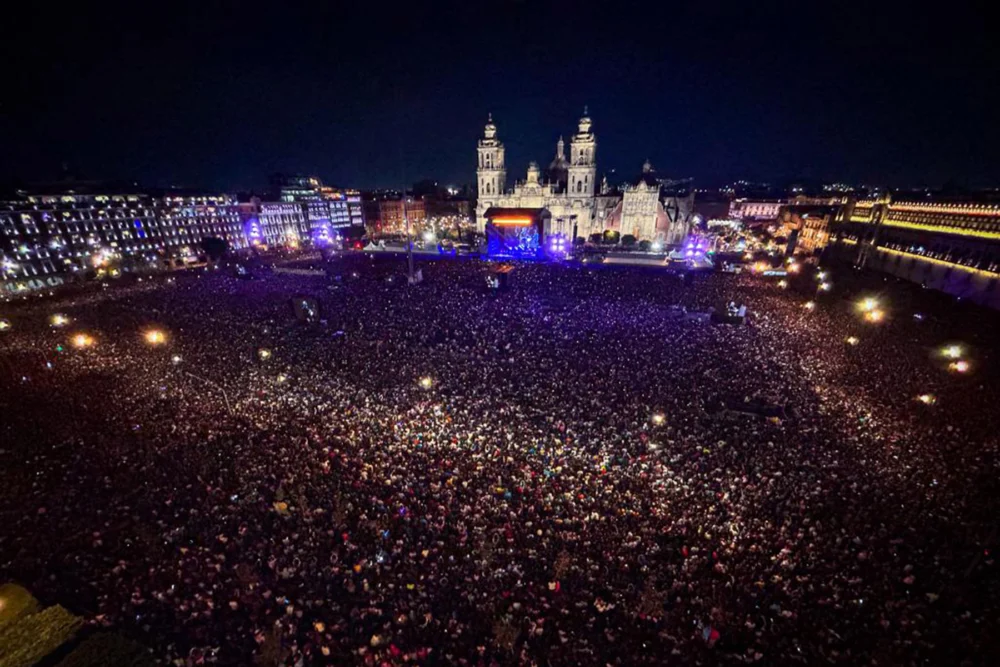
Since the late 1990s, Mexico City’s Plaza de la Constitución, universally known as the Zócalo, has transformed from the nation’s historical and political heart into a colossal open-air concert venue, drawing record-breaking crowds and etching indelible moments into the cultural landscape. This iconic square, a UNESCO World Heritage site and the second-largest public square globally, has witnessed a remarkable evolution, transitioning from a site of profound civic importance to a vibrant stage for some of the most massive and unforgettable musical performances of the modern era. The sheer scale of these events underscores not only the enduring power of music to unite people but also the Zócalo’s unique capacity to accommodate and amplify such cultural phenomena, solidifying its status as a global benchmark for large-scale public gatherings.

The most recent monumental event to grace the Zócalo was the unprecedented public screening of Mexican music legend Juan Gabriel’s first concert at the Palacio de Bellas Artes. Held on November 8, 2025, this commemorative event, organized by Netflix to coincide with the release of the docuseries Juan Gabriel: Debo, puedo y quiero, captivated an estimated 170,000 attendees. This figure, corroborated by city government data, represents a significant testament to the enduring popularity and cultural resonance of the late "Divo de Juárez." The Zócalo’s vast expanse provided a fitting backdrop for a collective experience, allowing a generation of fans and newcomers alike to immerse themselves in the artistry of one of Mexico’s most beloved figures.
This was not the first time the Zócalo had hosted a screening of a Juan Gabriel concert from the hallowed halls of Bellas Artes. In September 2024, a similar event showcasing his 2013 performance drew a substantial crowd of 70,000 people. The recurrence of these screenings highlights a deliberate effort to leverage the Zócalo’s capacity for mass appeal and its symbolic significance, connecting contemporary audiences with historical artistic triumphs. The success of these events underscores a growing trend in urban centers to utilize public spaces for large-scale cultural programming, transforming civic areas into dynamic platforms for shared experiences.

The Zócalo’s significance extends far beyond its physical dimensions. It is a space steeped in history, a silent witness to centuries of Mexican life, from pre-Hispanic rituals and colonial pronouncements to revolutionary fervor and modern political discourse. Its convergence of political, social, cultural, and religious narratives imbues any event held there with an added layer of historical weight. As the second-largest public square in the world, dwarfed only by Beijing’s Tiananmen Square, its sheer scale offers an unparalleled canvas for events that aim to reach vast audiences.
The modern era of large-scale musical performances at the Zócalo can be traced back to 1999, when the iconic norteño band Los Tigres del Norte delivered a nearly three-hour performance that captivated an immense audience. This marked a pivotal moment, signaling the Zócalo’s potential as a premier venue for popular music. Since then, the square has hosted a constellation of global music superstars and acclaimed artists, transforming it into a legendary stage. The roster of performers reads like a who’s who of international music, including legendary figures like Paul McCartney and Roger Waters, global pop phenomena such as Justin Bieber and Shakira, and Latin American powerhouses like Los Fabulosos Cadillacs and Grupo Firme.

The impact of these performances often transcends the immediate concert experience. For many artists, performing at the Zócalo is the pinnacle of their career. Spanish sensation Rosalía, during her Motomami tour, and the New York-based rock band Interpol have both publicly declared their Zócalo concerts to be the largest and most significant of their careers. These declarations not only speak to the immense draw of the venue but also to the profound connection forged between the artists and the massive, enthusiastic crowds that fill the historic plaza. The energy exchange in such a setting is palpable, creating a unique symbiotic relationship between performer and audience.
The Zócalo as a Global Stage: A Chronology of Monumental Concerts
The transformation of the Zócalo into a premier concert venue has been a gradual but impactful process, marked by a series of increasingly ambitious and well-attended events. While Los Tigres del Norte laid the groundwork in 1999, the subsequent decades have seen a consistent rise in both the caliber of artists and the size of the audiences.

- 1999: Los Tigres del Norte’s nearly three-hour performance sets an early benchmark for large-scale concerts in the Zócalo, showcasing the plaza’s potential as a massive public gathering space for musical events.
- Early 2000s – Late 2010s: The Zócalo continues to host a variety of artists, though specific attendance figures for many of these early performances are less meticulously documented than in later years. However, the trend of attracting significant crowds is established.
- 2012: A significant milestone is reached when Justin Bieber performs in the Zócalo, drawing an estimated crowd of over 200,000 people. This event, while not officially confirmed by city government figures in the same way as later events, is widely cited as one of the largest gatherings, underscoring the Zócalo’s capacity to draw a young, enthusiastic global audience.
- 2017: The iconic Argentinian rock band Los Fabulosos Cadillacs deliver a performance that solidifies their legendary status and further cements the Zócalo’s reputation as a venue capable of hosting world-class acts for immense audiences.
- 2019: Roger Waters, formerly of Pink Floyd, graces the Zócalo stage, drawing a massive crowd and delivering a politically charged performance that resonates deeply with the audience and the historical context of the plaza.
- 2020s: The Zócalo becomes a regular fixture for major music events. Performances by artists such as Shakira, Paul McCartney, and Grupo Firme attract hundreds of thousands, solidifying the Zócalo’s status as a global concert destination.
- September 2024: The first screening of Juan Gabriel’s 2013 Bellas Artes concert draws 70,000 attendees, marking a significant event that combines historical artistic legacy with the Zócalo’s public platform.
- November 2025: The screening of Juan Gabriel’s 1990 Bellas Artes concert attracts an estimated 170,000 people, making it one of the largest recorded gatherings in the Zócalo’s history and highlighting the enduring appeal of the artist and the power of shared cultural experiences.
Analyzing the Impact: More Than Just Music
The phenomenon of massive concerts in the Zócalo extends beyond mere entertainment. These events serve as powerful economic drivers, attracting tourists and stimulating local businesses. The sheer volume of attendees creates a temporary surge in demand for accommodation, food, and transportation, providing a significant boost to Mexico City’s economy. Furthermore, these concerts contribute to the city’s global image as a vibrant cultural capital, capable of hosting world-class events on an unparalleled scale.
From a social perspective, these gatherings foster a sense of community and shared identity. Millions of individuals from diverse backgrounds come together, united by their appreciation for music. This collective experience can transcend social and economic divides, creating a powerful moment of unity in a bustling metropolis. The Zócalo, with its deep historical and symbolic significance, becomes a crucible for this shared cultural expression, amplifying the emotional impact of the performances.

Official Recognition and Future Prospects
The city government of Mexico City plays a crucial role in facilitating these monumental events. Their involvement ensures logistical support, public safety, and accurate attendance figures, lending an air of official sanction and credibility to the proceedings. The meticulous documentation of attendance, as seen with the Juan Gabriel screenings, provides valuable data that underscores the Zócalo’s capacity and appeal.
Looking ahead, the Zócalo’s trajectory as a premier concert venue appears set to continue. As artists and promoters seek ever-larger platforms to connect with global audiences, the Zócalo’s unique combination of historical gravitas, immense capacity, and vibrant urban setting makes it an increasingly attractive proposition. The success of past events, particularly the record-breaking Juan Gabriel screenings, provides a compelling precedent for future endeavors. The Zócalo is no longer just a historical landmark; it is a dynamic, living stage that continues to write new chapters in the story of Mexico City’s cultural legacy. Its ability to host events of such magnitude not only entertains but also reinforces its status as a vital hub for national identity and global cultural exchange.

The Zócalo’s Legacy: A Stage for the Ages
The Plaza de la Constitución’s evolution into one of the world’s most significant open-air concert venues is a testament to its enduring appeal and adaptability. From its historical roots as the epicenter of Mexican political and social life, it has blossomed into a global stage where music transcends borders and unites millions. The sheer scale of the crowds drawn to the Zócalo, from the pioneering performances of Los Tigres del Norte to the record-breaking screenings of Juan Gabriel’s concerts, underscores the profound impact of music on society. These events are not merely concerts; they are cultural phenomena that contribute to the economic vitality, social cohesion, and global image of Mexico City. As the Zócalo continues to host legendary artists and attract unprecedented numbers of attendees, its legacy as an iconic stage for the ages is firmly cemented.

0 Comments