
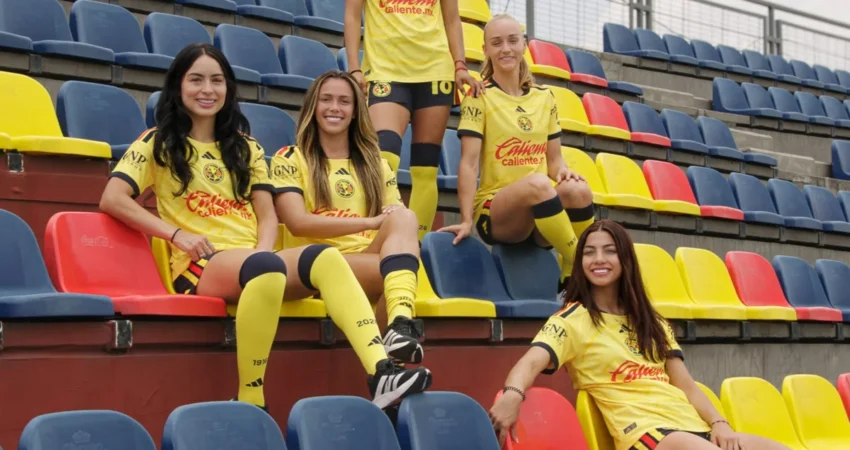
In a definitive display of athletic dominance and strategic execution, Club América Femenil etched its name into the annals of sporting history on May 17, 2026, by securing a historic treble that underscores the rapid professionalization of women’s football in Mexico. Before a capacity crowd of over 26,000 spectators at the Estadio Ciudad de los Deportes, the "Águilas" orchestrated a spectacular comeback against Rayadas de Monterrey, finishing with a 3-1 victory to claim the Liga MX Femenil Clausura 2026 title. This domestic triumph served as the cornerstone of an unprecedented campaign that also saw the club capture the Concacaf W Champions Cup and the Campeón de Campeonas trophy, marking the first time a Mexican women’s side has secured all three major honors in a single semester.
The achievement represents more than just silverware; it signifies the culmination of a project that began in 2017 with the inception of the professional league. Since then, Club América Femenil has emerged as a blueprint for excellence, appearing in eight league finals and securing three championships (Apertura 2018, Clausura 2023, and Clausura 2026). The 2026 season, however, stands as the pinnacle of their institutional evolution, reflecting a shift from a nascent sports program to a high-performance global powerhouse.
A Season of Unprecedented Dominance: The Path to the Treble
The road to the 2026 treble was characterized by consistency and tactical resilience. The Clausura 2026 campaign saw the Águilas maintain a high-press offensive style that overwhelmed domestic opponents. However, the final against Monterrey tested the squad’s psychological fortitude. After falling behind early in the match, the team relied on its veteran leadership and tactical adjustments to overturn the deficit. The 3-1 scoreline at the Estadio Ciudad de los Deportes was not merely a win but a statement of intent, proving that the gap between the league’s top contenders is increasingly being defined by mental conditioning and squad depth.
Simultaneously, the club’s pursuit of the Concacaf W Champions Cup expanded its brand beyond national borders. By competing against elite teams from the United States’ NWSL and other Caribbean and Central American champions, América demonstrated that the Mexican league’s technical quality is now competitive on a continental scale. The subsequent victory in the Campeón de Campeonas—a match pitting the season’s two most successful teams against each other—solidified their status as the undisputed leaders of the current era.
The Pillars of Success: Leadership and Internal Competition
The "Águila" philosophy, often cited by the coaching staff and management, demands a level of precision and focus that few organizations can sustain. Central to this culture is Nancy Antonio López, a founding player of the league whose career trajectory mirrors the growth of the sport in Mexico. Antonio, who previously enjoyed a trophy-laden stint with Tigres UANL (the "Amazonas"), brought a wealth of experience and a stabilizing presence to the América midfield.
"Simply wearing this crest, wearing this jersey, speaks of a demand that you must meet no matter what," Antonio stated during the post-treble celebrations. She emphasized the "invisible work"—the rigorous training sessions, nutritional discipline, and recovery protocols—that remains unseen by fans but is essential for elite performance. Antonio also credited her success to a lifelong commitment to the sport, noting that her family worked collectively to ensure she could focus entirely on her professional development.
This internal culture of excellence is further bolstered by the team’s communication strategies. Management has prioritized an environment where individual differences are embraced as collective strengths. By fostering open dialogue between the coaching staff and the roster, the team has managed to integrate international stars with domestic youth prospects seamlessly.

Profiles in Excellence: The Architects of the 2026 Campaign
The diversity of the 2026 squad provides a cross-section of the modern women’s game, featuring a mix of homegrown talent and international recruitment.
The Youth Prodigy: Montserrat Saldívar
At a young age, Montserrat Saldívar has already surpassed the 100-match milestone with Club América. Having left her home at the age of 13 to pursue a professional career, Saldívar represents the new generation of Mexican players who have benefited from structured youth academies. Her resilience is rooted in a family legacy; her father played for Pioneros de Cancún, and she has translated that heritage into a high-energy playing style that has become vital to the team’s offensive transitions.
The Mathematical Strategist: Sarah Luebbert
American forward Sarah Luebbert has become a symbol of the league’s ability to attract and retain international talent. Originally arriving on loan from a Chicago-based club, Luebbert’s integration into Mexican culture was so profound that she chose to sign a permanent contract despite offers to return to the United States. Known for her "calculated" approach to the game—a trait she attributes to her passion for mathematics—Luebbert provides a clinical edge to the América attack.
The Multi-Disciplinary Athlete: Priscila Da Silva
Brazilian international Priscila Da Silva brought a unique athletic profile to the treble-winning side. With a background in athletics, handball, judo, and jiu-jitsu, Da Silva’s physicality and stamina allow the team to maintain a high-intensity press for the full 90 minutes. Her transition from the streets of Brazil to the professional pitches of Mexico highlights the global scouting network that Club América has developed to maintain its competitive edge.
The Creative Engine: Scarlett Camberos
Scarlett Camberos serves as the creative heartbeat of the squad. Her journey emphasizes that elite talent is often the result of sheer perseverance. Camberos has spoken openly about not being considered "naturally gifted" in her early years, instead relying on a rigorous routine of "school, training, sleep" to hone her skills. Her creative flair on the pitch is matched by her off-field interests in fantasy literature, a combination that she believes helps her visualize plays and break through defensive lines.
Economic and Structural Evolution: A $300 Million Market
The success of Club América Femenil is happening within a broader context of explosive commercial growth. In less than a decade, the Liga Femenil BBVA has transformed from a developmental experiment into a commercial market valued at nearly $300 million. The league currently boasts over 200 active commercial sponsors, reflecting a paradigm shift in how corporations view women’s sports.
Data from global consultancies, including Deloitte, suggests that women’s elite sports are on track to surpass the $3 billion revenue mark globally by the end of 2026. Mexico is a significant contributor to this trend. The shift is attributed to several factors:
- Broadcast Visibility: Increased investment in high-definition broadcasting and streaming rights has brought the game to a wider audience.
- Family-Centric Demographics: Stadium atmospheres in the women’s league are notably different from the men’s game, attracting families and a younger, more diverse fan base that is highly attractive to advertisers.
- Performance Parity: As investment in training facilities and coaching staff reaches parity with men’s programs, the technical quality of the matches has improved, driving higher viewership and ticket sales.
The narrative that "women’s football doesn’t sell" has been thoroughly debunked by the 26,000 fans who filled the stadium for a domestic final and the millions who tuned in for the Concacaf W Champions Cup.

Historical Context and the Road to Brazil 2027
To understand the weight of América’s 2026 treble, one must look back at the historical hurdles the sport has faced in Mexico. While the men’s professional league dates back to 1902, the women’s league was not officially established until 2017—a 115-year gap. This delay was largely rooted in cultural biases that marginalized female athletes.
However, the appetite for women’s football in Mexico has always existed. In 1971, Mexico hosted an unofficial Women’s World Cup where the national team reached the final against Denmark. That match, held at the Estadio Azteca (then referred to as Estadio Banorte for sponsorship reasons), drew a staggering 110,000 spectators. Despite this massive public interest, the governing bodies of the time refused to sanction the sport, leading to decades of stagnation.
The 2026 treble by Club América Femenil serves as a modern redemption for that lost history. Today’s players are the first generation in Mexico to live entirely off their earnings as professional footballers, enjoying access to the same medical, tactical, and nutritional resources as their male counterparts.
Broader Implications and Future Outlook
The success of Club América Femenil has significant implications for the Mexican National Team as it prepares for the FIFA Women’s World Cup in Brazil in 2027. The high-level competition provided by the Liga MX Femenil and the Concacaf W Champions Cup ensures that domestic players are battle-tested against international styles of play.
Priscila Da Silva noted that the increase in sponsorship and investment is a self-sustaining cycle: "The more investment there is, the more we grow as players, and the better the product becomes for the fans." This sentiment is echoed by the league’s leadership, which continues to push for greater integration and visibility.
As the 2026 season concludes, the focus shifts to maintaining this momentum. The treble has set a new benchmark for what is possible in North American women’s club football. For Club América, the challenge will be to sustain this "momentum of an eagle," ensuring that their 2026 achievement is not a one-time peak but the new standard for the organization. The message to fans and stakeholders is clear: the era of women’s football as a "secondary" sport is over. In Mexico, it has become a primary driver of sporting excellence, commercial value, and social change.

0 Comments