
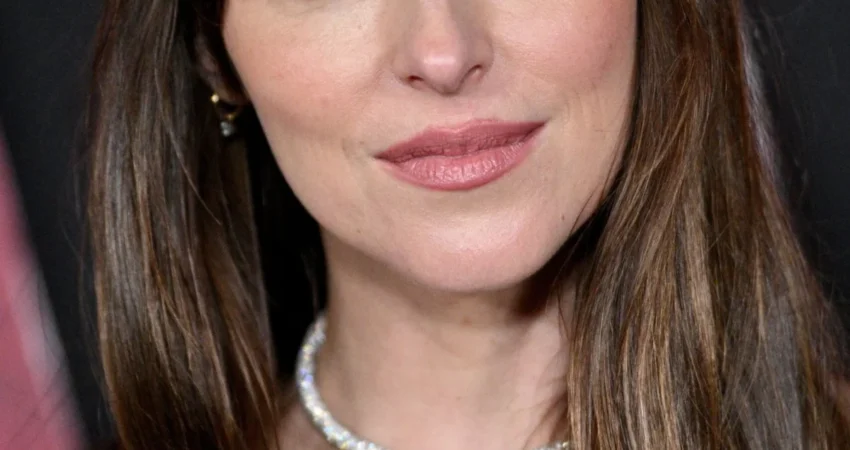
The cultural footprint of Dakota Johnson has once again expanded beyond the cinematic realm, re-establishing her as a primary architect of global beauty standards. Since her meteoric rise following the release of the Fifty Shades of Grey franchise, Johnson’s hair—specifically her signature fringe—has transitioned from a personal style choice to a permanent fixture in the lexicon of modern cosmetology. As of late 2025 and heading into the 2026 season, this aesthetic influence has reached a new zenith, driven by her high-profile performance in the film adaptation of Verity and her visually arresting appearance in the music video for "Patient Zero," a standout track from Taylor Swift’s critically acclaimed Encore edition of The Life of a Showgirl. This convergence of film, music, and fashion has solidified the "Johnson Fringe" as the definitive hair trend for the Autumn-Winter 2026 cycle, prompting a surge in salon requests and a renewed interest in the technical geometry of facial framing.
The Chronology of an Iconic Aesthetic
The journey of Dakota Johnson’s hair as a cultural phenomenon began over a decade ago. While many celebrities undergo frequent and radical transformations to maintain public interest, Johnson’s strategy has been one of refined consistency. By maintaining a versatile, face-framing fringe, she created a recognizable "brand" that stylists argue is both aspirational and accessible.
In the mid-2010s, the "Dakota Bangs" were characterized by a wispy, see-through quality that broke the severity of traditional blunt cuts. By the early 2020s, this evolved into a heavier, more structured look often paired with long, layered tresses. The current 2026 iteration, as seen in her recent media projects, represents a hybrid approach. In Verity, where she stars alongside Anne Hathaway and Josh Hartnett, her hair serves a narrative purpose, reflecting a character that is both enigmatic and grounded. Simultaneously, the "Patient Zero" music video showcases a more editorial version of the look, emphasizing texture and movement under high-contrast lighting. This visibility has forced the fashion industry to respond, with major design houses integrating variations of the fringe into their most recent runway presentations.

Runway Validation and Stylistic Divergence
The Autumn-Winter 2026 collections have provided the formal industry endorsement required to transition a celebrity trend into a global movement. While Johnson remains the muse, the runways of Paris, Milan, and New York have offered diverse interpretations that cater to varying demographics.
- The Minimalist Pixie: Houses such as Balenciaga and Chanel have pushed the boundaries of the trend by introducing the "mini-fringe." This ultra-short version is often paired with pixie cuts, offering a sharp, avant-garde alternative to the softer celebrity style.
- The Texturized Disarray: Collina Strada, Louis Vuitton, and Erdem have focused on a "deconstructed" fringe. This style prioritizes an effortless, almost messy texture that suggests a rejection of over-styling, aligning with broader cultural shifts toward "undone" luxury.
- The Y2K Revival: McQueen and Christian Dior have looked to the early 2000s, reintroducing the side-swept fringe. This nostalgic nod serves to soften the face and provides an option for those unwilling to commit to a full forehead-covering cut.
- The French Girl Classic: Chloé and Eckhaus Latta have leaned into the "Birkin Bangs" heritage. This version is long, heavy, and slightly parted in the center, evoking the effortless chic of 1970s icons like Jane Birkin and Françoise Hardy.
- The Shag Resurgence: Simone Rocha and Valentino have integrated the fringe into the "shag" or "wolf cut" silhouette. Inspired by 1970s figures such as Jane Fonda and Linda McCartney, this style uses heavy layering to create volume and a rebellious, rock-and-roll edge.
The Mathematical Approach: The "Rule of Three"
As the fringe returns to the forefront of fashion, the beauty industry has popularized a more scientific approach to determining suitability. The "Rule of Three," or the "Three-Finger Rule," has migrated from professional styling academies to viral social media platforms, providing a quantitative framework for potential hair changes. This method relies on facial proportions to generate a three-digit code that indicates whether a fringe will harmonize with the individual’s features.
The first metric involves measuring the forehead’s vertical height: three fingers width results in a "1," four fingers in a "2," and five fingers in a "3." The second metric identifies the widest part of the face: the forehead (1), the cheekbones (2), or the jawline (3). The final metric compares the distance between the eyebrows to the width of a single eye: a wider gap results in a "1," while a narrower gap results in a "2."
According to industry data and viral metrics, specific codes such as 222, 321, 312, 212, and 322 are considered "high-compatibility" profiles for a fringe. Conversely, codes like 111, 121, 221, and 231 suggest that a traditional fringe may disrupt the facial balance, and stylists might instead recommend face-framing layers or a side-swept alternative. This analytical shift marks a move away from impulsive salon decisions toward data-driven personal styling.

Facial Morphology and Structural Harmony
Beyond mathematical formulas, professional stylists emphasize the importance of facial shape in selecting the correct variation of the Dakota Johnson look. Johnson herself possesses an oval face, which is widely regarded in the industry as the most versatile canvas for hair design. However, the 2026 trend is inclusive of all morphologies, provided the cut is adjusted accordingly.
For individuals with round faces, the objective is to create the illusion of length. Stylists recommend a lateral, thinned-out, or center-parted fringe to break the circularity of the face. For square faces, characterized by a strong jawline, a long, layered "curtain" fringe is preferred to soften the angles. Those with elongated or rectangular faces benefit the most from a thick, straight-across fringe, which effectively "shortens" the face and creates a more balanced, horizontal focus. Finally, heart-shaped or inverted triangle faces are best served by wispy, side-swept bangs that minimize the width of the forehead while drawing attention to the eyes and cheekbones.
Technical Considerations: Texture and Maintenance
A significant factor in the longevity of the Dakota Johnson trend is its adaptability to different hair textures. While the actress is known for her relatively straight, fine-to-medium hair, the 2026 movement has seen a rise in the "curly fringe."
Professional hair associations have issued guidance for cutting fringes on wavy or curly hair, stressing the "dry cut" method. Because curls shrink significantly as they dry, cutting them while wet often results in a fringe that is much shorter than intended. Furthermore, the presence of cowlicks—natural growth patterns that cause hair to stand up or part in specific directions—can present a challenge for the classic straight fringe.

Interestingly, Dakota Johnson has publicly disclosed that she frequently maintains and trims her own fringe. This "DIY" element has resonated with a generation of consumers who value authenticity and self-reliance. However, stylists warn that while maintenance can be done at home, the initial structural cut should always be performed by a professional to ensure the weight distribution and "shattering" of the ends are handled correctly.
Broader Economic and Industry Impact
The resurgence of the fringe has tangible implications for the global hair care market. Salon owners report a 25% increase in "fringe maintenance" appointments, a service that was previously a complimentary add-on but has now become a standalone revenue stream. Additionally, the demand for specialized styling tools—such as mini-flat irons, round brushes designed for short hair, and lightweight dry shampoos—has seen a measurable spike.
From a psychological perspective, industry analysts suggest that the return to the fringe reflects a societal desire for "structured softness." In an era of rapid technological change and social complexity, the act of framing the face provides a sense of protection and personal definition. The "Dakota Johnson effect" is not merely about hair; it is about the projection of a persona that is at once vulnerable and composed.
As we progress through the Autumn-Winter 2026 season, the fringe remains more than a fleeting fad. It is a sophisticated interplay of celebrity influence, runway validation, and mathematical precision. Whether through a high-fashion "mini-pixie" or a classic "Birkin" part, the message from the world’s style capitals is clear: the fringe has returned, and it is more analytical, diverse, and influential than ever before. For those considering the change, the tools—from the "Rule of Three" to digital simulators—are now in place to ensure that the transition from inspiration to reality is as seamless as the iconic look itself.

0 Comments