
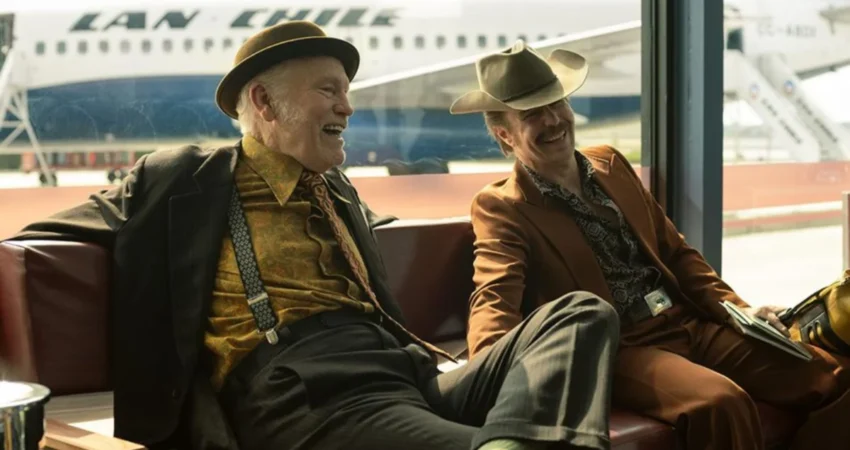
The 83rd Venice International Film Festival has once again served as the launchpad for a significant cinematic milestone as Martin McDonagh’s latest feature, Wild Horse Nine, premiered to a rapturous reception at the Palazzo del Cinema. On the evening of September 3, 2026, the film—a sharp-witted dark comedy centered on the intersection of American espionage and Chilean history—solidified its status as a frontrunner for the Golden Lion. Reports from the Lido indicate that the screening concluded with a standing ovation lasting between 13 and 14 minutes, a testament to the visceral impact of McDonagh’s storytelling and the high-caliber performances of its ensemble cast. Early critical assessments have been overwhelmingly positive, with the film debuting at a 90% approval rating on the review aggregator Rotten Tomatoes, signaling another critical triumph for the British-Irish director.
Wild Horse Nine marks McDonagh’s return to the Venice competition, a venue where he has previously enjoyed immense success. In 2017, his film Three Billboards Outside Ebbing, Missouri won the Best Screenplay award, and in 2022, The Banshees of Inisherin secured the same accolade while also earning Colin Farrell the Coppa Volpi for Best Actor. With Wild Horse Nine, McDonagh continues his exploration of human frailty, regret, and the absurdity of violence, this time shifting his lens toward the geopolitical complexities of the 1970s and the moral decay inherent in state-sponsored interventionism.
Narrative Framework and Historical Context
Set in the early 1970s, Wild Horse Nine follows two CIA agents, Chris (John Malkovich) and Lee (Sam Rockwell), who are dispatched to Easter Island (Rapa Nui) in the months leading up to the 1973 Chilean coup d’état. While the film utilizes the director’s trademark dark humor, it is grounded in a somber historical reality: the covert involvement of the United States government in destabilizing the socialist administration of Salvador Allende. The plot centers on the agents’ attempt to balance their clandestine mission with their deteriorating personal lives, all while the "wear and tear" of time begins to erode their professional resolve.
The choice of Easter Island as a primary location provides a stark, isolated backdrop that mirrors the psychological isolation of the protagonists. As the political climate in mainland Chile nears a boiling point, the agents find themselves caught between the rigid requirements of the agency and their own burgeoning existential crises. The film navigates the tension of a hostile political environment that is about to escalate into one of the darkest chapters of South American history, using the microcosm of the agents’ partnership to reflect the broader macrocosm of international interference.
A Cast of Existential Conflict
The success of Wild Horse Nine is heavily attributed to its powerhouse cast, many of whom are long-time collaborators with McDonagh. Sam Rockwell, who previously won an Academy Award for his role in Three Billboards, portrays Lee, an operative whose commitment to the mission begins to falter. Lee is depicted as a man questioning the ultimate purpose of his presence in Chile as his domestic life, represented by his estranged partner Marge (Parker Posey), crumbles from a distance. Rockwell’s performance has been described by critics as a masterclass in portraying "quiet desperation masked by bureaucratic cynicism."

Opposite Rockwell is John Malkovich as Chris, the elder of the two agents. Chris represents the physical and mental toll of a lifetime spent in the shadows. His character arc focuses on the arrival of old age and the fear that his legacy will be defined by actions he no longer believes in. Malkovich’s portrayal brings a gravitas to the film’s themes of guilt and the search for redemption. Steve Buscemi rounds out the American leadership as MJ, the agents’ handler and the personification of the institutional coldness of the CIA. Buscemi’s role serves as the narrative’s anchor to the "establishment," providing the authoritative pressure that drives the protagonists toward their eventual breaking points.
A significant highlight of the production is the inclusion of Chilean actress Mariana Di Girolamo, who plays a left-wing student with socialist ideals. Her character becomes an unexpected foil to the American agents, fostering an unlikely friendship that challenges their ideological convictions. Di Girolamo, known for her acclaimed work in Ema and Los Casablanca, has been hailed as one of the most vital Latin American voices in contemporary cinema. Her presence in Wild Horse Nine ensures that the Chilean perspective remains central to the narrative, preventing the film from becoming a purely Western-centric view of the conflict.
Director’s Vision and Political Resonance
In statements following the premiere, Martin McDonagh elaborated on the motivations behind the project. Speaking with Reuters, the director revealed that the concept for Wild Horse Nine was born from a long-standing interest in the history of U.S. covert operations abroad. McDonagh noted that while the film is a period piece, its themes are intentionally aligned with the contemporary global political landscape of 2026.
"It is almost the perfect time for a film like this to be released," McDonagh stated, "because it points out that these things have been happening through the CIA or the more perverse U.S. governments for quite a long time." The director’s comments come at a time of heightened discourse regarding modern American interventionism, particularly in relation to recent U.S. policy shifts toward Mexico and the ongoing political volatility in Venezuela. By revisiting the 1973 coup, McDonagh seeks to open a broader conversation about the cyclical nature of geopolitical influence and the enduring "open wounds" left by such interventions.
The film does not treat the events in Chile as an isolated historical curiosity but as a framework to explore the universal themes of accountability and the moral weight of one’s actions. The interplay between the absurdity of the agents’ daily lives and the gravity of the impending coup creates a narrative tension that is hallmark McDonagh, forcing the audience to oscillate between laughter and profound discomfort.
Production and Global Release Schedule
Wild Horse Nine is produced by Graham Broadbent and Pete Czernin of Blueprint Pictures, the same team behind McDonagh’s previous successes. The film’s technical execution has been praised for its evocative 1970s aesthetic, capturing the grain and color palette of the era without descending into nostalgia. The ensemble cast is further bolstered by appearances from Tom Waits, Ailín Salas, Samuel Wayt, Paola Giannini, and Morgan Grace Champ, creating a rich tapestry of characters that populate the high-stakes world of the film.

Following its debut at the Venice Film Festival, Wild Horse Nine is scheduled to continue its run through the fall festival circuit, with high expectations for its appearance at the Toronto International Film Festival (TIFF). The global theatrical release is set for November 6, 2026. Industry analysts predict that the film will be a major contender during the 2027 awards season, particularly in the categories of Best Original Screenplay, Best Director, and various acting categories for Rockwell, Malkovich, and Di Girolamo.
Broader Impact on the Cinematic Landscape
The reception of Wild Horse Nine underscores a growing appetite for "prestige" cinema that tackles complex political and historical themes through the lens of genre-blending narratives. By combining the tropes of the spy thriller with the sensibilities of a dark comedy and a character study on aging, McDonagh has created a work that resonates on multiple levels.
For the Chilean film industry and its actors, the film represents a high-profile platform to revisit national history. Mariana Di Girolamo emphasized the importance of this dialogue, stating to the press, "I think it is important to keep talking about it so as not to forget. For us Chileans, I think it is still an open wound; for us, it is something we grew up with and it is good to keep talking about it."
As the Venice Film Festival concludes its 2026 edition, Wild Horse Nine stands as a definitive highlight, confirming Martin McDonagh’s status as one of the most provocative and consistent filmmakers of his generation. The film’s ability to bridge the gap between historical critique and humanistic drama suggests it will remain a point of discussion long after its theatrical run concludes. With a 90% critical rating and a powerful debut on the world stage, the road to the 99th Academy Awards seems well-paved for this exploration of shadows, secrets, and the inevitable passage of time.

0 Comments