
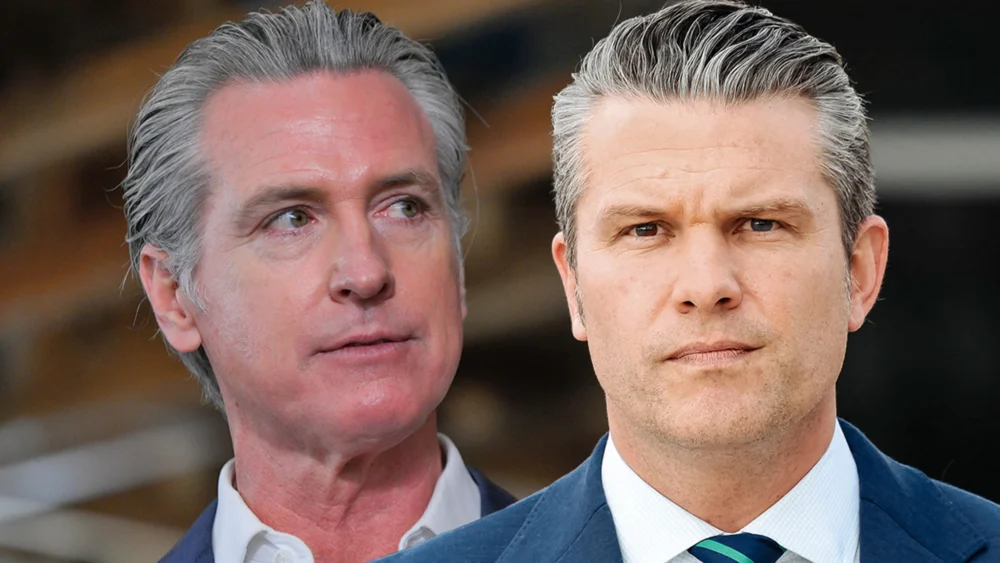
California Governor Gavin Newsom has launched a scathing critique against Pete Hegseth, the Secretary of the Department of War, accusing his department of an unprecedented $93 billion taxpayer-funded spending spree on luxury food items and other extravagant purchases during the final month of the fiscal year 2025. The allegations, brought to light by the government watchdog group Open the Books, have ignited a fierce political debate, with Newsom, a prospective 2028 Democratic presidential candidate, leveraging the controversy to highlight perceived fiscal irresponsibility at the highest levels of government.
The Allegations Unveiled: A Deep Dive into Department of War Spending
The core of the controversy centers on the Department of War’s expenditures in September 2025, the concluding month of the federal fiscal year. According to the detailed report from Open the Books, a non-profit organization dedicated to government transparency, the department engaged in bulk purchases totaling an astounding $93 billion. This figure represents the largest single-month spending surge by any federal agency since 2008, drawing immediate and widespread scrutiny.
Among the specific items highlighted in the watchdog’s report were substantial outlays on high-end culinary provisions. The Department of War reportedly allocated $6.9 million for lobster, $15.1 million for various cuts of steak, and $2 million for crab. While these sums represent only a fraction of the total $93 billion, they have become symbolic of the perceived misuse of taxpayer funds, especially given the context of a defense budget. Beyond the gourmet foodstuffs, other notable expenditures included a $98,329 Steinway & Sons grand piano, reportedly acquired for the residence of the Air Force chief of staff, further fueling public indignation over the nature of the spending. These specific purchases, though minor in the grand scheme of the $93 billion, have become potent examples in the narrative of excessive and inappropriate spending.
Gavin Newsom’s Forceful Rebuke and Political Context
Governor Newsom wasted no time in capitalizing on the Open the Books findings. On Tuesday, his press office issued a stark, all-caps declaration on the social media platform X (formerly Twitter): "HEGSETH BLOWING $93 BILLION OF TAXPAYER DOLLARS IN 1 MONTH !!" This direct and aggressive statement underscores Newsom’s intent to position himself as a champion of fiscal accountability and a critic of governmental waste.
Newsom’s attack on Secretary Hegseth is not merely a political broadside but also strategically aligns with his likely ambitions for the 2028 Democratic presidential nomination. By publicly challenging a high-profile figure in a Republican administration (assuming Hegseth’s appointment reflects a conservative administration), Newsom effectively draws a contrast between his vision of responsible governance and what he portrays as profligate spending. The Governor further amplified his criticism by referencing an AI-generated image, widely circulated by outlets like the Fort Worth Star-Telegram/TNS, depicting Hegseth lounging amidst a lavish spread of lobster tail, ribeye steak, and Alaskan king crab. This visual, though artificial, powerfully conveyed the essence of the allegations and resonated with public sentiment regarding perceived governmental excess.
Open the Books: The Watchdog’s Role and Findings
Open the Books, founded on principles of transparency and accountability, plays a crucial role in scrutinizing federal, state, and local government spending. Their methodology typically involves extensive Freedom of Information Act (FOIA) requests, meticulous data aggregation, and in-depth analysis of public financial records. For this particular investigation, the watchdog group likely delved into detailed procurement records and financial reports from the Department of War for the fiscal year 2025, specifically focusing on year-end expenditures.
Their finding that the $93 billion spending spree represented the largest bulk purchase by any federal agency since 2008 highlights a systemic issue that extends beyond the current administration or department. Previous reports from Open the Books and similar organizations have often pointed to patterns of increased spending at the close of fiscal years across various agencies, a phenomenon commonly referred to as "use it or lose it." The sheer scale of the Department of War’s spending in September 2025, however, sets a new precedent for concern, suggesting either a significant acceleration of this trend or an extraordinary allocation of funds for questionable purposes. The organization’s mission is to empower citizens with data to hold their government accountable, and this report serves as a prime example of their efforts to bring hidden expenditures into the public domain.
The "Use It or Lose It" Phenomenon: Fiscal Year-End Spending
The practice of aggressive spending at the end of the fiscal year is a well-documented phenomenon within government agencies, driven by the "use it or lose it" mentality. Federal agencies operate on annual budgets, and any unspent funds by the end of the fiscal year (September 30th) are typically returned to the Treasury. Crucially, agencies often fear that returning unspent funds will signal to appropriators that they requested more money than they needed, potentially leading to budget cuts in subsequent years.
This incentive structure often compels departments to spend their remaining allocations rapidly and sometimes indiscriminately in the final weeks or months of the fiscal year. While some of this spending may be legitimate and necessary, critics argue that it frequently leads to wasteful or non-essential purchases, as departments prioritize exhausting their budget over optimizing expenditures. The Department of War’s $93 billion surge in September 2025 appears to be a stark manifestation of this pattern, albeit on an exceptionally large scale. While the bulk of the $93 billion would likely be attributed to critical defense procurements, infrastructure projects, or operational necessities, the inclusion of luxury food items and a high-end musical instrument within this final-month push raises serious questions about the prudence and prioritization of these expenditures.

Department of War’s Silence Amidst Growing Scrutiny
As of the latest reports, the Department of War has offered no official comment regarding the allegations. Requests for clarification and response from the department have so far gone unanswered. This silence, while not uncommon in the initial stages of such controversies, is likely to intensify public and political pressure for an explanation.
Historically, federal agencies facing similar accusations of questionable spending often resort to a few common lines of defense. They might argue that the expenditures, even seemingly lavish ones, are justified under broad categories such as "troop morale," "diplomatic engagement," "essential operational support," or "classified strategic initiatives." For instance, high-quality food might be procured for official functions with foreign dignitaries, or to boost morale in specific units. A grand piano, while appearing frivolous, could be justified as an asset for a military band, for official entertainment, or even as part of a diplomatic residence’s furnishings. However, the sheer volume and cost associated with the reported food purchases, specifically luxury items like lobster, steak, and crab, make these standard justifications difficult to sustain without detailed, transparent breakdowns of how and where these items were consumed. The lack of an immediate response from Secretary Hegseth’s office or the Department of War only compounds the perception of potential impropriety, leaving a vacuum that critics like Governor Newsom are eager to fill.
Congressional and Public Reactions: Calls for Accountability
The revelations by Open the Books and Governor Newsom’s subsequent condemnation are expected to trigger significant reactions across the political spectrum. On Capitol Hill, congressional oversight committees, particularly those focused on appropriations, armed services, and government operations, are anticipated to launch investigations. Members of Congress from both parties, keen to demonstrate fiscal responsibility to their constituents, are likely to call for hearings, demand detailed expenditure reports from the Department of War, and scrutinize procurement processes.
Public reaction is also likely to be swift and largely negative. In an era where economic anxieties persist and public trust in government institutions is often fragile, reports of lavish spending by a federal agency, especially one tasked with national defense, tend to provoke outrage. Taxpayer advocacy groups and grassroots organizations are expected to join the chorus of calls for accountability, demanding transparency, internal audits, and potentially disciplinary actions against officials responsible for what is being characterized as wasteful spending. Social media platforms are already abuzz with discussions, with many expressing frustration over how their tax dollars are purportedly being mismanaged.
Historical Precedents and Defense Budget Oversight
The controversy surrounding the Department of War’s spending is not an isolated incident but rather fits into a long-standing pattern of scrutiny over defense budgets. For decades, the Pentagon (the real-world equivalent of the Department of War) has faced accusations of waste, fraud, and abuse, ranging from exorbitant prices for spare parts (e.g., $600 toilet seats) to inefficiencies in large-scale procurement programs. Oversight bodies, both internal and external, consistently highlight challenges in managing the vast sums allocated to defense, citing issues with contract management, lack of transparency, and the inherent complexities of military logistics.
The "use it or lose it" phenomenon, while not unique to defense, often manifests dramatically within the Department of War due to the sheer size of its budget. Past instances of year-end spending sprees have included rushed purchases of office furniture, vehicles, and even seemingly unnecessary equipment, all driven by the imperative to exhaust allocated funds. This recurring pattern underscores the systemic challenges in federal budgeting and the difficulty of implementing effective controls against waste without hindering essential government operations. The current allegations against Secretary Hegseth’s department serve as a potent reminder of these persistent issues and the ongoing need for robust oversight mechanisms.
Implications for Future Policy and Political Landscape
The Department of War’s alleged $93 billion spending spree carries significant implications for both future policy and the broader political landscape.
For Policy: This incident is likely to reignite congressional debate on federal budgeting practices, particularly the "use it or lose it" phenomenon. There could be renewed calls for reforms to appropriations processes, potentially leading to proposals for more flexible budget carry-over provisions or stricter controls on year-end spending. It may also prompt a deeper dive into defense procurement policies, with an emphasis on transparency, competitive bidding, and stricter definitions of what constitutes "essential" versus "discretionary" spending within a defense context. The Government Accountability Office (GAO) or the Inspector General’s office within the Department of War could initiate comprehensive audits, leading to recommendations for systemic changes.
For the Political Landscape:
- Gavin Newsom: The incident offers Newsom a powerful narrative to contrast himself with political opponents, portraying him as a fiscally responsible leader committed to taxpayer protection. This could significantly boost his profile as a serious contender for the 2028 presidential election, particularly among voters concerned about government spending.
- Pete Hegseth and the Department of War: Secretary Hegseth faces substantial reputational damage. The allegations could undermine public trust in his leadership and the department’s financial stewardship. Depending on the outcome of potential investigations, there could be calls for his resignation or even impeachment proceedings. The controversy could also cast a shadow over the administration he serves, feeding into broader criticisms about governmental efficiency and accountability.
- Public Trust: Ultimately, incidents like these erode public trust in government. When taxpayers see vast sums allegedly spent on luxuries while facing economic pressures, it fosters cynicism about the effectiveness and integrity of their elected officials and appointed leaders. Rebuilding this trust requires not only thorough investigations but also tangible reforms that demonstrate a commitment to responsible fiscal management.
As the story continues to unfold, the focus will remain on the Department of War’s eventual response, the scope of any official investigations, and the long-term ramifications for federal spending policies and the political careers of those involved. The allegations, though centered on a specific period and department, resonate with broader concerns about governmental accountability and the prudent use of public funds.

0 Comments