
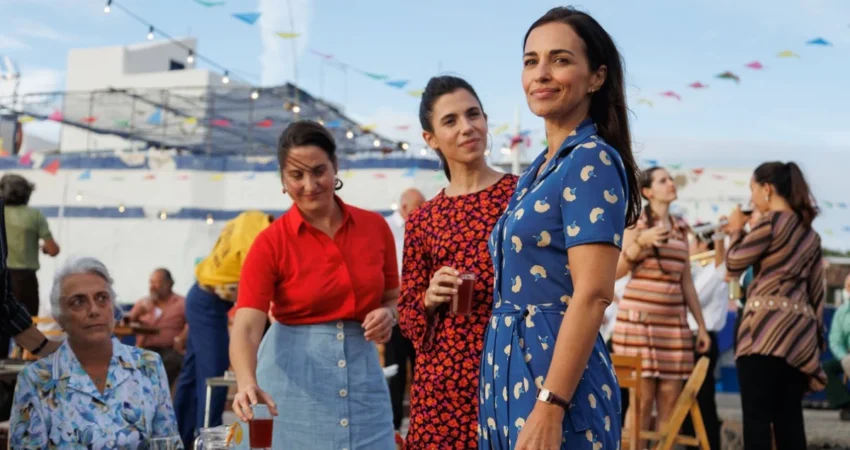
Atresmedia’s highly anticipated new series, "A la Deriva," is set to premiere exclusively on the streaming platform atresplayer this Sunday, September 20th. The ten-episode drama, each running approximately 50 minutes, plunges viewers into the turbulent 1970s in a picturesque fishing village, where the reappearance of sailors presumed lost at sea two years prior shatters the fragile peace. Starring Paula Echevarría, Daniel Grao, and Michel Noher, the series promises a compelling narrative that delves into the complex emotional and social ramifications of unexpected resurrections.
The series’ potent premise is rooted in the fictional coastal town of Bastuel in 1970. The community is still grappling with the profound grief and uncertainty following the shipwreck of the "Minerva," a vessel owned by the influential Parrado family. The tragic incident, which occurred during a fierce storm, resulted in the presumed loss of all hands. Crucially, no bodies were ever recovered, leaving the families of the missing sailors in a devastating legal and emotional limbo. Without official confirmation of death, the women were denied the status of widows, unable to formally mourn their lost loved ones or legally move forward with their lives. This administrative void translated into an agonizing emotional paralysis, trapping them in a state of perpetual suspense.
At the heart of "A la Deriva" is Lucía, portrayed by Paula Echevarría. Lucía is the wife of Héctor Parrado, the captain of the ill-fated "Minerva." Following her husband’s disappearance, Lucía managed to navigate the immense challenges, achieving what seemed impossible: she began to rebuild her life. Taking the reins of the family’s fishing fleet alongside her mother-in-law, Dolores, with whom she shares a strained relationship, Lucía found solace and love in Tristán, an old friend of Héctor’s, played by Michel Noher. Their tentative happiness, however, is about to be irrevocably disrupted.
The narrative pivots dramatically on the eve of the Virgen del Carmen festival, when news sweeps through Bastuel like a tidal wave: five of the missing crew members have been found alive. The town erupts in a mixture of disbelief and overwhelming joy, viewing the return as nothing short of a miracle.
However, this collective elation is not universally shared. For Lucía, the reappearance of Héctor, her husband, represents not a miracle but a profound personal crisis. The series quickly shifts gears from a story of reunion to a darker exploration of psychological and emotional turmoil. Héctor is depicted as a violent man, and his return forces Lucía to confront the reality of her liberation being stripped away.
Daniel Grao embodies Héctor, whose presence is a source of both relief and dread. The series makes it clear that Lucía’s central conflict is not simply choosing between two men, but rather confronting the return of a man from whom she had already managed to escape. This nuanced portrayal moves "A la Deriva" beyond typical melodrama, positioning it as a gripping character study and a commentary on the complex dynamics of abusive relationships and the long shadow they cast.

The series is designed as an ensemble piece, giving significant weight to the stories of several women in the town, each grappling with their own losses and the ripple effects of the sailors’ return. Maca lost her husband Vicente just days after their wedding. Rosa saw both of her sons disappear. Berta lost her father, and Paloma, her fiancé. These women, united by a shared experience of profound grief, forged a powerful friendship born from mutual understanding. The return of the presumed dead forces them to confront unresolved traumas and the potentially devastating consequences of reopening old wounds. This collective narrative amplifies the themes of resilience, community, and the enduring impact of loss on a small, interconnected society.
The supporting cast is a testament to the series’ ambitious scope. Adelfa Calvo, Lola Casamayor, Natalia Huarte, Lucía Guerrero, Silvia Alonso, Roberto Enríquez, Amparo Fernández, David Castillo, Llorenç González, Albert Baró, Camila Viyuela, Richard Holmes, and Mariam Hernández are among the notable actors who round out the ensemble, bringing depth and authenticity to the diverse characters of Bastuel. Their performances are expected to further enrich the intricate tapestry of the narrative.
"A la Deriva" was filmed across the picturesque landscapes of the Canary Islands and Madrid, leveraging these distinct locations to visually capture the period setting and the emotional atmosphere of the story. The writing team behind the series includes Susana López Rubio, Javier Holgado, and Juan Beiro, who have crafted a narrative that balances historical context with compelling personal drama. The directorial vision is shared among Humberto Miró, Menna Fité, and David Montoya, ensuring a cohesive and impactful visual storytelling approach. The production is a collaborative effort between Boomerang TV and Buendía Estudios Canarias, with the participation of Atresmedia, underscoring the network’s commitment to high-quality Spanish drama.
Following its premiere on atresplayer this Sunday, "A la Deriva" will release a new episode weekly on the platform. A broadcast on Antena 3’s primetime schedule is also planned for a later date, extending its reach to a wider audience.
The launch of "A la Deriva" comes at a significant moment for atresplayer, which has experienced a record-breaking season. The platform has attracted 24 million viewers throughout the year and boasts over 760,000 subscribers. This sustained growth has been fueled by a diverse catalog of successful titles, including "Mar Afuera," "La Nena," "33 Días," and "Las Hijas de la Criada," all of which have contributed to the platform’s expanding appeal and its position as a leading destination for Spanish content. The addition of "A la Deriva," a period drama with a potent emotional core, further strengthens atresplayer’s offering.
The true essence of "A la Deriva," however, is perhaps best encapsulated not by the official synopsis but by a telling detail from the first episode’s description: Lucía is the only person in Bastuel who does not celebrate the return of the shipwrecked sailors. This single sentence powerfully conveys the series’ thematic ambition. It signals that "A la Deriva" is not merely a story about a miraculous survival but rather an incisive examination of what unfolds when such a miracle becomes an individual’s worst nightmare. The series aims to explore the darker implications of hope deferred and the profound psychological impact of escaping a traumatic past only to have it violently reassert itself. This nuanced approach promises a thought-provoking and emotionally resonant viewing experience that delves into the complexities of human relationships, trauma, and the often-unseen consequences of apparent good fortune.

0 Comments