
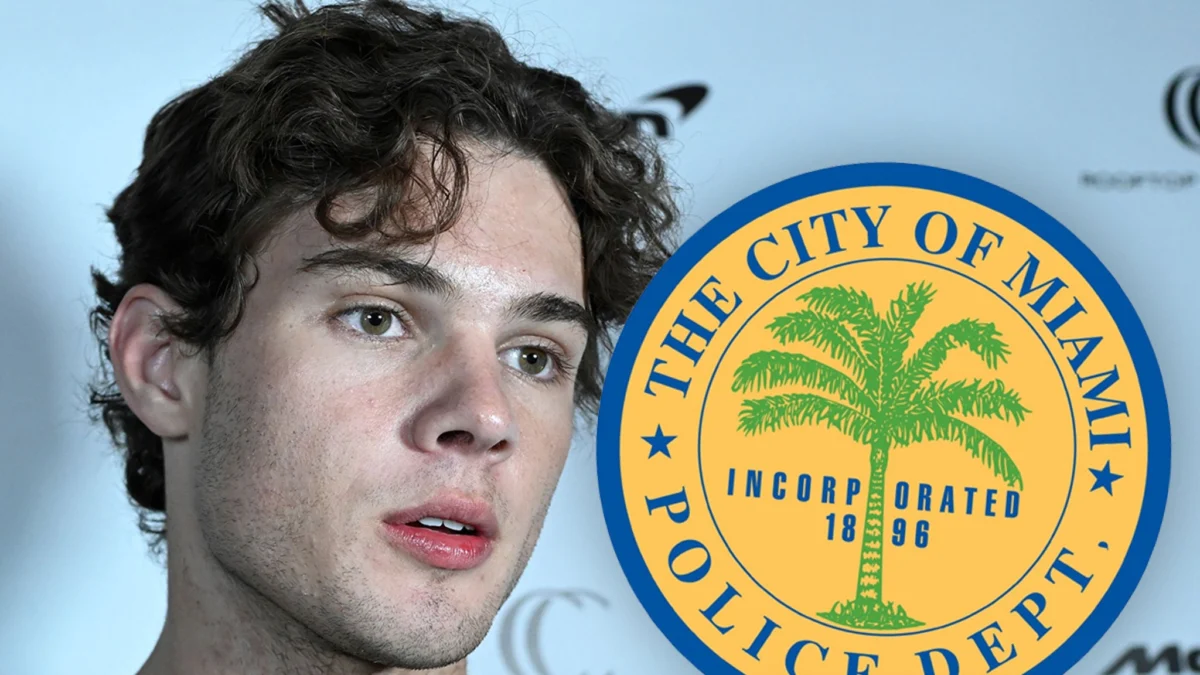
A night out in Miami took a dramatic turn for internet personality Clavicular, whose real name is Braden Peters, when he was allegedly slammed to the ground and choked by two men claiming to be performing a "citizen’s arrest" outside a prominent nightlife venue on Friday night. The intense altercation, which unfolded in a parking lot adjacent to Miami’s City Hall, was captured on video and quickly disseminated across social media platforms, sparking widespread debate about the boundaries of private security, the legality of citizen’s arrests, and the conduct of public figures.
The Incident Unfolds: A Videoed Confrontation
The widely circulated video footage depicts Braden Peters, known online as Clavicular, being forcibly restrained by two individuals identified as private security personnel from a club he and his associate, Drago, had reportedly just exited. According to initial reports and eyewitness accounts, the confrontation began after Clavicular was involved in several altercations with patrons inside the establishment. The security detail allegedly pursued Peters and Drago in their vehicle, apprehending them in a nearby parking lot.
The video shows Clavicular pinned on his back on the asphalt, struggling against his two assailants. At one point, he can be heard gasping for air and explicitly stating that he was having trouble breathing, indicating a chokehold or significant pressure applied to his neck. His close friend, Drago, is seen engaging in a verbal and minor physical skirmish with the second alleged security guard, reportedly taunting him about his appearance. The raw, unedited nature of the footage provides a stark visual account of the intensity of the incident, with the sounds of struggle and verbal exchanges clearly audible.
The immediate aftermath saw the arrival of Miami Police Department officers. The scene was chaotic, with both Clavicular and the men who had restrained him attempting to convey their versions of events to the responding officers. While the specifics of their statements are not entirely discernible from the video, it appears that no immediate arrests were made on the scene. A check of the Miami-Dade jail records for Clavicular (Braden Peters) did not yield any inmate information following the incident.
Legal Ambiguities of a "Citizen’s Arrest"
The concept of a "citizen’s arrest" is a legal provision that permits a private person to apprehend another individual without a warrant under specific circumstances. In Florida, as in many U.S. states, a private citizen may make an arrest if they witness a felony being committed or if a felony has actually been committed and they have probable cause to believe the person being arrested committed it. Some jurisdictions also extend this to certain misdemeanors committed in their presence. However, the legal framework is complex and fraught with potential liabilities.
A crucial distinction lies in the use of force. While a citizen may use reasonable force necessary to effect an arrest, excessive force can lead to civil lawsuits for assault and battery, and even criminal charges. The individual making the arrest also assumes the risk that their actions are legally justified; if the person being arrested did not, in fact, commit an arrestable offense, the "citizen’s arrest" becomes an unlawful detention, potentially exposing the arrester to legal repercussions. The claim by the security personnel that they were performing a "citizen’s arrest" immediately raises questions about the nature of the alleged offense Clavicular committed, whether it met the legal threshold for such an arrest, and if the force used was indeed "reasonable." Legal experts often advise against citizen’s arrests due to the inherent risks and complexities, recommending instead that individuals report incidents to law enforcement.
Clavicular’s Past Encounters with the Law
This incident is not Clavicular’s first brush with public controversy or law enforcement. Just four months prior, in March 2026, he was arrested and charged with misdemeanor battery. That incident, also widely publicized, alleged that Clavicular instigated a physical altercation between a 19-year-old woman and his then-24-year-old girlfriend, Violet Lentz. While sources close to the influencer at the time disputed the narrative, claiming he did not instigate the fight, the arrest nonetheless cast a shadow over his public image.
These repeated incidents highlight a pattern of involvement in public altercations, raising concerns among his followers and the broader public. As a "looksmaxer" and influencer, Clavicular cultivates a persona that often involves controversial takes and a strong online presence. However, the transition from online persona to real-world physical confrontations presents a different set of challenges and public scrutiny. The cumulative effect of these incidents could significantly impact his brand and professional opportunities, particularly as sponsors and platforms become increasingly sensitive to the conduct of their affiliated personalities.
Social Media’s Role in Public Scrutiny
The proliferation of smartphones and social media has transformed how public incidents are documented and consumed. In this instance, the rapid sharing of the video footage ensured that the alleged citizen’s arrest became an immediate trending topic. The unvarnished nature of the video provided a raw, unfiltered look at the event, circumventing traditional media gatekeepers and allowing the public to form immediate opinions.
Clavicular himself took to X (formerly Twitter) the morning after the incident, not to express remorse or provide a detailed account, but to seemingly make light of the situation. He quoted a video shared by Drago, his companion during the incident, writing, "Drago is my right hand man, absolute legend. W Drago." This response, while characteristic of some internet personalities who lean into controversy, has been met with mixed reactions. Some followers applauded his defiance, while others criticized what they perceived as a lack of seriousness regarding a potentially dangerous situation. Drago’s own video, reportedly making fun of the ordeal, further contributed to the narrative of the incident being treated with levity by those directly involved. This immediate digital response underscores the unique challenges public figures face in the age of viral content, where every action and reaction is scrutinized in real-time.
Law Enforcement’s Response and Ongoing Investigation
Upon arrival, Miami police officers were faced with conflicting accounts from all parties involved. Standard procedure in such situations involves separating the individuals, taking statements, and assessing the physical evidence, including any injuries. Given that no arrests were made on the scene, it suggests that officers either determined there was insufficient probable cause to arrest any single party for a crime at that moment, or they opted to conduct a more thorough investigation before making any decisions.
TMZ, the original publisher of the report, indicated they had reached out to Miami police for more information but had not yet received a response. This typical journalistic step is crucial for obtaining official confirmation of details, charges, or the status of any ongoing investigation. Law enforcement agencies usually conduct a review of all available evidence, including video footage, witness statements, and any potential surveillance from the club or surrounding areas, before determining if charges will be filed against any individual, including Clavicular or the security personnel involved in the alleged citizen’s arrest. The absence of an immediate arrest does not preclude future charges, as investigations can take time to develop.
Reactions from Involved Parties and Experts
While official statements from Miami police are pending, and club management has yet to comment publicly, various inferred reactions can be anticipated. Miami Police would likely issue a statement confirming they responded to an incident and that an investigation is underway, emphasizing their commitment to a fair and thorough review of all facts. They might also remind the public about the legal intricacies and dangers of citizen’s arrests.
From the perspective of the nightlife establishment, a formal statement might address their commitment to patron safety and the conduct of their security staff, potentially indicating an internal review of the incident. However, given the legal implications, they might opt for a more guarded response or none at all.
Legal experts, when commenting on such incidents in general terms, often highlight the significant legal risks associated with citizen’s arrests for both the person attempting the arrest and the person being detained. They would likely emphasize the importance of calling law enforcement rather than taking matters into one’s own hands, especially when it involves physical force. Concerns about potential civil lawsuits for false imprisonment, assault, or battery are paramount, alongside the possibility of criminal charges if excessive force is deemed to have been used.
Public reaction has been diverse, reflecting the polarizing nature of online personalities and the varying interpretations of the video. Some viewers express outrage over the alleged use of excessive force by the security personnel, advocating for justice for Clavicular. Others point to Clavicular’s history of altercations, suggesting his own conduct may have contributed to the situation. The incident has certainly reignited discussions about accountability for public figures and the responsibilities of private security in public spaces.
Broader Implications for Public Figures and Nightlife Security
The incident involving Clavicular raises significant questions for the entertainment and influencer industries. For public figures whose livelihood depends on their image and online presence, involvement in physical altercations, particularly those that go viral, can have severe repercussions. Endorsement deals, sponsorships, and even platform partnerships can be jeopardized. The expectation of professional conduct extends beyond their curated online content, into their personal lives, especially when those lives are thrust into the public eye through candid video.
For private security firms and nightlife establishments, the incident serves as a stark reminder of the legal and ethical tightrope they walk. While tasked with maintaining order and ensuring safety, their actions are subject to intense scrutiny, particularly when force is used. The line between reasonable crowd control and excessive force is fine, and missteps can lead to significant legal liabilities, damage to reputation, and potential regulatory action. The increasing prevalence of private security acting in roles that sometimes blur with law enforcement functions necessitates clearer guidelines, rigorous training, and robust oversight to prevent abuses of authority and ensure public trust.
The Evolving Landscape of Digital Documentation and Accountability
This incident is another example of how ubiquitous smartphone cameras and instant global communication through social media are fundamentally changing the landscape of accountability. Every public interaction, particularly involving public figures or controversial circumstances, now carries the potential to become a viral sensation. This constant state of being "on camera" places immense pressure on individuals and organizations to maintain impeccable conduct, as any misstep can be documented, shared, and scrutinized by millions within minutes.
For law enforcement, the availability of such footage can be a double-edged sword. While it provides valuable evidence for investigations, it also creates immediate public pressure and can lead to premature judgments before all facts are established. The challenge for justice systems is to integrate this digital evidence responsibly, ensuring that investigations remain thorough and impartial, irrespective of the viral narrative.
As the Miami Police Department continues its investigation into the events of Friday night, the incident involving Clavicular will likely serve as a case study for the complexities of public conduct, legal boundaries, and the pervasive influence of social media in contemporary society. The outcomes, whether in the form of charges, civil litigation, or shifts in public perception, will undoubtedly shape future discussions around the responsibilities of influencers, the authority of private security, and the evolving nature of public accountability.

0 Comments