
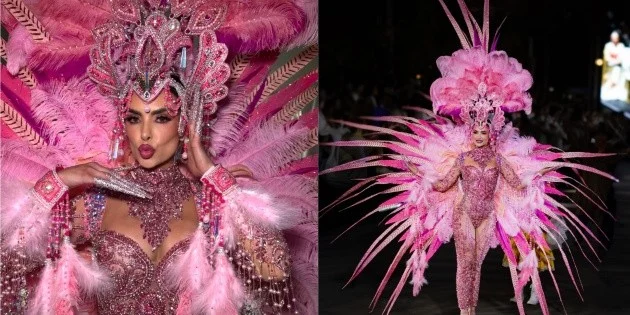
The "Cosmos Wixárika" national costume, a creation by Jalisciense designer Joel García, is poised to represent Mexico at the prestigious Miss Universe 2026 pageant, to be worn by María Vargas, also from Jalisco. This elaborate piece secured a decisive victory in the national costume competition held in Los Cabos, marking a significant "double victory" for the state of Jalisco, which will also send its reigning queen to the international stage. However, the triumph was swiftly followed by an intense digital debate, centered on the complex interplay of cultural representation, artistic interpretation, and the visual elements incorporated into the design.
The journey of the "Cosmos Wixárika" began with months of meticulous labor by Joel García, a designer whose roots are firmly planted in Jalisco. His declared objective was ambitious: to encapsulate the rich cosmovision of the indigenous peoples of his region, specifically the Wixárika (Huichol) community, while simultaneously navigating the aesthetic demands of a global beauty pageant. This delicate balance, seeking to honor ancestral traditions within the framework of contemporary fashion, has become the focal point of both admiration and scrutiny.
On August 26, the "Cosmos Wixárika" made its impactful debut on the national stage. Its distinctive visual narrative distinguished it among five formidable finalists, which included designs representing the diverse cultural tapestries of Michoacán, Coahuila, Zacatecas, and Sinaloa. The discerning panel of judges ultimately awarded first place to García’s creation, thereby cementing its passage to the international arena. This victory not only celebrated García’s craftsmanship but also underscored Jalisco’s prominent role in Mexican pageantry, further amplified by María Vargas’s own triumph as Miss Universe Mexico 2026.
The Genesis of Inspiration: Weaving Wixárika Cosmovision
The costume’s evocative name, "Cosmos Wixárika," directly references the Wixárika people, an indigenous group whose historical territories span the states of Jalisco, Nayarit, Durango, and Zacatecas. Their culture is renowned for its profound spiritual connection to nature and a vibrant artistic tradition expressed through intricate yarn paintings, beadwork, and ceremonial objects. The traditional iconography of the Wixárika is deeply symbolic, featuring sacred elements such as the deer (a spiritual guide and symbol of life), corn (sustenance and creation), peyote (a sacred plant central to their spiritual rituals), and the eagle (a messenger between the gods and humanity).
Central to García’s design is the tzicurri, more widely known as the "Ojo de Dios" or "God’s Eye." This geometric element, typically crafted from yarn and sticks, holds immense spiritual significance within indigenous communities across western Mexico. It is revered as a symbol of protection, vision, and a conduit to the spiritual world, often created by parents to bless their children and to offer prayers for health and well-being. The inclusion of the tzicurri in the "Cosmos Wixárika" was intended to imbue the costume with this deep spiritual resonance, connecting the wearer to ancestral wisdom and safeguarding.
The Flamingo Enigma: A Point of Contention
Despite the designer’s explicit declaration of Wixárika inspiration, the costume’s overall silhouette and specific visual attributes have sparked considerable debate among cultural commentators and the general public. The design features a prominent, fan-shaped backpiece, a striking palette dominated by shades of pink, and a distinctive headpiece that mimics a crest. These combined characteristics coalesce to form the unmistakable figure of a flamingo in flight.
This particular combination of concepts—a flamingo’s form and coloration intertwined with a design purporting to represent Wixárika cosmology—lies at the very core of the ongoing digital discussion. Users across various platforms have raised pertinent questions regarding the direct association between these visual aspects, particularly the flamingo, an avian species not commonly or traditionally linked to established Wixárika iconography, and the costume’s official designation as a tribute to the Wixárika people. While flamingos are present in certain coastal regions of Mexico, their spiritual or symbolic significance within the specific context of Wixárika traditions, which are primarily centered in mountainous and desert terrains, is not widely recognized. This perceived disconnect has fueled concerns about authenticity and the potential for cultural misrepresentation.
Joel García’s Artistic Ethos and the Demands of Creation
Through his official social media channels, Joel García Alta Moda articulated the immense personal and professional investment required to bring "Cosmos Wixárika" to fruition. He conveyed that witnessing his work on the national runway was the culmination of "absolute dedication" and painstaking effort. In defending his artistic vision, García emphasized the significant technical skill and unwavering commitment invested in every intricate detail of the attire. His statements highlight the arduous process of creation, underscoring the designer’s perspective on the artistic and engineering challenges inherent in constructing such a complex piece for a high-stakes competition.
However, the Miss Universe Mexico 2026 organization has yet to release an official technical sheet for the "Cosmos Wixárika." The absence of a detailed document outlining the exact materials utilized, the precise dimensions, the total weight, or the comprehensive time invested in its elaboration has sustained an element of ambiguity surrounding the costume’s construction and its elements. Such a document is traditionally expected for national costumes, providing transparency and offering deeper insight into the craftsmanship and conceptualization, which could potentially clarify some of the circulating queries regarding the design’s components and their symbolic intent. The anticipation builds to see if these critical aspects will be formally detailed prior to its grand unveiling on the international stage.
The National Costume Segment: A Global Stage for Cultural Identity
The national costume segment is a cornerstone of the Miss Universe pageant, serving as a vibrant and dynamic platform for each participating nation to showcase its unique cultural identity, heritage, and artistic ingenuity. Far from being merely a fashion show, this segment is a profound expression of national pride, where contestants don elaborate ensembles that tell stories of their country’s history, folklore, traditions, and natural wonders. Over the decades, the national costume competition has evolved from simple traditional attire to increasingly elaborate, often theatrical, creations designed to make a memorable impact on a global audience.
The judging criteria for this segment typically encompass creativity, originality, craftsmanship, cultural relevance, and stage presence. Designers are challenged to encapsulate the essence of their nation in a single, wearable art piece, a task that often involves extensive research into indigenous cultures, historical periods, and national symbols. The competition in Los Cabos, where "Cosmos Wixárika" triumphed, would have assessed García’s design against these stringent criteria, recognizing its overall impact and perceived cultural resonance within the national context. The victory for Jalisco thus not only celebrated García’s specific design but also affirmed the state’s cultural richness as a source of inspiration.
María Vargas: Jalisco’s Envoy to the Universe
María Vargas, the reigning Miss Universe Mexico 2026, carries the immense responsibility of presenting the "Cosmos Wixárika" to the world. As a native of Jalisco herself, her embodiment of the costume creates a powerful narrative of "talento tapatío" – a celebration of talent from Jalisco – representing both the designer and the representative from the same state. Her grace and stage presence will be crucial in animating the intricate details of the costume and conveying its intended message to a diverse international audience. The pressure on Vargas extends beyond merely wearing the outfit; she becomes a living canvas, tasked with communicating the cultural narrative that García has woven into his creation.
The Road to San Juan: International Scrutiny and Anticipation
The global spotlight will converge on the "Cosmos Wixárika" on November 21, when it makes its official presentation during the national costume parade, a highly anticipated preliminary event of the Miss Universe 2026 pageant. This parade offers a unique opportunity for each nation to display its cultural identity through elaborate and often spectacular indigenous attire and themed creations. The grand finale of Miss Universe 2026 is scheduled for November 24, at the iconic José Miguel Agrelot Coliseum in San Juan, Puerto Rico. It is there, on one of the world’s most watched stages, that Joel García’s work, meticulously brought to life by María Vargas, will face the ultimate international scrutiny.
The absence of a formal technical sheet for the costume becomes particularly significant as the international event approaches. Such documentation could serve as a vital tool for the Miss Universe Mexico organization to proactively address questions of cultural authenticity and artistic intent. Providing detailed explanations of the materials, techniques, and specific symbolic references would offer a transparent and authoritative narrative, potentially mitigating further misinterpretations or criticisms from a global audience less familiar with Wixárika culture or Mexican regional artistic practices. The transparency offered by such a document could transform debate into informed discussion, highlighting the designer’s research and the true depth of inspiration rather than allowing speculation to dominate the narrative.
Broader Implications: Navigating Cultural Authenticity in Global Pageantry
The digital debate surrounding the "Cosmos Wixárika" costume is emblematic of a broader, ongoing global conversation about cultural representation, authenticity, and artistic license within the realms of fashion, entertainment, and pageantry. In an increasingly interconnected world, the appropriation or misrepresentation of indigenous cultures is a sensitive and frequently discussed topic. While designers often aim to celebrate and bring global attention to rich cultural traditions, the line between appreciation and appropriation can sometimes be blurred, leading to unintended consequences.
This discussion prompts critical questions for pageant organizations, designers, and cultural institutions alike: How can traditional art forms and spiritual symbols be respectfully incorporated into contemporary designs for a global stage? What is the responsibility of designers to engage directly with the communities they seek to represent? And how can pageants foster genuine cultural exchange without inadvertently trivializing sacred elements or perpetuating stereotypes?
The "Cosmos Wixárika" controversy serves as a poignant case study, highlighting the dual potential of such designs: to raise international awareness and admiration for Mexico’s diverse indigenous heritage, or to inadvertently ignite discussions about cultural sensitivity and ownership. As María Vargas prepares to step onto the international stage in Puerto Rico, the costume will not only be judged for its aesthetic appeal and craftsmanship but will also stand as a powerful symbol in the evolving dialogue about how cultures are presented and perceived in the global spotlight. The outcome, both in terms of pageant success and public reception, will undoubtedly contribute to the ongoing discourse surrounding authenticity and respect in the vibrant, yet sometimes fraught, arena of cultural representation.

0 Comments