
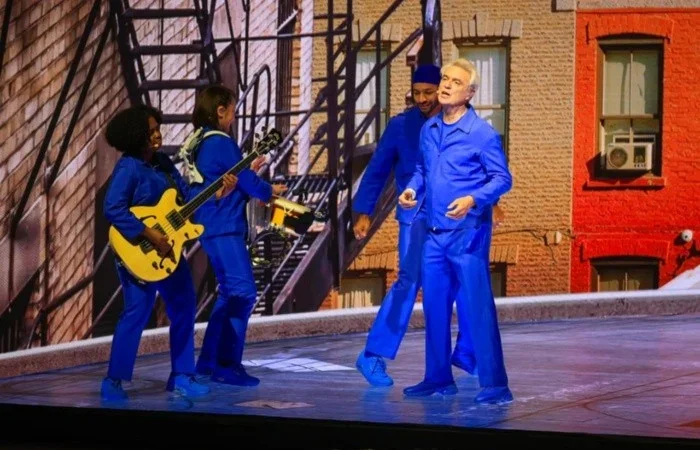
This past Tuesday, September 8, 2026, the legendary musician, composer, and former leader of Talking Heads, David Byrne, graced the stage of Guadalajara’s Auditorio Telmex, delivering a performance that transcended conventional concert formats. With an innovative stage design characterized by its minimalism and a dozen highly choreographed musicians accompanying him, Byrne embarked on a profound artistic exploration that has become a hallmark of his recent global tours. The event, part of the promotional cycle for his latest studio album, Who Is the Sky?, which serves as a continuation of his critically acclaimed 2018 release, American Utopia, drew an audience of 3,406 attendees according to Protección Civil figures, while Ocesa reported a slightly higher count of 3,500. Despite not reaching the venue’s full capacity, the evening was universally lauded by those present as a testament to Byrne’s enduring artistic vision and his relentless pursuit of innovation in live performance.
A New Paradigm for Live Performance: The Untethered Stage
The conceptual foundation of Byrne’s current tour, prominently displayed in Guadalajara, challenges deeply ingrained expectations of concert staging. From the moment the house lights dimmed shortly after 9:00 PM, a palpable sense of anticipation filled the Auditorio Telmex. Byrne, along with his ensemble, emerged onto a stage stripped bare of the typical clutter of amplifiers, drum kits, and mic stands tethered by an intricate web of cables. This deliberate emptiness was not a void but an invitation, signaling an immediate departure from the static performance models prevalent in contemporary music. Instead, the focus was squarely on the dynamic interplay between sound and motion, executed by the thirteen individuals (Byrne included) on stage.
This innovative approach is rooted in Byrne’s long-standing fascination with the intersection of music, theater, and visual art. It liberates musicians from their fixed positions, transforming them into active participants in a fluid, evolving choreography. Each of the twelve accompanying musicians, like Byrne himself, carried their instruments, allowing for uninhibited movement across the entire stage. This integration of dance and musicianship required not only exceptional musical prowess but also a high degree of physical discipline and coordination, effectively turning every song into a meticulously crafted piece of performance art. The absence of traditional stage paraphernalia served to amplify the human element, highlighting the synergy between the performers and their instruments as extensions of their bodies.
Thematic Visuals and Uniformity
Complementing the minimalist stage design, the visual aesthetic of the performance was striking in its coherence and impact. All thirteen performers, including Byrne, were uniformly dressed in blue attire, creating a visually unified ensemble that underscored the collective nature of the artistic endeavor. This sartorial choice minimized individual distinction, emphasizing the group’s collective presence and the intricate choreographic patterns they wove throughout the evening.
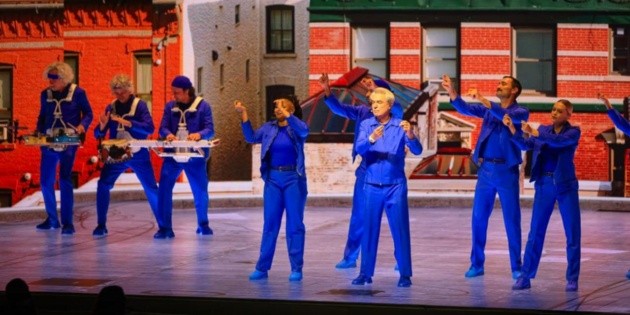
Behind the performers, a large format screen served as a dynamic backdrop, displaying an evolving tapestry of images. These visuals, ranging from urban cityscapes and architectural marvels to serene natural landscapes, were meticulously synchronized with each song, enhancing the narrative and emotional resonance of the music. The screen was not merely a passive projection surface but an active participant in the performance, guiding the audience’s gaze and amplifying the atmospheric shifts between pieces. This sophisticated integration of live performance, movement, and digital art created an immersive experience that was both intellectually stimulating and visually captivating, reinforcing the tour’s overarching theme of redefining the concert experience.
A Journey Through Time: Setlist Highlights and Audience Connection
The concert commenced with a powerful opening, as Byrne and his band launched into "Heaven" from Talking Heads, immediately followed by "Everybody Laughs." The transition between the two tracks set an energetic tone, and Byrne’s initial "gracias" in Spanish resonated warmly with the Guadalajara audience, establishing an immediate connection. This thoughtful gesture of acknowledging the local culture was a recurring motif throughout the night, deepening the rapport between the artist and his fans.
The setlist masterfully traversed Byrne’s extensive career, weaving together beloved Talking Heads classics with his solo material. Early in the evening, tracks like "And She Was," "Strange Overtones," and "Houses in Motion" maintained the dynamic rhythm established by the opening numbers. Each composition was imbued with distinct movements and atmospheres, showcasing the band’s versatility and the careful planning behind every segment of the show.
Byrne’s connection with the Guadalajara audience intensified during "T Shirt," a moment of genuine spontaneity and localized sentiment. As the music swelled, the giant screen behind the performers displayed impactful phrases, including "Make America Gay Again" – a statement of social commentary often associated with Byrne’s progressive views – and, to the delight of the crowd, "I love Guadalajara." The latter elicited an enthusiastic cheer, a testament to the audience’s appreciation for the personalized touch.
The concert continued its momentum with two iconic Talking Heads tracks, "Nothing But Flowers" and "This Must Be the Place (Naive Melody)." The opening notes of these songs were instantly recognized by the audience, who responded with palpable excitement, singing along and reinforcing the enduring appeal of Byrne’s legacy with the seminal new wave band. These moments highlighted the generational impact of his work, bridging gaps between longtime fans and those introduced to his music more recently.

The evening also provided ample space for Byrne’s solo ventures, showcasing the breadth of his artistic explorations beyond Talking Heads. "What Is the Reason for It?" stood out with its infectious rhythm, drawing close parallels to cumbia, and subtly referencing Byrne’s Spanish-language collaboration with Natalia Lafourcade. This track, among others such as "Like Humans Do," "When We Are Singing," "Independence Day," "I Met the Buddha," "My Apartment Is," "Air," and "Slippery People," demonstrated Byrne’s continued evolution as a solo artist, his willingness to experiment with diverse musical genres, and his knack for crafting introspective yet engaging compositions.
The Climactic "Psycho Killer" and Its Legacy
Undoubtedly, one of the most anticipated and electrifying moments of the night arrived with "Psycho Killer." The song’s recognizable opening drum beat, executed with ingenious simplicity on a single tom-tom drum suspended from the body of one of the musicians, immediately captivated the audience. As the track progressed, the stage lighting gradually incorporated more musicians, bathing the scene in striking black and white tonalities that perfectly mirrored the song’s iconic intensity and unsettling narrative. The audience, swept up in the performance, transformed "Psycho Killer" into one of the night’s most participatory anthems, singing along with fervent enthusiasm and cementing its status as a communal experience.
This rendition of "Psycho Killer" served as a powerful reminder of Byrne’s artistic lineage and his consistent ability to reinterpret his own work in fresh, compelling ways. The stagecraft, with its emphasis on mobile musicians and evocative visuals, resonated deeply with the spirit of Stop Making Sense, the legendary 1984 concert film documenting Talking Heads. That film, celebrated for its innovative staging and narrative use of the stage, established a precedent for Byrne’s current explorations, demonstrating a career-long commitment to making the stage itself an integral part of the storytelling. The Guadalajara performance illustrated that Byrne continues to evolve this foundational concept, pushing boundaries even further in the 21st century.
The Genesis of Who Is the Sky? and Collaborative Evolution
The current tour not only celebrates Byrne’s extensive back catalogue but also introduces audiences to his latest creative endeavor, Who Is the Sky? For this album, Byrne collaborated with acclaimed producer Kid Harpoon, renowned for his work with global superstars like Harry Styles and Miley Cyrus. This partnership underscores Byrne’s continued relevance and his eagerness to engage with contemporary musical landscapes and production talents.
Who Is the Sky? comprises twelve new songs and features an impressive roster of guest artists, including the powerful vocals of Hayley Williams of Paramore, the distinct artistry of St. Vincent (Annie Clark), and the intricate drumming of Tom Skinner from The Smile. These collaborations speak to Byrne’s enduring influence across diverse musical genres and his ability to attract top-tier talent, enriching his sound while maintaining his unique artistic voice. The album’s material, though new, seamlessly integrated into the concert’s flow, proving its resonance alongside Byrne’s established classics.

The Grand Finale: A Satisfied Audience
As the concert neared its conclusion, the energy in the Auditorio Telmex remained exceptionally high. The final stretch of the main set included exhilarating performances of "Life During Wartime," "Once in a Lifetime," and "Everybody’s Coming to My House," each delivered with the signature blend of precision and passionate intensity that defined the entire evening. These songs, particularly "Once in a Lifetime," with its profound lyrical content and hypnotic rhythm, served as powerful capstones to the meticulously curated setlist.
The evening culminated with the highly anticipated encore, as David Byrne and his band returned to deliver a rousing rendition of "Burning Down the House." This iconic track provided a fittingly explosive end to a night that was anything but ordinary. As the final notes reverberated through the venue, the audience erupted in a standing ovation, their enthusiastic applause echoing the sentiments of deep satisfaction.
While the Auditorio Telmex may not have been filled to its absolute maximum capacity, the enthusiasm and engagement of the attendees were undeniable. The concert was a resounding success, not merely as a musical performance but as a profound artistic statement. Byrne’s commitment to innovation, his masterful integration of music and movement, and his ability to connect with an audience on both intellectual and emotional levels left an indelible mark on Guadalajara. The evening served as a powerful reminder of David Byrne’s singular status as an enduring icon, continually reinventing the live concert experience and pushing the boundaries of what popular music can achieve. His visionary approach to performance ensures his legacy as an artist who consistently challenges, inspires, and delights.

0 Comments