
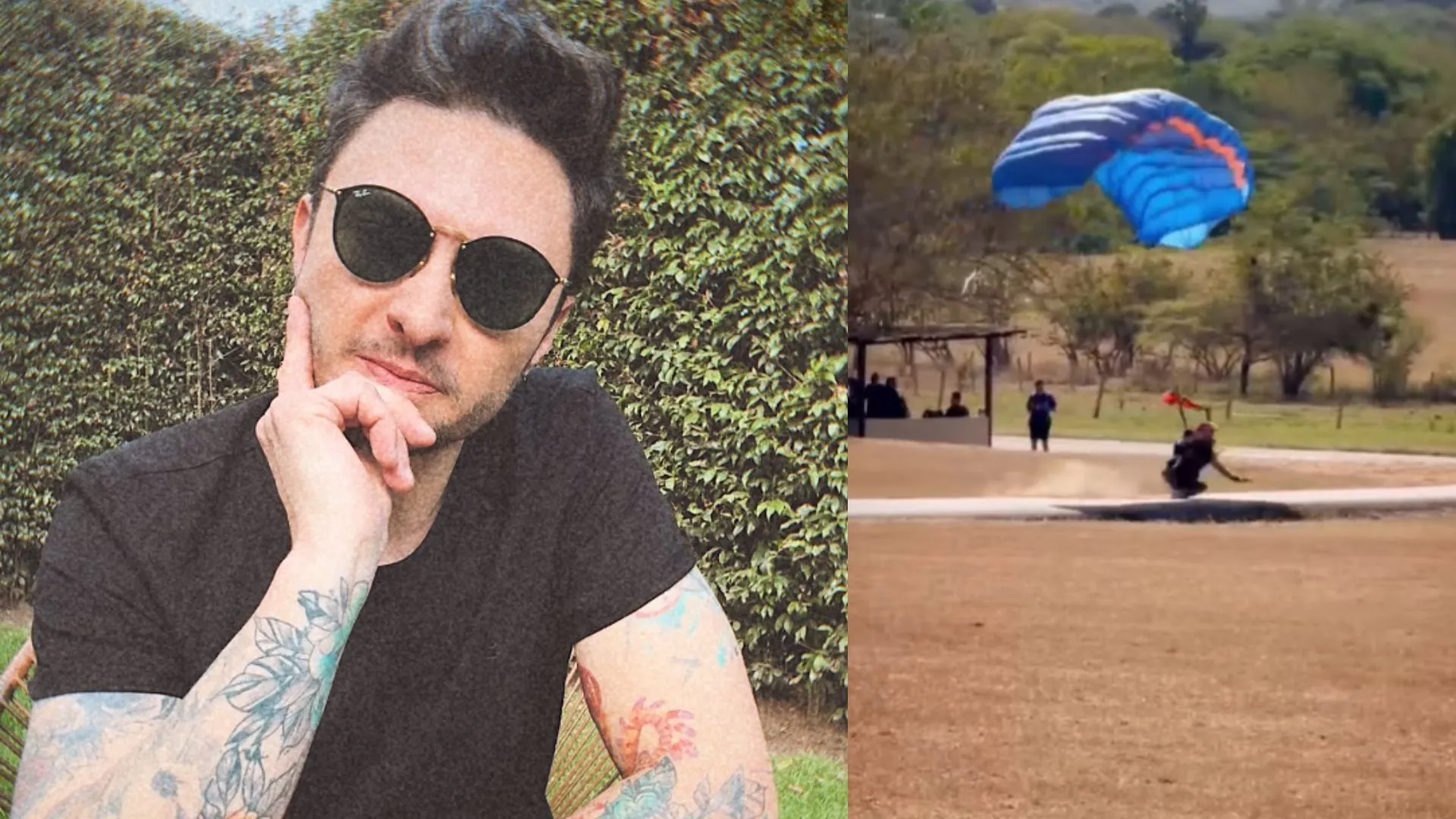
Colombian presenter, announcer, and musician Diego Sáenz has publicly shared the harrowing details of a severe accident he sustained while practicing parachuting, a sport he has long cherished. The incident, which occurred during a jump where Sáenz was using his own equipment for the first time, resulted in multiple fractures to his tibia, fibula, and ankle. Sáenz detailed the unfortunate chain of errors during the landing sequence that led to the severe injuries, emphasizing his optimistic outlook as he embarks on a challenging recovery process, with the ultimate goal of returning to the skies.
The Thrill Turns to Trauma: An Unforeseen Landing Mishap
The gravity of the situation was amplified by the fact that this particular jump held significant personal meaning for Sáenz. It marked his inaugural solo flight with his personally owned parachuting gear, a milestone he had eagerly anticipated for an extended period. This moment was intended to signify the commencement of a new and even more immersive chapter in his engagement with the sport. "During a parachuting jump, I suffered an accident during the landing," Sáenz recounted. "It was my first jump with my own equipment, and I was incredibly eager to experience this new phase in a sport I love."
However, the anticipated elation of this personal achievement was brutally interrupted by a starkly different reality. Sáenz explained that a confluence of misjudgments during the critical landing maneuver culminated in the accident. The visual evidence, captured in a video he shared on his YouTube channel, starkly illustrates the moment of impact as he met the ground. The footage clearly depicts the forceful and debilitating force transmitted to his legs. The immediate aftermath saw him sustain an open fracture, a serious injury that critically compromised his tibia, fibula, and ankle. This ordeal necessitates a protracted and intensive period of medical intervention and rehabilitation.
A Chain of Errors: Deconstructing the Accident
Reflecting on the incident, Sáenz acknowledged that a thorough analysis of the events allowed him to pinpoint the specific failures in his landing execution. He expressed a desire to share his experience not only to document his personal ordeal but also to serve as a cautionary tale, underscoring the paramount importance of rigorous preparation, continuous skill refinement, and unwavering adherence to safety protocols in high-risk activities like parachuting.
"Things did not go as I had anticipated," Sáenz admitted. "I made a chain of errors during the landing that led me to this point. It was a mistake that resulted in an open fracture of my tibia, fibula, and ankle." The emotional toll of the accident was also considerable. Sáenz confessed that the event represented one of the most profound personal challenges he has encountered. "In a matter of seconds, I went from enjoying a new chapter of my life and the sensation of flying to facing a situation I never imagined experiencing," he shared, recalling the terrifying moments.
Following the accident, Sáenz received immediate assistance and was promptly transported to a medical facility for specialized care. While he readily acknowledges the demanding and lengthy nature of his recovery, he projects an unwavering sense of positivity and determination regarding the upcoming surgeries and the subsequent rehabilitation regimen.
The Road to Recovery: Resilience and the Dream of Flight
Sáenz’s reflections on the incident reveal significant personal growth and a refined understanding of resilience. He articulated that true strength is not defined by the absence of fear or pain, but rather by the unwavering commitment to persevere in the face of adversity and uncertainty. "It is important to learn from our own mistakes and also from the mistakes of others," he stated. "I decided to focus my energy on moving forward. Strength does not mean not feeling fear or pain; it means continuing despite uncertainty and difficulties."
Despite the severity of his injuries, Diego Sáenz has emphatically conveyed that his passion for parachuting remains undimmed. He expressed a resolute aspiration to return to the sport once his recovery is complete. This enduring optimism is encapsulated in his recurring message to his supporters: "There’s a lot of Diego left."
The public sharing of his experience, particularly the video of the accident, has ignited a wave of support across social media platforms. Colleagues, friends, and countless followers have extended messages of encouragement and well wishes for a swift recovery. Many have lauded Sáenz for his candor and courage in openly discussing one of the most challenging periods of his life, a testament to his character and his dedication to transparency.
Parachuting Safety: Context and Data
The incident involving Diego Sáenz brings to the forefront the inherent risks associated with parachuting and the critical importance of safety protocols. While parachuting is generally considered a relatively safe sport when proper training and equipment are utilized, accidents can and do occur. According to data from the United States Parachute Association (USPA), which tracks statistics for its member drop zones, the sport has seen a significant improvement in safety over the decades. For instance, in 2022, there were approximately 0.4 fatalities per 100,000 jumps. This statistic, while low, underscores that fatalities are a reality of the sport. Injury rates, while less frequently publicized on a national scale, are more common. These can range from minor sprains to severe fractures, as was the case with Sáenz.
Factors contributing to accidents often include:
- Equipment Malfunctions: While rare with modern parachutes, malfunctions such as line twists or premature deployment can occur.
- Pilot Error/Misjudgment: This is frequently cited as a leading cause of accidents. Errors in judgment during freefall, canopy control, or landing are common. This aligns with Sáenz’s own admission of a "chain of errors."
- Environmental Factors: Wind conditions, visibility, and terrain at the landing zone can all play a role.
- Inexperience: Newer jumpers are at a higher risk, which is why rigorous training and gradual progression are emphasized in certified skydiving programs.
The progression of parachuting safety has been marked by technological advancements in parachute design (such as ram-air canopies that offer more steerability), mandatory reserve parachute packing by certified riggers, and the implementation of extensive training programs like the Accelerated Freefall (AFF) method. The USPA, and similar organizations worldwide, continuously review accident data to identify trends and improve safety recommendations and training standards. Sáenz’s case highlights that even experienced individuals can face severe consequences when multiple errors converge during a critical phase of the jump.
Broader Implications: The Human Element of Extreme Sports
The candid sharing of his experience by Diego Sáenz transcends a mere recounting of a personal mishap. It serves as a powerful humanizing element within the often-glamorized world of extreme sports. While media coverage frequently focuses on the adrenaline rush and the daring feats, Sáenz’s narrative brings to the forefront the vulnerability and the very real physical and emotional consequences that can arise.
His emphasis on learning from mistakes and maintaining a positive outlook in the face of significant physical trauma offers valuable insights for anyone facing adversity. It speaks to the psychological resilience required not only in extreme sports but in all aspects of life. The outpouring of support he received underscores the importance of community and connection, particularly during periods of intense physical and emotional challenge.
Furthermore, Sáenz’s commitment to returning to the sport, despite the severity of his injuries, reflects a deep-seated passion and a belief in his ability to overcome obstacles. This ambition, when coupled with a renewed focus on safety and learning, can contribute to a more nuanced public perception of extreme sports – one that acknowledges both the risks and the profound personal rewards and dedication involved. His story is a testament to the human spirit’s capacity for resilience and the enduring pursuit of passions, even in the wake of significant setbacks.

0 Comments