
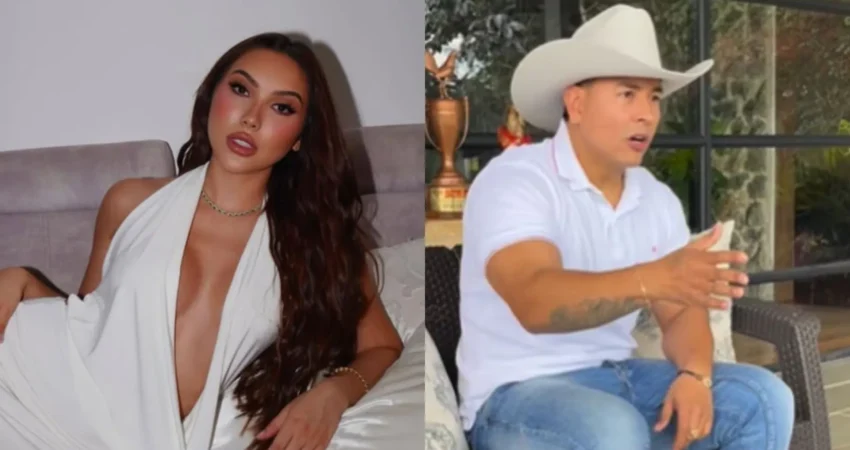
The public dispute between entrepreneur Juan David Tejada, widely known as El Agropecuario, and prominent content creator Aida Victoria Merlano has escalated with Tejada revealing he has initiated legal proceedings against Merlano. The lawsuit stems from the unauthorized appearance of their shared son, Emiliano, in a music video for the song "El peor hombre del mundo" by Colombian reggaeton artist Blessd. Tejada made these revelations during a recent interview on the program "Tamo en vivo," hosted by Dímelo King, where he also vehemently denied allegations of failing to meet his child support obligations for Emiliano and presented evidence to the contrary.
Legal Action Over Son’s Media Appearance
During the candid interview, Tejada addressed several points of contention with his former partner, with a significant focus on matters concerning their son, Emiliano. He expressed strong disapproval of Emiliano’s inclusion in the music video and promotional materials for Blessd’s song, which was released in June 2026. Tejada stated that he was not consulted prior to his son’s participation in the project, a decision he views as a breach of parental agreement and a violation of his rights as a father.
"I wake up one day and see the child on a cover; I am the child’s father, I am responsible for him. Why can’t she call me before that?" Tejada recounted during the broadcast, visibly expressing his frustration. "I have a legal issue with that and I sued because of it. As a mother and as a father, we both have to agree, she doesn’t have to give me money." This statement underscores Tejada’s stance that decisions impacting their son’s public image and potential commercial use require mutual consent between both parents.
The legal action initiated by Tejada signifies a serious escalation in their co-parenting disputes. While the specific details of the lawsuit remain confidential pending legal proceedings, Tejada’s public declaration suggests he is seeking legal recourse to assert his parental rights and prevent similar situations from occurring in the future. This case highlights the complex legal and ethical considerations surrounding the involvement of children in public media, particularly when parents have differing views on their exposure.
Differentiating Personal Posts from Commercial Exploitation
The conversation also delved into the broader issue of how both Tejada and Merlano present Emiliano on their respective social media platforms. Yaya Muñoz, a panelist on "Tamo en vivo," questioned Tejada’s critique of Merlano’s actions, pointing out that he himself has also shared content featuring his son.
Tejada differentiated his personal posts from what he perceives as commercial exploitation. He argued that sharing personal moments with his child on his own social media accounts is fundamentally different from utilizing the child’s image for promotional campaigns or potentially lucrative ventures without his explicit consent.
"I have posted him on my social media, but I have never exposed him to campaigns," Tejada explained. "It’s not the same as me posting my son on TikTok versus me posting him and charging, as the mother does." This distinction is crucial to Tejada’s argument, suggesting that his concern lies not with any public visibility of his son, but with the commercialization of Emiliano’s image and the alleged lack of parental consensus in such decisions. The reference to "charging" implies Tejada believes Merlano may have financially benefited from Emiliano’s appearance in the Blessd video, a point he contests as a violation of shared parental responsibility.
The embedded TikTok video, titled "El agrolimpio demandó a Aida por no darle un porcentaje de la campaña que hizo con blessd," further contextualizes the public perception of this dispute, indicating that the core of the conflict may indeed revolve around financial aspects of Emiliano’s media appearances.
Addressing Child Support Allegations with Evidence
Beyond the legal action concerning Emiliano’s media presence, Tejada also directly addressed persistent allegations from Aida Victoria Merlano regarding his alleged failure to meet child support obligations for their son. Merlano has, on multiple occasions, publicly stated that Tejada has not fulfilled his financial responsibilities towards Emiliano.
Tejada vehemently denied these claims during the interview, presenting what he described as multiple proof-of-payment receipts for child support. He asserted that his financial commitments to Emiliano are up-to-date and, in a surprising revelation, indicated that one of the presented payment proofs was dated for August 2026, suggesting a proactive and perhaps prepaid arrangement for future support.
"I have put up with a lot, and nothing she says is true," Tejada stated firmly, indicating his frustration with what he perceives as public misinformation. He explained that he felt compelled to publicly display these financial records after facing considerable criticism on social media platforms. Tejada maintained that he has consistently attempted to handle family matters with discretion and privacy, but felt forced to respond to what he deemed unfair public accusations.
The presentation of these financial documents, if verifiable, directly challenges Merlano’s narrative. The inclusion of a future-dated payment receipt is particularly noteworthy, suggesting a potential strategy to demonstrate his commitment to future financial support or perhaps a pre-arranged agreement for a longer duration. The validity and context of this future-dated payment will likely be a significant point of scrutiny should the dispute continue to unfold publicly or legally.
Broader Context: Co-Parenting Dynamics and Public Scrutiny
The dispute between El Agropecuario and Aida Victoria Merlano is not an isolated incident but rather a symptom of broader challenges faced by public figures and influencers navigating co-parenting in the age of social media. The constant public gaze and the pressures of maintaining an online persona can often exacerbate pre-existing parental disagreements.
Background of the Relationship: Juan David Tejada, known as El Agropecuario, is a businessman with a significant presence in agricultural sectors. Aida Victoria Merlano, daughter of former Colombian senator Aida Merlano, is a well-known social media personality and influencer with a substantial following. Their relationship, though now marked by public disputes, was once a source of content for their followers. The birth of their son, Emiliano, added another dimension to their public lives, with followers keenly interested in their family dynamics.
Timeline of Public Disagreements: While the specific timeline of their separation and the genesis of their current disputes is not fully detailed in the provided text, the current interview indicates a history of disagreements, particularly concerning Emiliano. The Blessd music video incident appears to be a recent catalyst for Tejada’s decision to pursue legal action and go public with his side of the story. Merlano has previously alluded to financial discrepancies in public forums, setting the stage for Tejada’s counter-response.
Implications of Public Disputes: High-profile co-parenting disputes can have several implications. For the parents, it can lead to increased stress, reputational damage, and ongoing legal battles. For the child, the most significant impact is the potential exposure to public scrutiny and the emotional toll of parental conflict. In this instance, Emiliano’s involvement in a music video, whether perceived as innocent or exploitative, has placed him at the center of a public disagreement.
Tejada’s Perspective on Fatherhood and Other Relationships
In addition to discussing Emiliano, Tejada broadened the scope of the interview to touch upon his role as a father to his other children. He revealed that he is a father to four children in total – two daughters and two sons – from different relationships. Tejada asserted that he maintains amicable relationships with the mothers of his other children, highlighting a contrast with the current strained dynamic with Merlano.
To further substantiate his claims about responsible fatherhood, Tejada facilitated a connection with one of the mothers of his daughters during the broadcast. This individual corroborated Tejada’s statements, describing him as a "very present" and "very responsible" father who has consistently met his obligations since their daughter’s birth. She confirmed that there are no outstanding financial debts owed to her by Tejada. This testimony serves as an attempt by Tejada to present a consistent pattern of responsible parenting across all his relationships, thereby bolstering his credibility in the dispute with Merlano.
Broader Impact and Future Outlook
The legal action initiated by Juan David Tejada against Aida Victoria Merlano over their son’s appearance in a music video and his defense against child support allegations bring to light the complex interplay of parental rights, privacy, and the pervasive influence of social media in modern family life. The case raises important questions about consent, commercialization of children’s images, and the legal frameworks designed to protect minors in such situations.
As of the reporting of this article, Aida Victoria Merlano has not issued any new public statements in response to Tejada’s interview, the presented evidence of child support payments, or the legal action he claims to have initiated. The public will be awaiting her response to these developments. The outcome of the legal proceedings initiated by Tejada could set a precedent for how parental rights are interpreted and enforced concerning children’s involvement in media and entertainment, particularly within the context of influencer culture. The ongoing scrutiny of their personal lives underscores the challenges faced by public figures in balancing their careers, personal relationships, and the well-being of their children.

0 Comments