
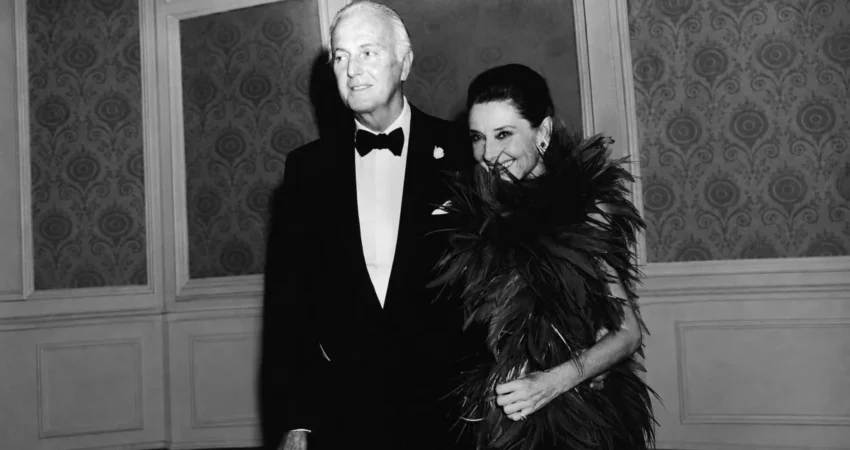
The world of high fashion is currently turning its gaze toward the Basque town of Getaria, where the Cristóbal Balenciaga Museum is hosting a landmark exhibition titled "The Givenchiaga Family." This retrospective, which remains open to the public until February 22, 2027, serves as a sophisticated prelude to the centenary of Hubert de Givenchy’s birth. Born in 1927, the late couturier would have reached his 100th year in 2027, a milestone that provides the perfect opportunity to analyze the profound impact he had on 20th-century aesthetics. By placing 24 of Givenchy’s original designs in direct dialogue with 11 masterpieces by his mentor, Cristóbal Balenciaga, the exhibition meticulously charts the evolution of a relationship that redefined the standards of Parisian haute couture.
Hubert de Givenchy, born Hubert James Marcel Taffin de Givenchy in Beauvais, France, was not merely a fashion designer; he was the architect of a specific type of mid-century refinement that prioritized silhouette, fabric quality, and a restrained, aristocratic grace. His journey from a young apprentice to the head of one of the world’s most recognizable luxury houses is a testament to the discipline of the craft. Before establishing his own label, Givenchy honed his skills in the most prestigious ateliers of the era, including those of Jacques Fath, Robert Piguet, and Lucien Lelong. Perhaps most influential was his tenure at the boutique of Elsa Schiaparelli, where he learned to blend the avant-garde with the wearable.
In 1952, at the age of 25, Givenchy opened his own couture house at 8 rue Alfred de Vigny in Paris. His debut collection, titled "Separates," was revolutionary for its time. While the prevailing trend favored rigid, highly structured total looks, Givenchy introduced interchangeable skirts and tops crafted from humble white shirting fabric. The standout piece of this collection was the "Bettina blouse," named after the prominent model Bettina Graziani. Characterized by its wide collar and ruffled sleeves embroidered with black eyelets, the blouse became an immediate commercial sensation and a symbol of a new, youthful elegance.

The Architect of Style: The Balenciaga Influence
The central pillar of Givenchy’s career was undoubtedly his relationship with the Spanish master Cristóbal Balenciaga. The two first met in New York in 1953, facilitated by the prominent Chilean socialite and client Patricia López-Willshaw. Although Givenchy never officially worked within Balenciaga’s workshop, he became the Spaniard’s most devoted disciple and closest confidant. This bond was so tight that by 1956, both designers took the unprecedented step of withdrawing from the official fashion calendar. They began presenting their collections to the press and buyers one month after the other major houses, a move intended to prevent design piracy and maintain an aura of exclusivity.
By 1960, the British journalist Katharine Whitehorn, writing for The Observer, famously coined the term "The Givenchiaga Family" to describe the aesthetic and professional symbiosis between the two men. Their studios eventually stood directly across from each other on the Avenue George V in Paris. The influence was reciprocal but clearly rooted in Givenchy’s reverence for Balenciaga’s technical mastery. When Balenciaga decided to close his house in 1968, a move that shocked the fashion world, he personally ensured that his most loyal clients and skilled seamstresses were transitioned to Givenchy’s care. Among these was the American philanthropist Rachel "Bunny" Mellon, who would remain one of Givenchy’s most significant patrons and friends for decades.
Givenchy’s own words in 2011 underscore this debt: "If I had not met Balenciaga, perhaps I would never have discovered the true essence of fashion." This sentiment is the driving force behind the current exhibition in Getaria, curated by Igor Uria. The display features 35 pieces that illustrate how Givenchy adapted and refined the architectural silhouettes pioneered by Balenciaga, such as the tunic, the sack dress, and the "baby-doll" dress.
The Muse and the Screen: Audrey Hepburn
While Balenciaga provided the technical foundation, it was the actress Audrey Hepburn who provided the face and spirit of the Givenchy brand. Their collaboration, which began in 1953 during the filming of Sabrina, is widely considered the most successful designer-muse relationship in history. Legend has it that when Givenchy was told "Miss Hepburn" was coming to his studio, he expected Katharine Hepburn; instead, he met a waif-like young woman in a gondolier hat.

This meeting birthed a lifelong friendship and a series of iconic cinematic moments. The Getaria exhibition prominently features the black evening gown Hepburn wore in the opening scene of Breakfast at Tiffany’s (1961), a loan from the Museo del Traje in Madrid. This garment is perhaps the most famous "Little Black Dress" in existence, embodying the minimalist chic that Givenchy championed. Beyond Tiffany’s, Givenchy’s work was central to the visual identity of films like Funny Face, Love in the Afternoon, and Charade. In Charade (1963), the marigold yellow wool coat with a mandarin collar and A-line skirt showcased Givenchy’s ability to use bold color within a strictly geometric framework.
The partnership extended beyond the screen. In 1957, Givenchy created a perfume specifically for Hepburn called L’Interdit (The Forbidden). Originally intended for her private use, it eventually became the first celebrity-fronted fragrance when it was released to the public, marking Givenchy’s successful expansion into the beauty industry.
Diplomatic Elegance: The Kennedy Connection
Givenchy’s influence also permeated the highest levels of global politics. During the 1960s, he was a preferred designer for Jacqueline Kennedy, the First Lady of the United States. Though she was encouraged to wear American designers to support the domestic industry, she frequently turned to Givenchy for her most high-profile international appearances.
The most notable instance occurred in June 1961, during the Kennedys’ official state visit to France. For a lavish dinner hosted by President Charles de Gaulle at the Palace of Versailles, Mrs. Kennedy wore a Givenchy Haute Couture gown. The ivory silk zibeline dress featured an intricately embroidered bodice with silk thread, ribbons, and seed pearls, executed by the legendary embroidery house Hurel. The appearance was so successful that President John F. Kennedy famously introduced himself to the press by saying, "I am the man who accompanied Jacqueline Kennedy to Paris." This dress, now preserved in the John F. Kennedy Presidential Library and Museum, remains a pinnacle of 20th-century diplomatic fashion.

Corporate Transition and the Modern Era
As the fashion industry began to shift toward large-scale luxury conglomerates in the late 20th century, Givenchy adapted. In 1988, he sold his firm to the French luxury group LVMH (Moët Hennessy Louis Vuitton). Despite the change in ownership, he remained the artistic director until his retirement in 1995. His final runway show was an emotional farewell attended by the titans of the industry, marking the end of an era for traditional haute couture.
Following his departure, the house of Givenchy saw a succession of high-profile creative directors, each bringing a different interpretation to the brand’s DNA. These included John Galliano, Alexander McQueen, Julien Macdonald, Riccardo Tisci, Clare Waight Keller, and Matthew M. Williams. Each designer grappled with the legacy of Givenchy’s "elegant restraint" versus the modern demand for spectacle and streetwear. In 2024, the house entered a new chapter with the appointment of Sarah Burton, formerly of Alexander McQueen, as Creative Director. Burton is tasked with reconciling the house’s historic focus on exquisite tailoring with contemporary luxury needs.
Analysis of the Getaria Exhibition and Its Implications
The current exhibition at the Cristóbal Balenciaga Museum is more than a simple display of vintage clothing; it is a scholarly examination of "continuity" in fashion. By focusing on the period between 1956 and 1972, the exhibition captures the transition from the golden age of couture to the rise of luxury ready-to-wear.
The data presented by the museum highlights the meticulous nature of this curation. Of the 35 pieces, the 24 Givenchy designs were largely sourced from the House Archive in Paris, supplemented by pieces from the Museo del Traje in Madrid. The 11 Balenciaga pieces are drawn from the museum’s permanent collection and two private collections. This cross-institutional collaboration underscores the importance of Givenchy as a cultural figure whose work belongs to the history of art as much as the history of commerce.

The exhibition’s layout, which follows a chronological path, allows visitors to see how Givenchy took Balenciaga’s revolutionary volumes—often described as "monastic" or "architectural"—and softened them for a more feminine, accessible appeal. This "refinement of the improvement," as Givenchy described his process in 1969, is the hallmark of his career.
Legacy and the Future of French Chic
Hubert de Givenchy passed away in 2018 at the age of 91 at his home near Paris. He left behind a legacy defined by the belief that a dress should never dominate the woman wearing it. His contribution to fashion was a specific form of "French Chic" that was clean, well-bred, and timeless.
As the 2027 centenary approaches, the "The Givenchiaga Family" exhibition serves as a vital reminder of the standards Givenchy set. In an era of fast fashion and rapidly changing trends, Givenchy’s insistence on "continuity" and "refinement" offers a blueprint for sustainable luxury. The exhibition in Getaria not only honors a master of the craft but also reinforces the historical link between Spanish rigor and French flair, a partnership that continues to inspire designers and fashion enthusiasts worldwide. For those visiting the Basque Country before February 2027, the Aldamar Park in Getaria offers a rare opportunity to witness the physical manifestation of a friendship that changed the silhouette of the 20th century.

0 Comments