
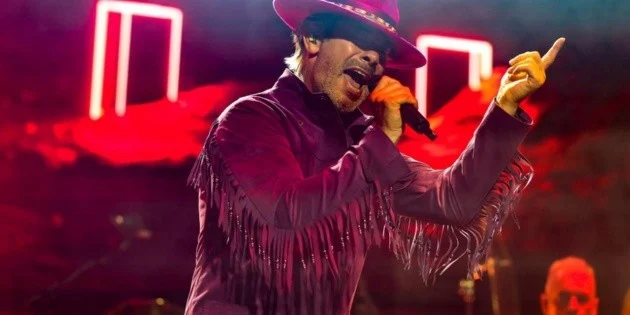
Jay Kay, the inimitable frontman of Jamiroquai, emerged onto the stage of the Arena Guadalajara, an almost spectral figure silhouetted by the crimson glow of the stage lights, a wide-brimmed sombrero casting his face in dramatic shadow. Dressed in his characteristic dark attire, microphone firmly in hand, he commanded attention not through grand pronouncements but through the sheer magnetic force of his presence and the pulsating rhythms of the music. The scene was a masterclass in atmospheric production: a canvas of red lights, tendrils of smoke swirling through the air, and an intricate array of geometric structures that sculpted dynamic lines across the stage, all converging to amplify the band’s distinctive aesthetic. Without uttering a single extensive speech, the vocalist allowed the music, a vibrant tapestry of funk, acid jazz, and disco, to articulate the evening’s narrative, rekindling a deep connection with the 8,300 fans who had eagerly awaited this reunion.
A Long-Awaited Homecoming for a Global Phenomenon
The much-anticipated concert by the British funk and acid jazz pioneers commenced precisely at 9:45 PM local time, drawing a dedicated audience of 8,300 fervent fans. This event marked Jamiroquai’s triumphant return to Guadalajara after an absence of 13 years, a significant hiatus that had only intensified anticipation among their loyal Mexican fanbase. The last time Jamiroquai graced a stage in the city was on March 1, 2013, at the Auditorio Telmex, also as part of a broader Latin American tour. On that occasion, the band captivated an even larger crowd, with over 9,000 attendees filling the Zapopan venue. The slight decrease in attendance for the current concert, while numerically notable, does little to diminish the palpable excitement and the profound sense of connection that permeated the Arena Guadalajara, underscoring the enduring appeal of a band that has consistently defied easy categorization since its inception in the early 1990s.
Jamiroquai’s journey began in 1992, founded by Jay Kay, who quickly became its iconic face. The band rapidly rose to prominence, pioneering the acid jazz movement in the UK before evolving to incorporate elements of funk, disco, and electronica. Their debut album, "Emergency on Planet Earth" (1993), immediately garnered critical acclaim, but it was subsequent releases like "The Return of the Space Cowboy" (1994), "Travelling Without Moving" (1996), and "Synkronized" (1999) that cemented their status as global superstars. With over 26 million albums sold worldwide, numerous awards including a Grammy, and a reputation for electrifying live performances, Jamiroquai has cultivated a legacy built on innovative soundscapes and an unwavering commitment to musical integrity. Jay Kay, with his distinctive vocal style ranging from soulful croons to rapid-fire improvisations, and his signature headwear – a constantly evolving collection of extravagant hats and headdresses – became an undeniable cultural icon, embodying the band’s vibrant and eclectic spirit.
The Evolution of a Live Experience: Visuals and Atmosphere
For this latest Guadalajara engagement, the stage of the Arena Guadalajara was transformed into an immersive extension of the band’s sophisticated aesthetic. The lighting design was a dynamic spectacle, oscillating between deep crimson hues and crisp whites, with powerful beams of light piercing through the theatrical smoke. These light shafts played across the geometric structures positioned behind the musicians, creating a multi-layered visual experience that complemented the band’s sonic landscape. This meticulous attention to visual detail has long been a hallmark of Jamiroquai’s live shows, which often blend futuristic elements with retro-funk sensibilities, reflecting the thematic depth of their music that frequently touches upon environmentalism, social commentary, and existential musings.
Jay Kay’s appearance at the heart of this meticulously crafted landscape was instantly recognizable. His signature wide-brimmed hat, a sartorial emblem that has accompanied his image for decades, once again took center stage. Dressed entirely in dark garments, his figure moved with fluid energy across the stage, microphone in hand, his body language intuitively marking the intricate rhythms of each song. This deliberate choice to let the music speak, rather than rely on elaborate monologues, underscored the band’s focus on musicality and performance. Jay Kay’s movements, often described as a hypnotic blend of dance and expressive gesturing, are an integral part of the Jamiroquai live experience, connecting the visual and auditory elements into a cohesive, immersive spectacle. The interaction, though minimal in spoken words, was profound in its musical delivery, establishing an intimate dialogue between the artist and the thousands present.
A Setlist Spanning Decades of Innovation
The evening’s musical journey commenced with "Don’t Give Hate," a powerful opener that immediately set a high-energy tone. This was swiftly followed by the infectious grooves of "Little L," "Use the Force," and the timeless "Space Cowboy," each track a testament to the band’s genre-blending mastery. Jay Kay’s communication with the audience remained concise throughout the performance. There were no protracted speeches or elaborate explanations preceding each song; his interventions were primarily distilled into various forms of heartfelt gratitude, most notably the simple yet impactful phrase, "Gracias, Guadalajara," which resonated deeply with the local crowd. This directness ensured that the music itself remained the undisputed protagonist of the night.
The performance seamlessly transitioned into a captivating sequence of tracks, allowing the band’s musicianship to shine brightly. "Light Years," "Alright," "Tallulah," "Disco Stays," "Feeling," and the electrifying "Canned Heat" followed in quick succession. With "Canned Heat," the Arena Guadalajara momentarily transformed into an expansive dance floor, its 8,300 occupants surrendering to the irresistible beat, a collective testament to the track’s enduring power to ignite movement and joy. This particular moment underscored the profound connection between Jamiroquai’s music and its audience, transcending mere listening to become a full-body, communal experience. The band’s instrumental prowess, often lauded by critics, was on full display, with intricate basslines, soaring horn sections, and sophisticated keyboard arrangements underpinning Jay Kay’s vocals.
The repertoire continued to delight with "Cosmic Girl" and "Love Foolosophy," building anticipation towards one of the most eagerly awaited moments of the night: "Virtual Insanity." This iconic track, instantly recognizable for its groundbreaking music video and poignant lyrics, found Jay Kay once again at the forefront of the stage, bathed in the dramatic lighting. The geometric figures of the stage production mirrored the song’s complex rhythms and futuristic undertones, creating a symbiotic visual and auditory experience that was both nostalgic and refreshingly contemporary. "Virtual Insanity" represents a pivotal moment in Jamiroquai’s discography, showcasing their ability to blend social commentary with infectious melodies, and its live rendition was a powerful reminder of its lasting cultural impact.
The concert concluded with the powerful "Deeper Underground," a track that often serves as a dramatic closing statement, before an final encore that traversed a curated selection of songs, connecting disparate eras of the band’s illustrious career. This final medley served as a poignant summary, demonstrating the breadth and consistency of Jamiroquai’s musical output over nearly three decades, leaving the audience with a comprehensive taste of their sonic evolution.
Guadalajara as a Hub for International Music
The return of Jamiroquai to Guadalajara, attracting 8,300 attendees, solidifies the city’s standing as a significant destination for international music acts in Mexico. While slightly fewer than the 9,000+ strong crowd in 2013, the numbers reflect a robust and dedicated fanbase in the region. The Arena Guadalajara, a more recently established venue compared to the Auditorio Telmex, offers a distinct atmosphere and capacity, influencing the dynamics of attendance. This consistent draw for a band with a decades-long career underscores the cultural maturity of Guadalajara’s concert-going public and its eagerness to engage with diverse global artists.
From an economic perspective, events of this magnitude inject significant revenue into the local economy. Beyond ticket sales, the concert stimulated activity in the hospitality sector, with hotels, restaurants, and transportation services experiencing increased demand. Merchandising sales, local vendor participation, and temporary employment opportunities also contributed to a brief but notable economic boost. Promoters, while not issuing official statements, are understood to be pleased with the strong turnout and the smooth execution of the event, reinforcing Guadalajara’s reputation as a reliable and enthusiastic market for high-profile international tours. The success of this concert could serve as an encouraging signal for other major artists and booking agencies considering Mexico as a tour stop.
For the fans, many of whom had waited over a decade, the concert was more than just a musical performance; it was a deeply nostalgic and celebratory experience. Social media platforms immediately buzzed with reactions, with attendees expressing overwhelming delight at the opportunity to witness Jay Kay’s iconic stage presence and the band’s unparalleled musicianship live. Long-time enthusiasts spoke of reliving cherished memories, while newer fans discovered the enduring magic of Jamiroquai in a live setting. This cross-generational appeal is a testament to the timeless quality of their music, which continues to resonate with audiences regardless of age.
Broader Implications and the Enduring Legacy of Live Music
The Jamiroquai concert in Guadalajara serves as a compelling case study for the enduring power and relevance of live music in an increasingly digital age. In a world saturated with streaming platforms and virtual experiences, the communal act of gathering to witness musical artistry firsthand remains an irreplaceable phenomenon. Legacy acts like Jamiroquai, with their deep catalogs and refined stagecraft, continue to draw substantial crowds, demonstrating that authentic musical talent and a captivating live performance can transcend fleeting trends.
The success of this event also highlights the sophisticated infrastructure and organizational capabilities present in Guadalajara, positioning it as a key cultural hub not just within Mexico but across Latin America. The city’s ability to host such large-scale international acts efficiently and safely contributes to its global image as a vibrant, culturally rich destination. As the global music industry continues to evolve, the demand for immersive live experiences remains constant, and cities like Guadalajara are proving their capacity to meet this demand, ensuring that the magic of live performance continues to thrive for years to come. The triumphant return of Jamiroquai was not merely a concert; it was a reaffirmation of the profound connection between artists and their audience, underscored by the universal language of funk and soul.

0 Comments