
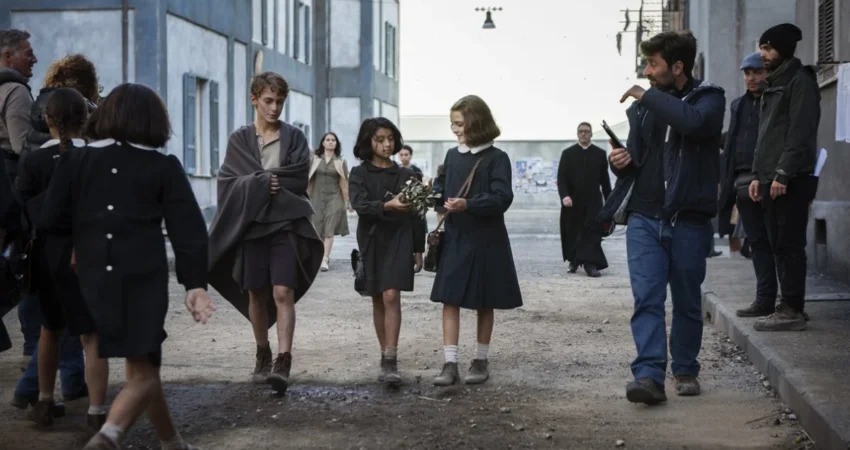
Spanish public broadcaster La 1 is implementing an unconventional and aggressive programming strategy this Saturday, September 12th, dedicating its entire primetime and late-night schedule to the acclaimed Italian drama "My Brilliant Friend" (L’amica geniale). The extensive broadcast will feature four brand-new episodes followed by two re-runs, commencing at 10:05 PM and continuing until the early hours of 3:40 AM. This marathon viewing event, spanning over five consecutive hours, signals a significant shift in how the network is attempting to bolster the viewership of the series, which has reportedly not met expectations since its transition to La 1’s generalist programming.
A Desperate Measure or Strategic Gambit?
The decision to air such an extensive block of episodes, especially following last week’s already notable programming of three consecutive new installments, points towards a network grappling with the series’ performance. Industry insiders suggest this tactic, often referred to as "audience engineering" or "viewership arithmetic," is designed to consolidate viewers within a single time slot. By presenting multiple episodes back-to-back, the network aims to inflate the average viewership figures for the entire block, thereby presenting a more favorable overall picture of the night’s performance, even if individual episode ratings are modest. This strategy is a clear acknowledgment, both implicit and explicit, that the international sensation, based on Elena Ferrante’s globally lauded novels, has struggled to find its footing within the Spanish terrestrial television landscape.
The Challenge of European Dramas on Generalist Channels
The difficulties faced by "My Brilliant Friend" are not unique. European productions, even those with established international critical acclaim, often encounter significant hurdles when broadcast on Spanish generalist channels. The primary challenge lies in competing with the deeply ingrained viewing habits of the Spanish audience, which are heavily skewed towards domestic productions, particularly during peak primetime hours. The narrative pacing and thematic nuances of European dramas can differ considerably from what Spanish viewers have come to expect from mainstream offerings. This discrepancy often leads to a dilution of the audience or a failure to attract the intended demographic when these series are placed in direct competition with local content.
Timeline of Broadcast Adjustments
- Previous Week: La 1 aired three consecutive new episodes of "My Brilliant Friend," a move already considered noteworthy.
- Current Week (Saturday, September 12th): The network escalates this strategy by scheduling four new episodes followed by two re-runs, occupying the primetime and late-night slots from 10:05 PM to 3:40 AM.
This programming choice carries a dual interpretation. On one hand, it can be seen as a strong vote of confidence in the series itself, with La 1 allocating an unprecedented amount of airtime to give it every possible opportunity to connect with viewers. On the other hand, it implicitly acknowledges that the late-night, Saturday slot, often considered less valuable than traditional weekday primetime, is deemed a more suitable environment for this type of content when conventional scheduling has not yielded the desired results.
Background and Context: The Enduring Appeal of Ferrante’s Neapolitan Novels
"My Brilliant Friend," the television adaptation of Elena Ferrante’s quartet of novels, chronicles the complex, lifelong friendship between Elena Greco and Raffaella Cerullo, set against the backdrop of Naples in the post-war era. The series, produced by Wildside, Fandango, and Rai Fiction, has garnered widespread critical acclaim internationally for its faithful adaptation, stellar performances, and evocative portrayal of social and political upheaval in Italy. The novels themselves have achieved phenomenal global success, translated into over 40 languages and selling tens of millions of copies worldwide. This international success, however, has not automatically translated into robust ratings on La 1, suggesting a divergence between critical appreciation and mass audience appeal within the Spanish context.
The decision to air the fourth season in this manner comes after previous seasons have also aired on Spanish television, indicating a continued commitment from the broadcaster despite the perceived challenges. The specific season being featured, the fourth, is significant as it marks the culmination of the narrative arc established in Ferrante’s novels, potentially drawing in dedicated fans who have followed the series from its inception.

Supporting Data and Industry Analysis
While specific viewership data for "My Brilliant Friend" on La 1 has not been publicly detailed in the provided text, the network’s decision to implement such an unusual programming schedule strongly suggests that previous ratings have been below expectations. In the competitive Spanish television market, where audience share is paramount, networks often rely on data-driven decisions. The average viewership for a primetime slot on a major Spanish channel can range significantly, but for a public broadcaster like La 1, consistent performance is crucial for demonstrating value and justifying public funding.
The strategy of consolidating episodes is a known tactic. For instance, if an individual episode garners an average of 800,000 viewers, broadcasting four consecutive episodes might aim to present a total of 3.2 million accumulated viewers for that block, even if the average per episode remains around that 800,000 mark. This "stacking" technique can influence how a series is perceived in performance reports and can be particularly useful for niche or less broadly appealing content that has a dedicated but smaller following. It’s a way to give the series "airtime density" to maximize exposure within a limited window.
Potential Reactions and Implications
For Viewers: This marathon presents an unprecedented opportunity for viewers to immerse themselves in the latest installment of "My Brilliant Friend" without the need to tune in over multiple weeks. It caters to those who prefer binge-watching or who might have missed earlier episodes of the current season. The extended broadcast allows for a deep dive into the characters’ development and the intricate plotlines.
For La 1: The success or failure of this programming experiment will provide valuable insights for La 1 regarding its international acquisitions strategy. If the marathon successfully boosts viewership figures, it could validate the approach of concentrating episodes for other foreign dramas that may be struggling to gain traction. Conversely, if the numbers remain low, it might indicate that the series’ appeal is inherently limited within the current Spanish broadcast model, forcing the network to reconsider its placement or potentially move it to a less competitive slot on one of its digital channels, or even consider it a less viable acquisition for future seasons.
For the Television Industry: The move highlights the ongoing tension between producing high-quality, internationally recognized content and ensuring its commercial viability within diverse national markets. It underscores the challenge of adapting to evolving viewer habits, where streaming platforms have normalized binge-watching and on-demand consumption, making traditional linear television scheduling a more complex undertaking. The performance of "My Brilliant Friend" on La 1 will be a case study in how established public broadcasters attempt to compete in this evolving landscape.
Conclusion: A High-Stakes Broadcast Experiment
This Saturday’s extensive broadcast of "My Brilliant Friend" on La 1 is more than just a programming decision; it is a high-stakes experiment. It represents the broadcaster’s commitment to a critically acclaimed series while simultaneously acknowledging the significant challenges it faces in capturing a broad audience on Spanish generalist television. The outcome will undoubtedly influence future programming strategies for international content on La 1 and provide a fascinating glimpse into the intricate art of audience engagement in the modern media environment. For dedicated fans of Elena Ferrante’s world, it offers an uninterrupted journey into the complex lives of Lila and Lenù, while for La 1, it’s a crucial test of a bold strategy in the ongoing battle for viewership.

0 Comments