
Spanish influencer Naim Darrechi is at the center of a significant legal and public controversy following a formal complaint filed against him for alleged non-consensual touching during the birthday celebration of Mexican content creator Abelito. The complaint, lodged by Cristina Romero, Abelito’s mother, escalates what began as a social media uproar into a serious legal matter, highlighting critical issues of consent, public conduct by digital personalities, and the legal repercussions of inappropriate behavior in the public eye. The incident, captured in various videos that subsequently went viral, has ignited a fervent discussion across digital platforms regarding the boundaries of celebrity interaction and the imperative of respect for personal autonomy.
The Unfolding Narrative: A Chronology of Events
The catalyst for the current legal proceedings was Abelito’s 27th birthday party, a festive gathering of content creators and social media personalities held on a recent Sunday. As is common in the influencer ecosystem, segments of the celebration were recorded and shared across various platforms, inadvertently capturing the moments that would later become the subject of a formal police complaint.
The Alleged Incident: Details from Videos and Romero’s Account
During a dance sequence at the party, videos circulating online show Cristina Romero, a woman of advanced age and living with acondroplasia, being approached and allegedly "cornered" by Naim Darrechi and Argentinian influencer Agustín Fernández. The footage, which has been widely analyzed and shared, depicts a scenario where Romero appears to be physically constrained during the dance, leading to the allegations of non-consensual touching. While the visual evidence provides a snapshot of the interaction, the subsequent legal action provides a more definitive interpretation of the victim’s experience, asserting a violation of her personal space and consent. The nature of the interaction immediately drew criticism online, with many viewers expressing discomfort and concern over Romero’s apparent predicament.
Darrechi’s Initial Response: The "Se la recargué en el cuello" Controversy
In the immediate aftermath of the incident, Naim Darrechi addressed the situation during a conversation with Mexican influencer Luis Eduardo Guillén González, widely known as "Suavecito." Darrechi’s comments during this exchange proved particularly incendiary. He reportedly stated, "Yo le apoyé todo… Se la recargué en el cuello" (I supported her all… I leaned it on her neck), attempting to downplay or justify his actions. He further claimed ignorance of Romero’s identity, stating he was unaware she was Abelito’s mother. This initial public statement from Darrechi was met with significant backlash, as critics viewed it not only as an admission of the physical contact but also as a demonstration of a lack of understanding or disregard for the concept of consent, especially given the context of an alleged physical imposition. The remarks further fueled public outrage and intensified calls for accountability.
The Formal Complaint: CUR’s Statement and Romero’s Powerful Words
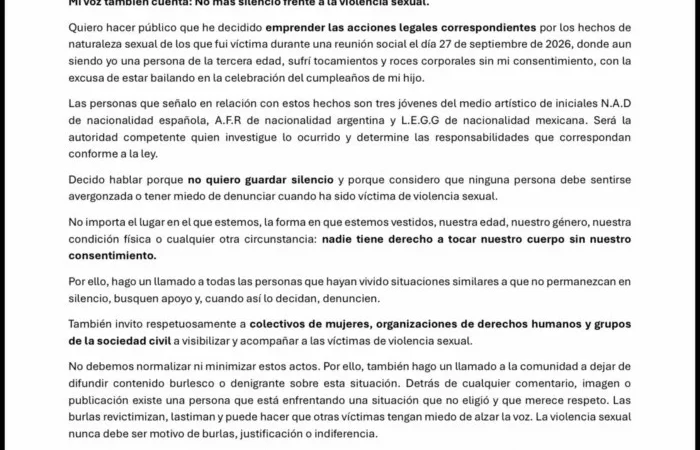
The social media outcry quickly transitioned into official legal action. The reputable law firm CUR issued a public statement, signed by Cristina Romero, formally announcing the initiation of legal proceedings. The statement meticulously detailed the allegations, asserting that Romero "suffered touchings and bodily rubbings without my consent, under the excuse of dancing at my son’s birthday celebration." This formal declaration underscored the seriousness with which Romero and her legal representatives are pursuing the matter, moving beyond the realm of online criticism into the judicial system.
Crucially, Romero’s statement explicitly named the individuals involved: "The persons I point out in relation to these events are three young people from the artistic milieu with the initials N.A.D., of Spanish nationality; A.F.R., of Argentine nationality, and L.E.G.G., of Mexican nationality." While the full names were initially withheld in the statement, the context clearly identifies Naim Darrechi, Agustín Fernández, and Luis Eduardo Guillén González, implicating all three in the alleged sequence of events. Romero’s statement concluded with a firm resolve: "It will be the competent authority who investigates what occurred and determines the corresponding responsibilities in accordance with the law." This move signifies a clear intent to seek justice and establish legal precedent regarding behavior at public events involving prominent figures.
Darrechi’s Public Apology: A Shift in Stance
Days after the formal complaint and widespread condemnation, Naim Darrechi adopted a markedly different tone. During a live stream broadcast to his considerable audience, the influencer offered an apology for his conduct. He acknowledged having "taken too many liberties" and expressed a recognition of the need to "learn to guard those limits." This public apology, while coming after the formal complaint and initial defiant statements, suggested a potential realization of the gravity of the situation and the severe implications for his career and public image. However, the timing and context of the apology have also led to scrutiny, with some questioning its sincerity given the preceding legal action.
Key Figures in the Controversy
The incident brings into focus several prominent figures within the digital media landscape, each with distinct roles and implications in the unfolding drama.
Naim Darrechi: A Profile in Digital Fame and Controversy
Naim Darrechi is a Spanish influencer who has cultivated a massive following, particularly among younger audiences, through his presence on platforms like TikTok and Instagram. Known for his often provocative content, lifestyle vlogs, and interactions with other influencers, Darrechi has built a significant digital empire. However, his career has not been without its share of controversies. Past incidents, though distinct from the current allegations, have sometimes seen him criticized for controversial statements or actions, contributing to a public perception that oscillates between admiration and contention. His large following, which translates into considerable influence, also places a greater onus on him to model responsible behavior, making the current allegations particularly damaging to his personal brand and professional standing. The legal action now represents a significant challenge to his career, potentially impacting endorsements, collaborations, and his overall public image.
Cristina Romero: The Complainant’s Stand
Cristina Romero is the mother of Mexican content creator Abelito, who was celebrating his birthday when the alleged incident occurred. Her decision to file a formal complaint is a powerful act of advocacy, particularly given her public identity and the sensitive nature of the allegations. Her statement, emphasizing her status as an "elderly person" and implicitly referencing her acondroplasia (dwarfism), highlights potential vulnerabilities and underscores the importance of protecting individuals from non-consensual physical contact, regardless of their background or physical characteristics. Her courage in coming forward against prominent public figures is a testament to her resolve and serves as an important example for victims of similar experiences.
Agustín Fernández and Luis Eduardo Guillén González: Co-accused and Witnesses
Agustín Fernández, an Argentinian influencer, has been named in Cristina Romero’s formal complaint as one of the individuals involved in the alleged incident. His reported participation alongside Darrechi places him under similar legal scrutiny. Luis Eduardo Guillén González, known as "Suavecito," a Mexican influencer, was the individual with whom Darrechi initially discussed the incident, making him a potential witness to Darrechi’s initial interpretation of events. While his direct involvement in the physical act is not explicitly detailed in the same manner as Darrechi and Fernández, his presence during Darrechi’s controversial remarks makes his role relevant to the ongoing investigation. The legal implications for Fernández and Guillén González will depend on the specifics of the investigation and the extent of their alleged involvement or knowledge.
The Legal Landscape: Understanding Mexican Law on Sexual Abuse
The formal complaint against Naim Darrechi and others will be subject to the legal framework of Mexico, where the incident occurred. Mexican law, like many jurisdictions globally, takes a serious stance on non-consensual physical contact, classifying it under various forms of sexual offenses.

Defining Non-Consensual Touching
In Mexico, acts such as "tocamientos y roces corporales sin consentimiento" (touchings and bodily rubbings without consent) can fall under the umbrella of sexual abuse (abuso sexual) or similar offenses, depending on the specific nature and intent. The fundamental principle is the absence of consent, which is legally defined as a clear, voluntary, and ongoing agreement to engage in specific physical contact. Any physical contact without explicit consent is deemed a violation of bodily autonomy and can lead to criminal charges. The legal system will scrutinize the video evidence, witness testimonies, and Romero’s account to determine if the elements of a sexual offense are met.
Potential Penalties and Aggravating Factors
Should the investigation confirm the allegations and lead to a conviction, the individuals involved could face significant legal consequences. In Mexico, penalties for sexual abuse typically range from 6 months to 6 years of imprisonment, as outlined in various state and federal penal codes. However, several factors could potentially act as aggravating circumstances, leading to more severe penalties:
- Age of the Victim: Cristina Romero’s status as an "elderly person" (persona de la tercera edad) can be considered an aggravating factor. Laws often provide enhanced protections for older adults, recognizing their potential vulnerability and increasing the severity of penalties for crimes committed against them.
- Vulnerability Due to Physical Condition: Romero’s acondroplasia (dwarfism) could also be recognized as a factor contributing to her vulnerability. Exploiting or disregarding the physical condition of a person, which may limit their ability to resist or escape, can be seen as an aggravating circumstance in legal proceedings, demonstrating a heightened level of culpability.
- Multiple Perpetrators/Joint Participation: The alleged involvement of more than one individual (Darrechi, Fernández, and potentially Guillén González) in the incident could also be considered an aggravating factor. When multiple individuals participate in an offense, it can suggest a greater degree of planning, intimidation, or a collective disregard for the victim’s rights, potentially leading to increased sentences for all involved.
The Role of the Competent Authorities
The complaint will trigger an investigation by the competent legal authorities in Mexico. This process will involve gathering evidence, interviewing witnesses, analyzing the video footage, and potentially conducting forensic examinations. Based on the findings, prosecutors will determine whether to formally press charges and proceed with a trial. The legal system aims to ensure a thorough and impartial investigation to determine criminal liability and administer justice in accordance with the law.
Echoes in the Digital Sphere: Public Reaction and Media Scrutiny
The incident involving Naim Darrechi has not only resulted in legal action but has also reverberated profoundly across digital platforms, shaping public discourse and subjecting all parties to intense media scrutiny.
Viral Videos and Social Media Outcry
The immediate dissemination of the videos capturing the alleged incident ensured that the events at Abelito’s birthday party quickly became a viral sensation. Millions of views, shares, and comments flooded platforms like TikTok, X (formerly Twitter), and Instagram. Hashtags related to Darrechi, Abelito, and Cristina Romero trended, transforming the private celebration into a very public spectacle. The widespread availability of the footage allowed for immediate public judgment and condemnation, putting immense pressure on Darrechi and his associates. This rapid viral spread underscores the power of social media in breaking news and mobilizing public opinion, often ahead of formal legal processes.
The Debate on Consent and Influencer Ethics
Beyond the immediate criticism of Darrechi, the incident has sparked a broader, more nuanced debate on the critical issue of consent. Discussions have focused on what constitutes consent, especially in casual social settings, and how it applies to interactions between individuals with varying levels of public recognition and power dynamics. The case has served as a stark reminder that consent must be explicit, continuous, and freely given, without coercion or implied obligation.
Furthermore, the controversy has reignited conversations about the ethical responsibilities of influencers. As public figures with vast reach, particularly among impressionable younger audiences, influencers are often expected to uphold certain standards of conduct. The Darrechi incident has prompted many to question whether some influencers are sufficiently aware of the impact of their actions and the importance of modeling respectful behavior. The pressure on brands and platforms to hold their sponsored creators accountable for their conduct has also intensified.
Reputational Ramifications
For Naim Darrechi, the reputational damage from this incident is likely to be substantial and long-lasting. His initial dismissive comments, followed by a later apology, have been dissected by the public. Such controversies can severely impact an influencer’s career, leading to loss of endorsement deals, diminished engagement, and a tarnished public image. Brands are increasingly wary of associating with personalities involved in legal or ethical scandals, given the potential for negative public relations. The case serves as a cautionary tale for all public figures about the fragility of their online persona and the severe consequences of perceived misconduct.
Broader Implications: Accountability in the Age of Influencers
The Naim Darrechi case extends beyond the individuals involved, touching upon broader societal implications concerning accountability, victim advocacy, and the evolving norms of public behavior in the digital age.
Setting a Precedent for Digital Personalities
This legal complaint could set an important precedent for how sexual misconduct allegations against influencers are handled within the legal system. As the lines between online and offline life blur for digital personalities, and as their influence grows, so does the expectation for them to adhere to legal and ethical standards. A judicial outcome in this case could send a clear message to the influencer community and their audiences that fame and followers do not grant immunity from legal accountability for inappropriate or criminal behavior. It could encourage a more responsible approach to content creation and public interaction among influencers.
The Importance of Victim Advocacy
Cristina Romero’s decision to pursue legal action is a powerful act of victim advocacy. It underscores the importance of individuals coming forward to report alleged misconduct, even when faced with the considerable public platform and resources of an accused influencer. Her bravery in navigating the public scrutiny and legal complexities provides an inspiring example for others who may have experienced similar violations but hesitated to seek justice. The case highlights the critical role of legal support and public solidarity in empowering victims.
Shifting Norms Around Public Behavior and Consent
The incident reflects and contributes to a broader societal shift in understanding and demanding respect for personal boundaries and explicit consent. There is a growing intolerance for behaviors that were once perhaps dismissed as harmless or merely "awkward." This case, amplified by social media, reinforces the idea that consent is non-negotiable and that everyone, regardless of their public status or the setting, is entitled to bodily autonomy and respect. It signals a move towards a culture where accountability for inappropriate physical contact is increasingly expected and enforced, even in contexts perceived as informal or celebratory.
Conclusion: Awaiting Judicial Resolution
As the legal process unfolds, the eyes of both the digital world and the justice system will be on this case. The complaint against Naim Darrechi and his associates represents a critical moment for examining the intersection of influencer culture, personal conduct, and legal accountability. The outcome will not only determine the fate of the individuals involved but will also contribute significantly to the ongoing global dialogue about consent, the responsibilities of public figures, and the pursuit of justice for victims in the digital age. The competent authorities are now tasked with the meticulous investigation and adjudication of the alleged events, promising a resolution that will resonate far beyond the confines of Abelito’s birthday celebration.

0 Comments