
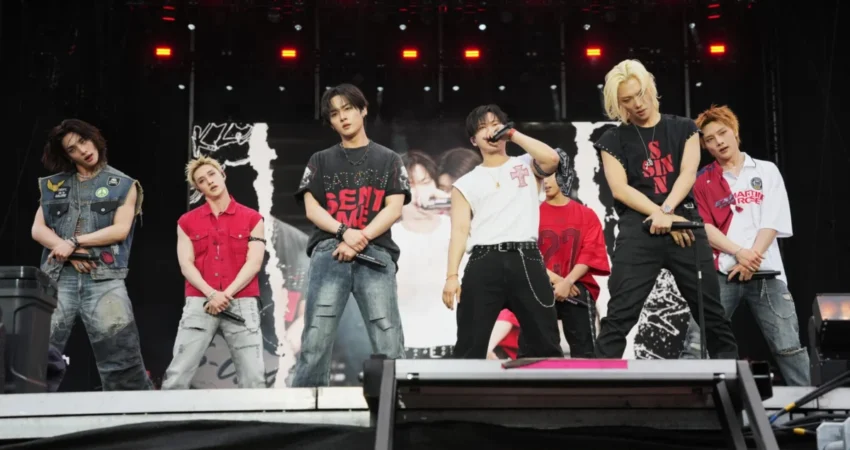
Mexican President Claudia Sheinbaum has acknowledged a miscommunication that led to an anticipated visit by the globally renowned K-pop group Stray Kids to the National Palace on Thursday, September 24th. The President admitted she had believed the popular South Korean ensemble would be accompanying South Korean President Lee Jae Myung during his official visit, a detail that had been previously announced and subsequently resulted in a significant gathering of the group’s dedicated fanbase outside the presidential residence.
The highly anticipated performances by Stray Kids are scheduled for September 25th and 26th at the Estadio GNP Seguros in Mexico City, marking a significant cultural event for the nation’s vibrant K-pop community. The initial announcement of the group’s potential presence at the National Palace, made by President Sheinbaum herself, created considerable excitement and anticipation among the "STAYs," the official fandom name for Stray Kids’ supporters.
In a video shared on her official TikTok account on Thursday evening, President Sheinbaum addressed the situation, stating, "We are seeing off the president of the Republic of Korea, Lee Jae Myung. We thought perhaps he was coming with the group Stray Kids. They are performing tomorrow at one of Mexico City’s most important venues. And we have already invited them to come to our country on another occasion." This statement confirmed that the group’s appearance at the presidential headquarters was not part of the planned itinerary for President Lee’s visit.
The confusion originated from President Sheinbaum’s earlier press conference on Thursday morning. During this briefing, she had explicitly announced a visit by Stray Kids in conjunction with the South Korean leader. Her remarks at the time described the group, noting, "The group coming is called Stray Kids. They’re kind of like BTS, but younger. I don’t know if they’re boys and girls – they’re young, younger than the members of BTS." This comparison to BTS, another global K-pop phenomenon, underscored the perceived cultural significance of Stray Kids’ potential presence.
For context, Stray Kids’ members range in age from 25 to 28, while the members of BTS are between 29 and 33 years old. This age difference, while seemingly minor, was highlighted by the President to articulate the group’s contemporary appeal and their position within the evolving K-pop landscape.
The President’s initial announcement about Stray Kids’ intended visit had a tangible effect, drawing dozens of the group’s fans to the vicinity of the National Palace. The expectation was that the members would join President Sheinbaum and President Lee on the presidential balcony to greet the gathered crowd. However, only President Sheinbaum and President Lee Jae Myung appeared on the balcony and subsequently emerged at the building’s entrance to acknowledge those who had assembled in the Zócalo, the main public square. Videos capturing this moment, showing the two leaders and the expectant crowd, quickly circulated on social media platforms, amplifying the narrative of the miscommunication.
This incident draws a parallel to a significant event involving BTS in May of the previous year. During their visit, the members of BTS did meet with President Sheinbaum. They appeared on one of the balconies of the presidential residence, waving to an estimated 50,000 members of ARMY, BTS’s fanbase, who had gathered in the Zócalo. This previous interaction set a precedent for how high-profile K-pop groups are received and celebrated in Mexico, perhaps contributing to the widespread anticipation for Stray Kids’ potential appearance.
Background of Stray Kids and Their Global Appeal
Stray Kids, formed by JYP Entertainment in 2017, has rapidly ascended to global superstardom. Comprising eight members – Bang Chan, Lee Know, Changbin, Hyunjin, Han, Felix, Seungmin, and I.N – the group is renowned for its self-produced music, often characterized by its distinctive "noise music" genre, powerful performances, and strong lyrical messages that resonate with themes of youth, self-discovery, and overcoming challenges.
Their discography includes multiple chart-topping albums, such as "5-Star" and "Rock-Star," which have achieved significant commercial success both domestically in South Korea and internationally, particularly in the United States and Europe. The group has consistently ranked high on global music charts, including the Billboard 200, demonstrating their substantial and growing fanbase worldwide. Their concerts are typically characterized by high energy and elaborate stage productions, drawing tens of thousands of fans to each venue.
The Significance of K-Pop in Mexico
The K-pop phenomenon has a strong and dedicated following in Mexico. The country has emerged as one of the largest markets for South Korean popular culture in Latin America. This enthusiasm is fueled by accessible online content, dedicated fan communities, and the increasing frequency of international tours by prominent K-pop groups. The popularity of groups like BTS and now Stray Kids highlights a significant cultural exchange and a deep engagement between Mexican youth and South Korean entertainment.
The Mexican government, recognizing this cultural influence, has on occasion engaged with K-pop artists. As evidenced by the BTS visit, such interactions can generate substantial public interest and serve as diplomatic touchpoints. President Sheinbaum’s initial announcement, while based on a misunderstanding, reflects an awareness of Stray Kids’ cultural impact and a desire to engage with such prominent global artists.
Implications of the Miscommunication
The miscommunication, while likely unintentional, underscores several key aspects of contemporary celebrity culture and diplomatic engagement. Firstly, it highlights the immense power and reach of K-pop fandoms. The swift mobilization of dozens of fans to the National Palace based on a single announcement demonstrates the deep connection and loyalty fans feel towards their idols.
Secondly, it points to the evolving nature of public diplomacy and cultural exchange. Governments are increasingly aware of the soft power wielded by popular cultural entities. In this instance, the anticipation surrounding Stray Kids’ potential presence at the National Palace indicates a recognition of the group’s status as cultural ambassadors.
Finally, the incident serves as a reminder of the importance of clear and precise communication, especially in public-facing roles. While President Sheinbaum’s follow-up statement was gracious, the initial misunderstanding led to a situation that, while ultimately harmless, could have been managed with greater clarity. The group’s upcoming concerts are expected to be major events, drawing a significant audience and contributing to the local economy. The excitement surrounding their performances remains high, undeterred by the earlier confusion. The fact that the group is performing in Mexico City for two nights at a major stadium signifies their substantial popularity and the demand for their live shows in the region. Their concerts are anticipated to be a major cultural event, further cementing their presence in the Latin American music scene.
The engagement of political figures with global music artists is becoming increasingly common, reflecting the interconnectedness of culture, politics, and global commerce. As K-pop continues its global expansion, such instances of cultural engagement, whether perfectly executed or marked by minor missteps, will likely continue to be a feature of international relations and public discourse. The focus now shifts to the highly anticipated performances, where Stray Kids will undoubtedly deliver the powerful and engaging shows that have earned them a devoted global following.

0 Comments