
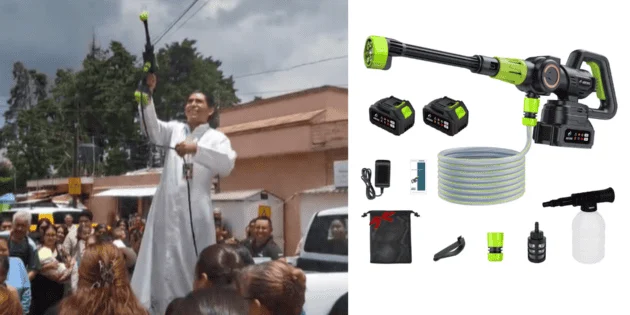
A video capturing an unprecedented moment during a religious celebration in Contepec, Michoacán, Mexico, has exploded across social media platforms, primarily TikTok, depicting a Catholic priest using a Karcher power washer to dispense holy water to hundreds of congregants. The extraordinary scene, which amassed millions of views and thousands of comments within days of its upload, has ignited a global discussion regarding the boundaries of innovation in religious rites, drawing a sharp divide between those who lauded the priest’s resourceful and engaging approach and critics who deemed the method undignified and inappropriate for a sacred ceremony. This event, set against the backdrop of traditional festivities honoring Santiago Apóstol, has become a potent symbol of the evolving interplay between ancient spiritual practices and modern-day adaptability, particularly within dynamic community contexts.
Context and Setting: The Heart of Michoacán’s Popular Religiosity
The viral incident unfolded during the vibrant annual festivities dedicated to Santiago Apóstol (Saint James the Greater), a patron saint deeply revered across Mexico and Latin America. These celebrations, typically observed around July 25th, are often characterized by a rich tapestry of religious devotion, cultural traditions, music, dance, and communal gatherings that can span several days. In communities like Contepec, a municipality nestled in the northeastern part of Michoacán, these festivities are not merely religious observances but pivotal social and cultural events that unite residents, often including those who have migrated elsewhere but return for these significant occasions. Michoacán, a state renowned for its strong Catholic heritage and deeply rooted popular religiosity, provides a fertile ground for such expressions of faith, where traditional reverence often coexists with unique local adaptations and a profound sense of community participation.
Contepec, a largely rural municipality with a population reflecting a significant indigenous heritage and strong agricultural traditions, embodies many characteristics of Mexican communities where the local parish priest often serves not only as a spiritual leader but also as a central figure in community life, social cohesion, and even practical organization. The challenges of ministering to large congregations, especially during outdoor processions or open-air masses common in these festivities, can be considerable. Ensuring that all attendees, particularly those in sprawling crowds or along lengthy routes, feel included in blessings and rituals requires creative solutions, a context that sheds light on the rationale behind Father Rubén Pérez Rubio’s unconventional method. The very nature of these communal gatherings often encourages a more participatory and less rigidly formal atmosphere than indoor church services, allowing for a degree of improvisation in the pursuit of greater engagement and a shared celebratory spirit. This cultural backdrop is crucial for understanding why such a method, while shocking to some external observers, might have been readily embraced by the local populace.
The Genesis of a Viral Sensation: A Chronology of Dissemination
The specific blessing captured in the video is understood to have occurred during the peak of the Santiago Apóstol festivities, likely in late July, a traditional period for these celebrations across the region. The moment was filmed by an attendee and subsequently uploaded to TikTok by user @michoveal, quickly transcending its local origins to become a global talking point. The video prominently features Father Rubén Pérez Rubio standing in the elevated bed of a white pick-up truck, a common and practical platform for religious leaders or dignitaries during parades and community events in rural Mexico. From this vantage point, he skillfully wielded a Karcher brand power washer, directing a steady, fine stream of what was identified as holy water over the assembled faithful lining the route. The spray reached individuals across various age groups – women, men, children, and the elderly – all actively participating in the celebration, many extending their hands or smiling towards the priest.
The rapid dissemination of the video across TikTok, and subsequently other social media platforms, underscores the immense power of digital media in transforming localized events into worldwide phenomena. Within hours and days of its posting, the clip garnered millions of views, shares, and a torrent of comments in multiple languages, reflecting its broad international appeal and the immediate curiosity it provoked. This immediate viral explosion highlights how easily content that combines an unusual visual with a culturally significant and religiously charged context can capture the public imagination, often sparking intense debate across diverse audiences. The clear visual of a universally recognizable tool – a a power washer – being used in an entirely unexpected, sacred context was inherently shareable, provocative, and immediately understandable across cultural barriers.
Father Rubén Pérez Rubio’s Rationale and Local Community Reception
According to local testimonies and comments shared on social media by attendees, the priest at the center of the viral sensation is Father Rubén Pérez Rubio. His decision to employ the power washer was reportedly motivated by a practical and pastoral desire: to extend the blessing to a greater number of people and to inject a more dynamic and interactive element into the religious celebration. In crowded outdoor settings, especially along lengthy procession routes or in large open spaces characteristic of these festivals, traditional methods of blessing, such as sprinkling with an aspergillum (a liturgical implement designed for sprinkling holy water), can be limited in reach and often prove insufficient for truly engaging hundreds or thousands of attendees simultaneously. Father Pérez Rubio’s innovative approach appears to have been a pragmatic solution to a logistical challenge, aiming for broad inclusivity and ensuring that as many faithful as possible could receive the blessing.
Crucially, the video itself provides significant insight into the immediate reactions of the congregants present. Far from displaying discomfort, offense, or confusion, many attendees are seen responding with smiles, laughter, and an evident sense of humor, actively embracing the unusual method of blessing. Children are seen reaching out, adults are seen laughing good-naturedly, and the overall atmosphere appears joyful and participatory. The priest is also heard pronouncing a traditional blessing, stating, "Que mi magnínima misericordia derrame sus gracias sobre todos ustedes" (May my magnificent mercy pour out its graces upon all of you), reinforcing the spiritual intent behind the action and ensuring the message of divine grace was clearly communicated. This overwhelmingly positive and lighthearted reception from the local community suggests that, within the immediate cultural and pastoral context, the method was perceived not as a desecration or an act of disrespect but as a creative, efficient, and even endearing way for the priest to connect with his flock and ensure everyone felt included in the blessing. This local perspective is vital in understanding the event beyond the often-judgmental lens of external, online commentary. It speaks to a communal spirit where adaptability, a sense of shared experience, and a certain degree of playful reverence can sometimes override strict adherence to conventional form.
Theological and Liturgical Considerations: A Fact-Based Analysis
The use of holy water holds profound significance within the Catholic Church. It is a sacramental, an object or action instituted by the Church to prepare recipients for grace and to dispose them to cooperate with it. Holy water is blessed by a priest through a specific rite and is used for various purposes, including blessings of persons, objects, and places; purification; and as a reminder of baptismal vows. The act of blessing with holy water is intended to invoke divine favor, protection, and sanctification upon individuals or their environment. Traditionally, holy water is dispensed by sprinkling it with an aspergillum, by immersion, or through personal use, such as making the sign of the cross with it upon entering a church or home.
From a purely theological standpoint, the validity of a blessing typically hinges on two primary factors: the proper intent of the minister (the priest) and the use of validly blessed water. Assuming Father Pérez Rubio intended to confer a blessing and the water in the power washer had been properly blessed according to the Church’s rites, the core spiritual efficacy of the blessing would generally be considered intact, regardless of the unconventional delivery mechanism. The Church’s liturgical norms primarily guide the manner of ritual performance, aiming for reverence, decorum, and symbolic clarity, ensuring that the outward form reflects the inward spiritual reality. While the power washer undeniably deviates significantly from these established norms, it does not inherently invalidate the spiritual act itself, as long as the essential elements (intent and blessed water) are present.
The ensuing debate thus centers less on the theological validity and more on the liturgical appropriateness, symbolic resonance, and pastoral prudence of the method. Critics argue that employing a device typically associated with industrial cleaning and maintenance might diminish the solemnity, sacredness, and dignity of the ritual. They contend that the unconventional symbolism of the power washer could overshadow the profound spiritual significance of the holy water, potentially trivializing a sacred act and undermining the reverence due to religious ceremonies. Conversely, proponents argue that the priest’s pastoral intent—to reach and engage a large number of people in a meaningful way—is paramount. They might suggest that in an increasingly secularized world, or in contexts where traditional methods fall short in reaching vast crowds, creative adaptations might be necessary to make faith more accessible, inclusive, and relatable, especially to younger generations or in dynamic community settings. This tension between strict liturgical adherence and pastoral innovation, between preserving tradition and ensuring effective evangelization, is a recurring theme in contemporary religious practice globally.
Broader Impact: Online Reactions and Potential Official Responses
The viral video has served as a powerful catalyst for a wide spectrum of online reactions, vividly highlighting the diverse perspectives on religious practice in the modern age. On one side, numerous social media users expressed admiration for Father Pérez Rubio’s inventiveness, praising his ability to connect with his community in a memorable, efficient, and engaging way. Comments such as "This priest understands modern problems require modern solutions!" or "Blessings delivered with Karcher power – efficiency meets spirituality! God bless him!" circulated widely, often accompanied by laughing emojis or expressions of appreciation for the priest’s approachable style. Many saw it as a refreshing departure from overly rigid traditions, fostering a sense of joy, inclusivity, and community spirit that resonated with their own understanding of faith. Some even quipped that it was a "power blessing" for the soul.
However, a significant portion of the online discourse was critical, with users expressing concerns about the perceived lack of reverence and the potential for trivializing a sacred ritual. Comments like "This is disrespectful to the sacrament, where is the solemnity?" "Tradition must be upheld, not turned into a spectacle," or "The Church should not compromise its dignity for viral fame" reflected a sentiment that religious acts should maintain a certain decorum and gravity befitting their sacred nature. Some users even questioned the suitability of the water pressure, humorously or seriously, for direct application on individuals, particularly children and the elderly, raising minor safety concerns or simply pointing out the absurdity from a traditional perspective. This stark dichotomy in reactions underscores the broader cultural tension between maintaining traditional religious forms and adapting to contemporary contexts and sensibilities, particularly when amplified by the instantaneous and often decontextualized nature of social media.
While no official statement from the Diocese of Zamora, which encompasses Contepec, Michoacán, has been publicly issued regarding this specific incident, such unconventional practices often prompt internal discussions within ecclesiastical authorities. Dioceses typically strive to balance pastoral creativity and dynamism with adherence to established liturgical norms and guidelines outlined in Church law and tradition. In similar past instances of priests employing unusual methods—such as "drive-through" confessions or blessings delivered from a distance during the COVID-19 pandemic—diocesan responses have varied. Some have offered tacit approval, acknowledging the pastoral need in extraordinary circumstances, while others have issued gentle reminders about maintaining liturgical decorum and the symbolic integrity of sacred rites. The absence of a public rebuke in this case could imply an ongoing internal review, a strategic decision not to further amplify the controversy, or perhaps even an understanding that within the specific local context, the act was received positively by the community and was genuinely intended as a blessing. The Church often encourages priests to be dynamic and creative in their ministry but also to ensure that innovations do not inadvertently detract from the dignity, reverence, and meaning of sacred rites.
Precedents and the Evolving Landscape of Ministry
While the specific use of a power washer for holy water distribution is undeniably unique and unprecedented in its virality, the broader concept of adapting ministerial practices to contemporary challenges is not entirely new within the history of the Church. Throughout its two-millennia existence, the Church has often found ways to innovate in its mission, from utilizing new technologies for evangelization (like printing presses or broadcast media) to adapting liturgical expressions to local cultures and languages, provided the core tenets of faith remain intact. More recently, global events like the COVID-19 pandemic forced many religious leaders worldwide to rethink how they could continue to minister to their flocks while observing public health protocols. This led to a surge in online masses, virtual confessions, and creative ways to offer blessings and sacraments from a safe distance, often utilizing technology in unprecedented ways.
These adaptations, while born out of necessity, have opened broader conversations about accessibility, engagement, and the role of technology in faith. The Michoacán incident, though not directly pandemic-related, taps into a similar spirit of problem-solving: how to effectively minister to a large, enthusiastic crowd in an open-air setting where traditional methods might be impractical. It highlights a recurring tension: where does practical ingenuity end and liturgical innovation begin? And at what point does innovation risk alienating a segment of the faithful who value tradition and solemnity above all else? The event in Contepec serves as a stark, albeit humorous and thought-provoking, illustration of these ongoing dialogues within the global Church, pushing the boundaries of what is considered conventional and prompting a reevaluation of what truly constitutes effective and reverent ministry in diverse cultural landscapes. It underscores that the Church, while deeply rooted in tradition, is also a living, adapting institution, constantly seeking ways to bring its message and graces to the faithful in an ever-changing world.
Conclusion
The viral video from Contepec, Michoacán, featuring Father Rubén Pérez Rubio blessing his congregation with a power washer, encapsulates a complex interplay of faith, tradition, innovation, and digital dissemination. What began as a local, perhaps even spontaneous, act of pastoral care during a cherished community festival quickly transformed into a global spectacle, sparking fervent debate across social media platforms. While the immediate community enthusiastically embraced the priest’s creative solution with humor and gratitude, the wider internet audience remained sharply divided, reflecting the enduring tension between liturgical conservatism and the call for greater accessibility and dynamic engagement in religious practice. This event serves as a compelling case study on how traditional institutions navigate modernity, how local cultural nuances can clash with global perceptions, and how a single video can ignite profound discussions about the very nature of sacred rites in an ever-evolving world. The Michoacán power washer blessing will undoubtedly remain a memorable, if unconventional, chapter in the ongoing narrative of religious adaptation, prompting continued reflection on the balance between reverence and relevance in contemporary worship.

0 Comments