
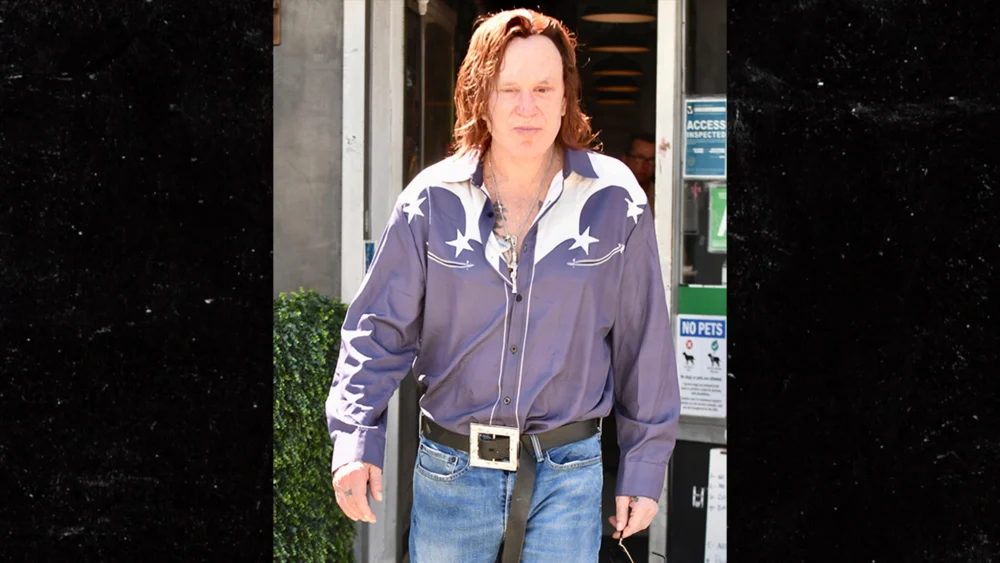
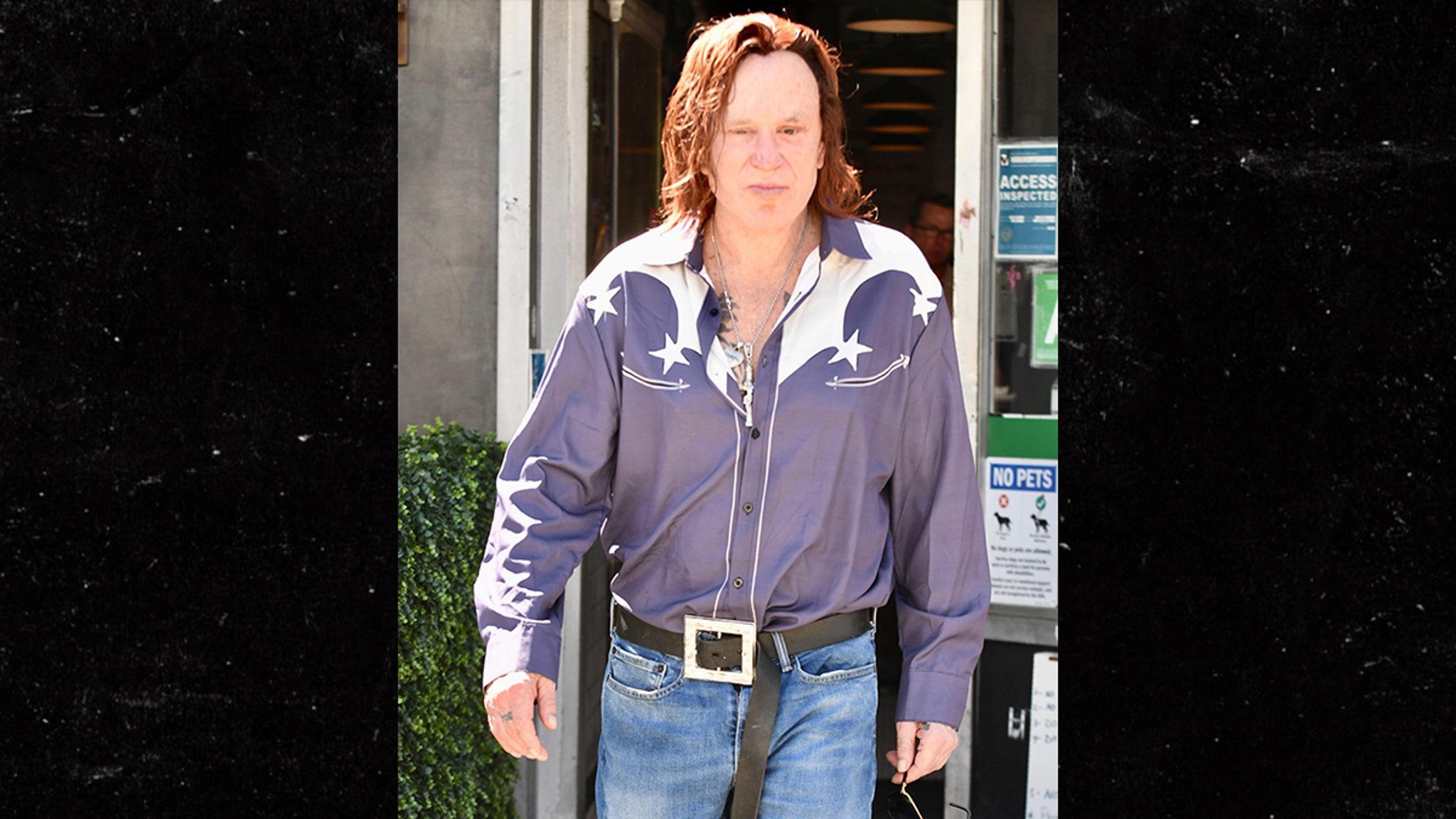
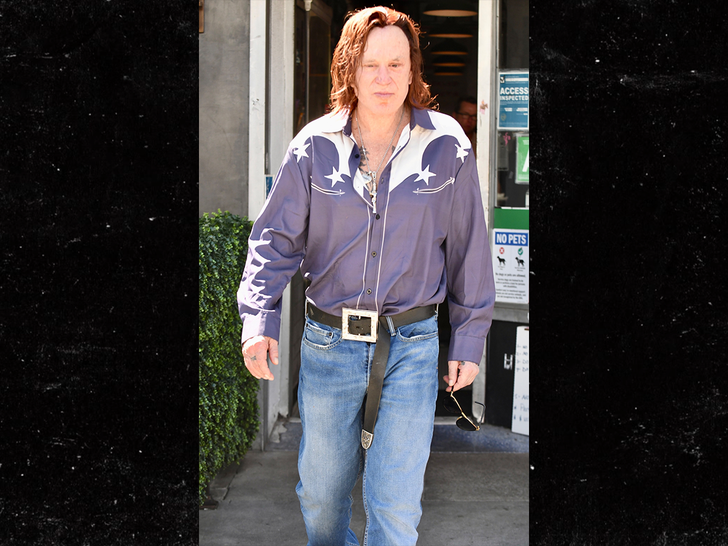
Veteran actor Mickey Rourke, known for his dynamic performances and equally tumultuous personal life, was recently observed in Beverly Hills sporting a striking new dark red hairstyle, a notable aesthetic shift occurring amidst a period of significant personal upheaval marked by a recent eviction ruling. The sighting, which took place on a Thursday afternoon, presented Rourke in his characteristic eclectic fashion, further fueling public interest in the star’s ongoing narrative. His appearance, characterized by a purple cowboy shirt and jeans, as he exited the popular Mulberry pizza establishment, quickly became a focal point for paparazzi, whose lenses captured the distinctive new coiffure that seemed to defy, or perhaps embrace, the current challenges he faces.
The Recent Eviction Ruling: A Legal Setback
The unveiling of Rourke’s vibrant new look coincided directly with news of a judge issuing a default eviction ruling against him, favoring his landlord in a protracted dispute over an apartment in Los Angeles. This legal development signifies the formal culmination of a tenant-landlord conflict that has reportedly seen the actor living in a hotel for several months alongside his canine companion. A default judgment typically arises when a defendant fails to respond to a legal summons or appear in court, allowing the plaintiff to win the case by default. While the specific legal nuances of this particular case remain under wraps beyond the public record of the judgment, the outcome underscores a challenging period for the Hollywood figure.
Rourke has publicly asserted his reasons for withholding rent, citing an alleged severe rodent infestation and other unresolved maintenance issues within the property. His claims suggest a dispute rooted in habitability concerns, a common ground for tenant grievances in rental agreements. The actor previously informed sources that these conditions rendered the apartment uninhabitable, thus justifying his decision to cease rental payments. This stance sets the stage for a classic landlord-tenant battle, where the obligation to pay rent is often linked to the landlord’s duty to maintain a safe and habitable living environment. The default ruling, however, indicates that Rourke’s defense, whatever its merits, was not formally presented or adjudicated in court, leading to a judgment in favor of the property owner based on the lack of a legal response.
A Chronology of Dispute and Displacement
The timeline leading to this eviction ruling paints a picture of escalating tensions and eventual displacement. According to previous reports, Rourke had checked into a hotel with his dog as early as January 5, 2026, signaling a pre-emptive move or an early stage of vacating the apartment long before the final judgment. His decision to stop paying rent, reportedly in March 2026, could have triggered the formal eviction proceedings, which in California, typically involve a series of notices and legal filings before a court date is set.
Once a landlord initiates an unlawful detainer action (the legal term for eviction in California), the tenant is served with a summons and complaint, requiring a formal response within a specific timeframe, usually five days. Failure to respond can lead to the landlord requesting a default judgment, as appears to have happened in Rourke’s case. This process, while seemingly swift in its final judgment, often involves weeks or even months of back-and-forth communication, attempts at resolution, and legal preparation. Rourke’s reported shift to hotel living suggests an awareness of the impending legal outcome or a proactive decision to remove himself from the disputed property, regardless of the ongoing legal battle. His recent public appearance, seemingly unperturbed by the legal setback, might indicate a degree of acceptance or perhaps a strategic move to project resilience in the face of adversity.
Mickey Rourke: A Career Defined by Resilience and Reinvention
To fully understand the context of Rourke’s current situation, it is imperative to delve into his storied career and public persona. Born Philip Andre Rourke Jr., the actor rose to prominence in the 1980s with critically acclaimed roles in films like "Diner" (1982), "Rumble Fish" (1983), and the controversial erotic drama "9 1/2 Weeks" (1986). His raw talent, unconventional good looks, and rebellious attitude quickly established him as a Hollywood iconoclast. However, his career trajectory was anything but linear.
The late 1980s and 1990s saw a downturn in his acting career, marked by a series of personal struggles, highly publicized feuds with directors, and a foray into professional boxing. From 1991 to 1994, Rourke stepped away from acting to pursue boxing, a move that left him with significant facial injuries requiring multiple reconstructive surgeries. This period profoundly impacted his appearance and public image, further solidifying his reputation as a maverick who defied conventional Hollywood expectations.
His triumphant return to critical acclaim came in 2008 with his Golden Globe-winning performance in Darren Aronofsky’s "The Wrestler," a role that many critics and fans saw as deeply autobiographical, mirroring his own struggles with professional decline and personal redemption. This powerful comeback cemented his status as a survivor and an actor capable of profound emotional depth. Subsequent roles in films like "Iron Man 2" (2010) and "The Expendables" (2010) further capitalized on his renewed popularity.
Rourke’s journey through Hollywood has always been characterized by a blend of artistic brilliance and personal turbulence. His financial stability has also been a subject of public discussion over the years, with various reports speculating on his net worth, given the peaks and valleys of his career. While his major roles undoubtedly commanded substantial fees, the nature of a career built on intermittent high-profile projects and periods of lower activity can lead to fluctuating income. Therefore, an eviction, even for a recognized celebrity, can highlight the precarious financial realities that even public figures can face, particularly when personal circumstances or legal disputes arise.
The Dynamics of the Los Angeles Rental Market and Celebrity Housing
The Los Angeles rental market is notoriously competitive and expensive, making housing a significant concern for residents across all socioeconomic strata, including celebrities. High demand, limited inventory, and soaring property values contribute to an environment where tenant-landlord disputes are not uncommon. For high-profile individuals, these disputes often become public spectacles, attracting media attention that might otherwise be absent in a typical eviction case.
While Rourke’s claim of a rodent infestation is specific to his situation, issues of property maintenance, unaddressed repairs, and disputes over living conditions are frequent points of contention in California’s robust tenant protection laws. Landlords have a legal obligation to provide habitable living conditions, and tenants have rights to report and seek remedies for deficiencies. However, proving these claims in court, especially against a default judgment, requires timely and proper legal action.
The fact that Rourke, a figure with a considerable public profile and presumably access to legal counsel, faced a default judgment raises questions about his engagement with the legal process. It could suggest a strategic decision to disengage from the legal battle once he had vacated the premises, a belief that his claims were self-evident, or simply an oversight in responding to the court. Regardless, the outcome serves as a reminder that even fame does not exempt individuals from the intricacies and consequences of civil law.
Implications and Public Perception
The news of Mickey Rourke’s eviction, juxtaposed with his seemingly defiant new hairstyle, sparks various interpretations and implications. On one hand, it invites sympathy, particularly given his stated reasons for withholding rent. The image of a celebrity grappling with a rodent problem in their home humanizes a figure often seen as larger than life, reminding the public that even stars can face mundane, frustrating living conditions. This narrative can resonate with many who have experienced similar landlord-tenant struggles.
On the other hand, a default judgment can prompt questions about personal responsibility and engagement with legal obligations. Some might view the situation through the lens of a wealthy individual seemingly avoiding rental payments, regardless of the alleged conditions. However, Rourke’s public statements have consistently framed his actions as a response to unaddressed issues, positioning himself as a tenant asserting his rights rather than simply neglecting responsibilities.
The "red hair" itself, a bold and attention-grabbing choice, can be seen as a symbolic gesture. In a classic sense, "painting the town red" implies a lively, celebratory outing, often associated with revelry and defiance. For Rourke, whose career has often been about self-expression and pushing boundaries, this visual statement could be interpreted as a form of artistic or personal rebellion against his current circumstances, a refusal to be defined by his legal woes. It projects an image of resilience and an unwillingness to be "shook up," as noted by observers.
For the entertainment industry, Rourke’s situation adds another layer to the ongoing discussion about celebrity finances, privacy, and public image management. While Hollywood is often associated with immense wealth, the reality for many actors, particularly those with non-linear careers, can be more complex. Such incidents highlight the often-unseen struggles that can affect even well-known personalities.
Looking Ahead: Rourke’s Next Chapter
As Mickey Rourke navigates the aftermath of this eviction and continues his stay in a hotel with his dog, his future housing situation remains a subject of public curiosity. Given his enduring appeal and recent acting projects, it is likely that he will secure new, permanent residence in due course. However, the public record of an eviction, even if a default judgment, could potentially complicate future rental applications, though his celebrity status and financial resources might mitigate some of these challenges.
Professionally, Rourke continues to take on roles, demonstrating his commitment to his craft. His ability to bounce back from adversity, both personal and professional, has been a defining characteristic of his career. The current situation, while a personal setback, is unlikely to derail his artistic endeavors. Instead, it merely adds another chapter to the complex, often dramatic, and undeniably compelling narrative of Mickey Rourke—a narrative that, much like his recent choice of hair color, refuses to fade quietly into the background. His appearance, seemingly unfazed, suggests a man ready to face his next challenge, whatever color he decides to paint it.

0 Comments