
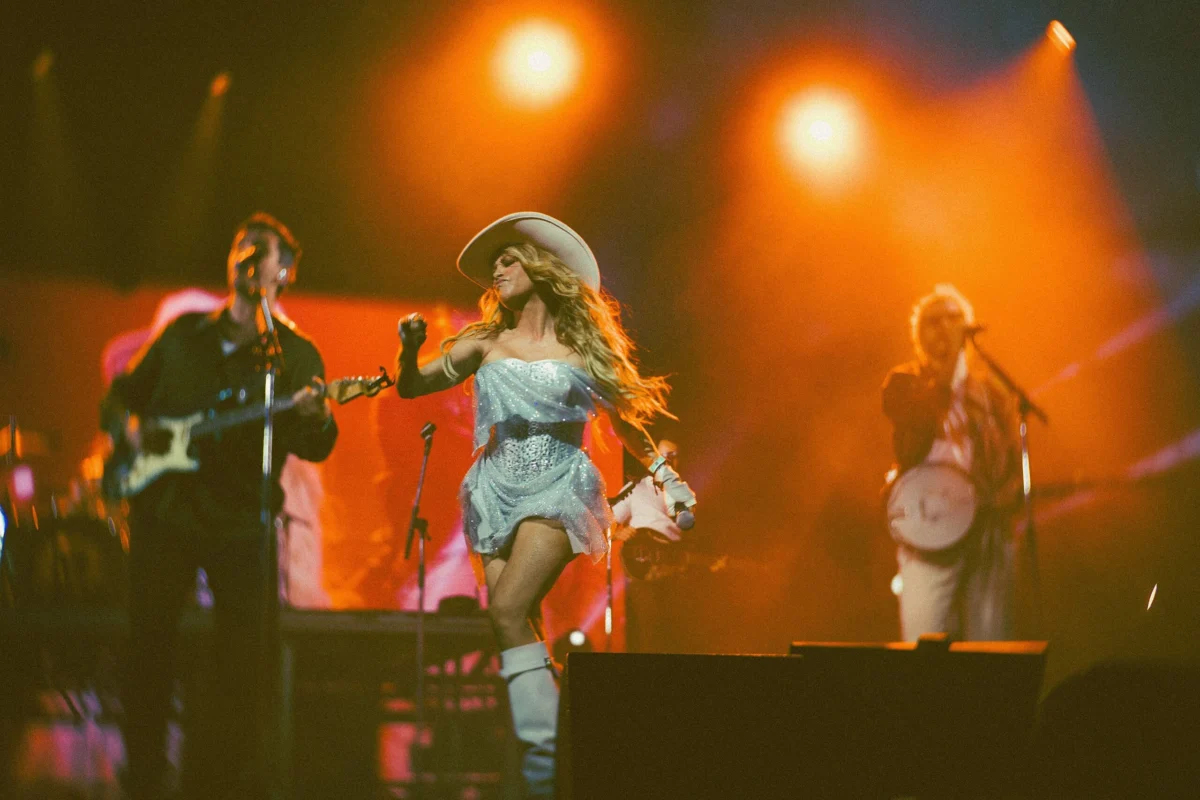
The Coachella Valley Music and Arts Festival has long served as a global stage for career-defining moments, and the 2026 edition proved to be no exception for Mexican pop icon Paulina Rubio. In a surprise appearance that bridged generational gaps and celebrated the enduring influence of Latin pop, Rubio joined the Colombian quartet Morat on stage for a high-energy performance that marked her first-ever appearance at the prestigious Indio, California, festival. Dressed in a striking silver minidress and iconic designer footwear, the singer known as "La Chica Dorada" (The Golden Girl) reinforced her status as a fashion and musical trailblazer, fulfilling a milestone that has eluded many of her contemporaries in the Latin music industry.
A Strategic Performance: The "Mi Nuevo Vicio" Connection
The centerpiece of the collaboration was a rousing rendition of "Mi nuevo vicio," a track that holds deep historical significance for both artists. Originally released in 2015 and gaining massive traction throughout 2016, the song served as Paulina Rubio’s comeback single after a three-year hiatus from the recording studio. At the time, Morat was an emerging band from Bogotá, and the collaboration with an established superstar like Rubio acted as their primary gateway into the international market.
Performing the track at Coachella 2026 represented a full-circle moment. For Morat, who have since evolved into one of the most successful Latin pop-rock groups globally, hosting the woman who helped launch their international career was a gesture of gratitude and a testament to their growth. For Rubio, the performance was a validation of her longevity in an industry that often prioritizes the "new." The chemistry on stage was palpable as the group transitioned from their signature folk-pop sound into the high-octane pop energy that Rubio has championed for over three decades.
Fashion as Narrative: The Givenchy Shark Lock Legacy
Paulina Rubio’s appearance was as much a fashion statement as it was a musical one. To mark her Coachella debut, she opted for a "glamorous cowboy" aesthetic, a trend that has seen a massive resurgence in 2026. The focal point of her ensemble was a pair of white gaiter boots, specifically the Shark Lock model by the French luxury house Givenchy.

The choice of the Shark Lock boot is significant within the fashion community. Originally introduced in 2012 by Ricardo Tisci during his tenure as Givenchy’s creative director, the boots became an instant icon of the 2010s. They were later revitalized under the creative direction of Matthew M. Williams between 2020 and 2024. By 2026, these boots have transitioned from a seasonal trend to a highly sought-after archival piece. Because the specific gaiter style seen on Rubio has been largely discontinued in recent production cycles, their appearance on the Coachella stage signaled Rubio’s deep connection to fashion history and her access to exclusive style archives.
Rubio’s relationship with high fashion is well-documented. In previous retrospectives of her career, she has noted that her stage presence is inextricably linked to the designers she wears. Her personal archive includes custom pieces from Dolce & Gabbana and Roberto Cavalli. Her choice to wear the Shark Lock boots—shoes that are recognized by "insiders" as a staple of modern luxury—aligned with the "Cowboy Core" atmosphere of Coachella while maintaining the polished, high-fashion edge that has defined her brand since her solo debut in the early 1990s.
The Evolution of Morat: From Fantasy to the Coachella Stage
For Morat—comprised of Juan Pablo Isaza, Juan Pablo Villamil, Simón Vargas, and Martín Vargas—the 2026 Coachella performance was the culmination of a decade of strategic international expansion. Following the set, the band took to social media to reflect on the journey, stating, "We used to fantasize that a tomorrow would come where we would play at Coachella. Today is that tomorrow."
The band’s trajectory is a case study in the globalization of Latin music. Unlike the reggaeton and urban artists who have dominated the charts in recent years, Morat has carved out a niche through instrumental proficiency and a focus on the singer-songwriter tradition. Their ability to draw a massive crowd at a mainstream US festival like Coachella highlights the diversifying tastes of the global audience. The inclusion of Paulina Rubio was not merely a nostalgic nod; it was a strategic move that unified the "classic" Latin pop era with the modern "pop-rock" resurgence.

Chronology of a Cross-Generational Partnership
To understand the weight of this 2026 performance, one must look at the timeline of the Rubio-Morat partnership:
- Early 2015: Morat, then a relatively unknown group, catches the attention of Rubio’s production team with the demo for "Mi nuevo vicio."
- February 2015: The single is officially released. It quickly climbs the charts in Spain and Mexico, eventually being certified Multi-Platinum.
- 2016: The song becomes a staple of Latin radio, effectively introducing Morat to the Latin Billboard charts and establishing Rubio’s relevance in the digital streaming era.
- 2017–2025: Morat achieves superstar status, selling out stadiums in Madrid, Mexico City, and Bogotá. Meanwhile, Rubio continues to tour, maintaining a loyal "Chicadictos" fan base while leaning into her legacy as a pop pioneer.
- April 2026: The two acts reunite on the Coachella stage, signaling a symbolic passing of the torch and a celebration of a shared milestone.
Data and Trends: The Rise of Latin Representation at Coachella
The appearance of Rubio and Morat is part of a broader trend of increased Latin American representation at major North American music festivals. Data from the last five years of Coachella lineups shows a 40% increase in Spanish-language acts across all stages. While the festival initially focused on "indie" and "alternative" Latin acts, the mid-2020s have seen a pivot toward mainstream pop icons and heritage acts.
Market analysis suggests that Coachella’s organizers are responding to the shifting demographics of festival-goers. With the Hispanic and Latino population in the United States reaching new heights and their purchasing power exceeding $2 trillion, booking artists like Paulina Rubio provides a bridge between the younger, English-dominant "Gen Z" attendees and their Spanish-speaking parents or older siblings. This "nostalgia-driven" booking strategy has proven successful for other legacy acts and was utilized effectively with Rubio’s surprise set.
Industry Implications and the "Legacy Act" Revival
Rubio’s successful debut at Coachella 2026 suggests a new chapter for her career, one where she is positioned as a "legacy icon" rather than just a contemporary pop star. This shift allows artists of her stature to headline or guest-star at alternative venues and festivals that were previously closed to "pure" pop acts.

Furthermore, the "Shark Lock" fashion moment highlights the growing importance of "visual storytelling" in the social media age. Images of Rubio in her silver dress and Givenchy boots circulated rapidly on platforms like Instagram and TikTok, garnering millions of impressions within hours. This synergy between high fashion, musical nostalgia, and festival culture serves as a blueprint for other Latin icons looking to rebrand for a global, digital-first audience.
Broader Cultural Impact
The collaboration also speaks to the strengthening ties between the Mexican and Colombian music industries. For decades, Mexico was the undisputed "launchpad" for Latin talent. While Mexico remains a vital market, Colombia has emerged as a creative powerhouse. The Rubio-Morat performance at Coachella 2026 represents a modern "union of powers," where the established Mexican "Queen of Pop" and the reigning Colombian "Kings of Pop-Rock" meet on neutral ground in the United States to assert their cultural dominance.
As the festival concluded, the consensus among critics and fans alike was that Rubio’s guest appearance was a highlight of the weekend. It provided a moment of pure, unadulterated pop joy in a lineup often dominated by experimental electronic music and rap. For Paulina Rubio, the 2026 Coachella festival was more than just a performance; it was a definitive statement that her "golden" era is far from over. For Morat, it was a reminder that while they have reached the pinnacle of the music world, they have not forgotten the "vices" and the mentors that helped them get there.

0 Comments