
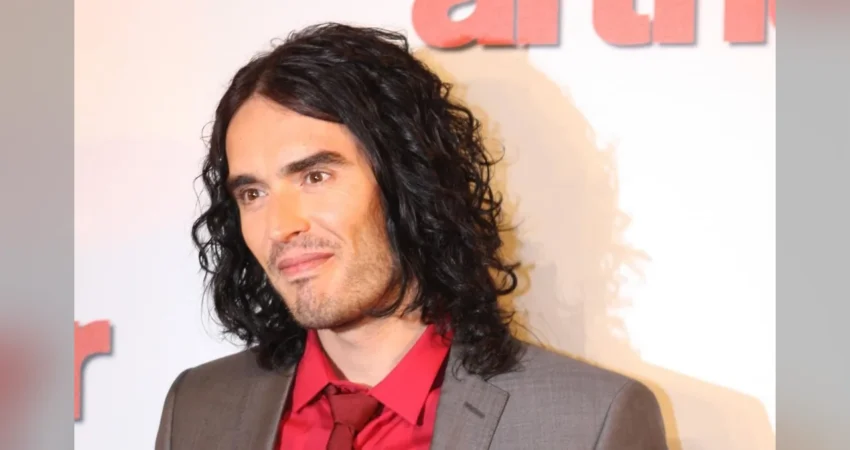
A London court has delivered a guilty verdict against actor and comedian Russell Brand, finding him culpable on one charge of rape and three counts of sexual assault. The 51-year-old British celebrity was taken into immediate custody following the pronouncement of the verdict, with his sentencing scheduled for Monday. The Metropolitan Police have also confirmed they are investigating two additional allegations of rape against Brand.
The landmark decision was announced by a jury at the Southwark Crown Court, comprising eight men and four women, after approximately eight and a half hours of deliberation that concluded a trial lasting nearly four weeks. Brand, who rose to international fame through his comedic performances and Hollywood roles, heard the verdict in the courtroom, accompanied by his wife, Laura Brand, who observed the proceedings from the public gallery.
Justice Joel Bennathan was unequivocal upon learning of the jury’s findings, informing the comedian that the consequence of the verdicts was "inevitably a significant custodial sentence." He ordered Brand’s immediate remand in custody, denying a bail application due to the risk of him absconding. The formal sentencing hearing has been set for the upcoming Monday.
The Full Scope of the Verdicts Against Russell Brand
In total, Russell Brand faced seven charges, including three counts of rape, three counts of sexual assault, and one count of attempted indecent assault. These accusations were brought forth by six women who testified anonymously, having been granted lifetime anonymity orders. The jury found Brand guilty on four of these charges.
The most severe charge, rape, pertains to an incident in 2009 involving a 21-year-old fan whom Brand met following one of his performances in West London. According to the victim’s testimony, the sexual assault occurred at Brand’s residence in the British capital.
Brand was also found guilty of indecently assaulting an MTV employee at a central London bar during a party in 2004. Further convictions include the sexual assault of another woman at a radio station between 2004 and 2005, and a sexual assault against a third woman in 2009 during the filming of a commercial.
Conversely, the jury acquitted Brand on two other rape charges and the charge of attempted indecent assault. The alleged offenses under investigation span a decade of Brand’s career, from 1999 to 2009, a period that saw his meteoric rise from a relatively unknown stand-up comedian to a globally recognized television and film star.
The Genesis of the Case: A Documentary’s Impact
Significantly, the women who came forward did not initially report the alleged incidents to the police. The situation dramatically shifted in September 2023 with the broadcast of a Channel 4 documentary and a coordinated journalistic investigation that brought the allegations into the public domain. This exposé prompted the accusers, individually, to step forward and formally report their experiences.
During the trial, the prosecution characterized Brand as a calculating and manipulative "sexual predator" with an "indiscriminate and voracious" appetite for sexual contact. Following the verdict, David Roberts, the Senior Crown Prosecutor for the London Rape and Serious Sexual Offences Unit, stated, "He was a predator and used his celebrity status to commit sexual offenses."
Russell Brand consistently denied all accusations. When he took the stand to testify, he maintained that all his sexual encounters were consensual, emphasizing that consent is "absolutely non-negotiable." He described the legal proceedings as "deeply traumatic" for his life. His defense team had argued that the documentary had "poisoned" the accusers, a contention vehemently rejected by the prosecution.
The Legal Ramifications and Ongoing Investigations
The guilty verdict has opened the door to significant legal consequences for Russell Brand. In the United Kingdom, the maximum penalty for rape is life imprisonment, while each charge of sexual assault can carry a sentence of up to ten years in prison. Legal analysts suggest that the comedian is likely to face a multi-year prison sentence when the judge delivers his sentence on Monday.
Further complicating Brand’s legal situation, it has been revealed that the Metropolitan Police are actively investigating new allegations of rape brought forward by two additional women. Detective Chief Inspector Andy Furphy, who led the initial investigation, expressed hope that the jury’s verdict would provide "value" and "confidence" to other potential victims, encouraging them to come forward and report their experiences.
Russell Brand’s career trajectory is well-documented. He achieved global recognition for his roles in films such as "Forgetting Sarah Marshall," "Get Him to the Greek," and "Arthur." His highly publicized marriage to singer Katy Perry ended in divorce in 2012. In recent years, Brand had pivoted to a significant online presence, cultivating millions of followers and presenting himself as an independent commentator, largely diverging from the traditional film and television studios that propelled him to stardom.
The legal proceedings and the public fallout from this case represent a significant moment for the #MeToo movement and underscore the challenges victims face in coming forward, particularly when confronting powerful public figures. The jury’s decision signifies a critical step towards accountability for alleged sexual misconduct.
Broader Societal Implications and Precedents
The case of Russell Brand has ignited discussions surrounding celebrity privilege, the power dynamics inherent in public life, and the long-term impact of sexual abuse. The fact that the allegations surfaced years after the alleged events, spurred by investigative journalism and documentary filmmaking, highlights the evolving landscape of how such accusations are brought to light and pursued through the justice system.
The prosecution’s portrayal of Brand as a "predator" who "used his celebrity status" resonates with broader societal concerns about the potential for individuals in positions of power to exploit their influence. The defense’s argument that the documentary "poisoned" the accusers, while ultimately unsuccessful, reflects a tactic sometimes employed in high-profile cases to cast doubt on the accusers’ motivations.
The ongoing police investigation into further allegations suggests that this case may continue to unfold, potentially leading to more legal challenges for Brand. The police’s explicit statement about encouraging other victims to come forward indicates a strategic effort to ensure comprehensive justice.
The potential sentencing of Russell Brand serves as a stark reminder of the legal consequences for those convicted of serious sexual offenses. The maximum penalties available underscore the gravity with which the legal system treats such crimes.
The media’s coverage of this trial has been extensive, reflecting the public’s keen interest in a figure who has occupied a prominent space in popular culture. The detailed reporting on the proceedings, from the jury’s deliberations to the statements of legal representatives, provides a transparent view of the judicial process.
Ultimately, the conviction of Russell Brand on multiple counts of sexual assault and rape marks a significant turning point in his public life and career. It is a development that will undoubtedly be dissected and analyzed for its implications on the entertainment industry, the legal system, and the ongoing societal dialogue around consent, accountability, and the protection of victims. The upcoming sentencing will provide further clarity on the judicial system’s response to these grave charges.

0 Comments