
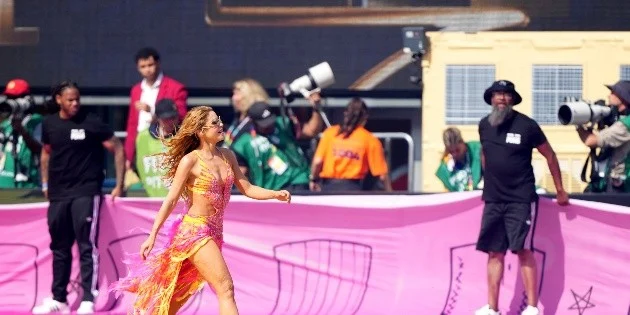
The global stage of the FIFA World Cup 2026, a tournament already making history with its multi-nation hosting, recently became the epicenter of an unexpected debate following pop icon Shakira’s two high-profile performances. While her musical contributions were undeniably a highlight, captivating millions worldwide, it was a persistent and intriguing "double" theory that truly ignited social media, drawing comparisons between her appearance at the tournament’s inauguration in Mexico City and her show-stopping act during the final in the United States. This viral speculation, which initially surfaced after the opening ceremony, gained renewed momentum and intensified scrutiny in the hours and days following the championship match, propelling it to the forefront of online discussions and overshadowing even some of the sporting achievements.
A Tale of Two Performances: Inauguration in Mexico City
The journey of this viral theory began on June 11, 2026, with the grand inauguration ceremony of the FIFA World Cup at the iconic Estadio Ciudad de México, also known as Estadio Azteca, in Mexico City. As one of the primary host nations alongside the United States and Canada, Mexico kicked off the tournament with a vibrant cultural celebration designed to showcase its rich heritage and passion for football. Shakira, a perennial favorite for World Cup anthems and performances, took to the stage to deliver a highly anticipated set. During her performance, the Colombian superstar was notably seen wearing dark sunglasses throughout, a detail that would later become a focal point of online conjecture. Observers across various social media platforms quickly began to circulate whispers, suggesting that the performer on stage might not have been Shakira herself, but rather a body double. These initial claims were often vague, centering on perceived discrepancies in her facial features, hair, and overall stage presence, though without concrete evidence. The sheer scale of the event, with billions tuning in globally, meant that even minor observations were amplified exponentially.
The Grand Finale: A Star-Studded Extravaganza in the United States
Weeks later, on July 19, 2026, the spotlight shifted to the MetLife Stadium in East Rutherford, New Jersey, USA, where the World Cup Final between Spain and Argentina unfolded. This championship match was preceded by one of the most ambitious and star-studded halftime shows in World Cup history. The 12-minute performance, which extended the traditional halftime break to a lavish 27 minutes, featured an unprecedented lineup of global music titans. Shakira shared the stage with an eclectic mix of artists including pop legend Madonna, global sensation Justin Bieber, K-Pop phenomenon BTS, and British rock band Coldplay. It was during this monumental show that Shakira delivered a captivating rendition of "Dai Dai," the official song of the Copa del Mundo 2026, alongside Nigerian superstar Burna Boy and the vibrant Mexican group Ghetto Kids.
However, beyond the dazzling lights and collaborative energy, a crucial detail emerged that inadvertently reignited the "double" theory. Unlike her inauguration performance, Shakira appeared on stage without her signature dark sunglasses. This seemingly minor change immediately caught the attention of eagle-eyed fans and online sleuths who had been tracking the earlier theory.
Unpacking the "Double" Theory: Mexico vs. USA
The contrasting appearances quickly fueled a renewed wave of comparisons across social media platforms, turning the "double" theory into a trending topic worldwide. Users meticulously analyzed side-by-side clips and images from both performances, highlighting what they perceived as stark differences between the two iterations of Shakira.
- The Sunglasses Anomaly: The most prominent piece of "evidence" cited by proponents of the theory was the presence of sunglasses during the Mexico City inauguration and their absence during the US final. The argument posited that the sunglasses in Mexico were a deliberate choice to obscure the face of a body double, a tactic allegedly deemed unnecessary or discarded for the final performance in the United States.
- Physical Appearance Discrepancies: Beyond the eyewear, countless internet users pointed to perceived differences in Shakira’s facial features. Claims ranged from subtle shifts in facial structure to variations in makeup application that, according to some, fundamentally altered her appearance. Her hair, too, came under scrutiny, with some suggesting dissimilarities in style, volume, or even color between the two shows. Furthermore, observations regarding her physique and overall figure were common, with some asserting a noticeable difference in build or energy levels.
- Stage Presence and Energy: Perhaps even more compelling for many was the alleged variance in her stage demeanor and performance intensity. Commentators suggested that the Shakira who performed in Mexico City appeared less dynamic, perhaps even somewhat reserved, compared to the vigorous, high-energy dancing and passionate engagement displayed during the final in the United States. This perceived difference in "Shakira-ness" became a cornerstone of the theory, suggesting that the individual in Mexico might not have possessed the same characteristic stage presence as the authentic artist.
- Playback Allegations: Adding another layer to the controversy, several internauts questioned whether the Mexico City performance had relied heavily on playback, or lip-syncing, a common practice in large-scale live productions to ensure vocal consistency amidst complex choreography and technical challenges. Conversely, the final performance was widely praised for its apparent live vocals and the raw energy of Shakira’s uninhibited dancing, leading some to conclude that a live vocal performance would be less likely for a double.
The Context of World Cup Performances and Global Spectacle
World Cup opening and closing ceremonies are monumental events, representing a fusion of sport, culture, and entertainment on an unparalleled global scale. The 2026 tournament, co-hosted by three nations (USA, Mexico, and Canada), added another layer of logistical complexity and cultural representation. Each ceremony is meticulously planned, often years in advance, involving thousands of performers, intricate stage designs, cutting-edge technology, and stringent security protocols. The pressure on artists performing at such events is immense, with billions of eyes watching, and every detail scrutinized.
Historically, major sporting event performances have occasionally been subject to scrutiny regarding live vocals versus playback. The Super Bowl halftime show, for instance, has seen numerous debates over lip-syncing, often due to the technical difficulties of performing live vocals in vast stadiums with complex sound setups and demanding choreography. The use of body doubles, while rare for lead artists, is not unheard of in film and television for stunts or specific shots, but its application in a live, close-up musical performance of this magnitude would represent an unprecedented logistical and ethical challenge.
The Role of Social Media in Amplifying Speculation
The rapid spread and intense focus on the "double" theory are a testament to the pervasive power of social media in the digital age. Platforms like X (formerly Twitter), TikTok, and Instagram served as echo chambers where observations, suspicions, and "evidence" were shared, debated, and amplified instantly. Hashtags related to Shakira and the "double" theory trended globally, drawing in both ardent fans defending the artist and skeptical observers seeking answers. The immediate, unfiltered nature of social media allows for rapid dissemination of information, or misinformation, often without the traditional gatekeeping of mainstream media. This phenomenon creates an environment where theories, regardless of their factual basis, can gain significant traction and influence public perception. The sheer volume of comparisons and discussions created a narrative that, for many, superseded the actual musical performances.
Beyond the Headlines: A Deeper Look at Logistics and Implications
While the "double" theory remained largely speculative, it raises interesting questions about the logistics of large-scale celebrity performances and the public’s perception in an era of heightened scrutiny. For an artist of Shakira’s caliber, with a career spanning decades and a reputation for energetic live shows, the use of a body double for a headline World Cup performance would be an extraordinary and highly risky endeavor.
- Security and Logistics: The security protocols surrounding a FIFA World Cup, particularly for headlining artists, are incredibly strict. Swapping performers, even for a short segment, would require an intricate conspiracy involving numerous individuals, from production staff to security personnel, without any leaks. The risk of exposure would be astronomical, potentially leading to severe reputational damage for the artist, event organizers, and broadcasters.
- Artistic Integrity: For an artist known for her distinctive voice, dance moves, and stage presence, deploying a double could be seen as a compromise of artistic integrity. Fans connect deeply with the authentic presence of their idols, and any perceived deception could erode trust.
- Technological Feasibility: While CGI and deepfakes are advancing rapidly, a live performance in a stadium, with high-definition cameras capturing every angle for billions, presents unique challenges for seamlessly integrating a double without detection. The subtleties of human movement, vocal delivery, and spontaneous interaction are incredibly difficult to replicate perfectly.
- Public Scrutiny: The incident underscores the intense scrutiny celebrities face in the digital age. Every gesture, every outfit, every perceived change is meticulously analyzed by a global audience, often leading to viral theories that may or may not have any basis in reality. This constant public gaze places immense pressure on artists and their teams.
Official Silence and Ongoing Debate
As of this report, neither Shakira nor her official representatives have issued any statements addressing the "double" theory. Similarly, FIFA, the organizing body of the World Cup, has not commented on the speculative claims, focusing instead on the successful execution of the tournament and its associated cultural events. This official silence, while standard practice for managing unsubstantiated rumors, only serves to further fuel the online debate, leaving the theory to propagate in the absence of definitive refutation.
The enduring fascination with the "double" theory highlights a broader cultural trend: a growing skepticism and a penchant for conspiracy in the age of digital information overload. While the World Cup 2026 delivered thrilling football and unforgettable musical moments, it also inadvertently showcased the power of collective online speculation to create its own compelling, albeit unverified, narrative. Whether Shakira truly employed a double remains a subject of intense online discussion, serving as a curious footnote to one of the most anticipated sporting events in history. The episode underscores how even the most spectacular global events are now subject to immediate, widespread, and often deeply personal interpretations by a hyper-connected audience, challenging traditional notions of verifiable truth in the digital sphere.

0 Comments