
The arrival of April 2026 brings with it the perennial challenge of transitional dressing, a meteorological gray area where temperatures fluctuate significantly between dawn and dusk. As the global fashion industry pivots from the heavy textiles of winter to the airy silhouettes of high summer, the "It-girls" of the current era—including Kendall Jenner, Kaia Gerber, and Hailey Bieber—have become the primary architects of the season’s most effective sartorial strategies. This year, the focus has shifted toward high-function layering that maintains aesthetic integrity regardless of the thermometer’s reading. The Spring/Summer 2026 Ready-to-Wear cycle has emphasized a "seasonless" approach, reflecting a broader industry move toward garments that offer versatility across multiple micro-climates.
The Evolution of Transitional Aesthetics in 2026
The difficulty of dressing for the first days of April is rooted in the "shoulder season" phenomenon. In many fashion capitals, morning temperatures may hover near 10°C (50°F), only to peak at 22°C (72°F) by mid-afternoon. Fashion analysts at major trend-forecasting agencies like WGSN have noted that consumer demand for "convertible" clothing has risen by 18% over the last fiscal year. This shift is driven by a combination of unpredictable weather patterns and a growing preference for "capsule" wardrobes that prioritize quality over quantity.

To navigate these shifts, the 2026 trend cycle relies heavily on the "base-plus-one" rule. This involves a lightweight, breathable base layer—such as a silk camisole or a fine-gauge cotton tee—paired with a substantial outer layer that can be easily removed or draped over the shoulders. By examining the street-style choices of modern icons, we can identify five distinct archetypes for the Spring 2026 season.
Sports-Luxe and the Resurgence of the Leather Bomber
Hailey Bieber has pioneered a look that balances athletic nostalgia with high-fashion luxury. The centerpiece of her transitional wardrobe is the oversized leather bomber jacket, specifically those adorned with sports-inspired patches, such as her notable New York Knicks iteration. This choice is more than a nod to "fan-core"; it represents a strategic use of materials. Leather provides an effective windbreak for chilly mornings but, when worn open, allows for sufficient ventilation as the day warms.
Bieber pairs these statement jackets with baggy trousers and minimalist leather accessories. Industry data suggests that the "Hailey Bieber effect" has led to a 25% increase in searches for vintage-inspired sports outerwear on secondary market platforms like Depop and Vestiaire Collective. The utility of this look lies in its adaptability: by removing the jacket, the wearer is left with a clean, monochromatic ensemble suitable for high-noon sun, while the jacket itself can be draped over the shoulders for a "chic-utilitarian" evening look.

The Minimalist Blueprint: Kaia Gerber and the "Model Off-Duty" Standard
For many fashion enthusiasts, the complexity of transitional weather is best met with simplicity. Kaia Gerber continues to champion the "quiet luxury" movement into 2026, utilizing a formula of elevated basics. Her signature spring look consists of a classic denim jacket, ballet flats, and a structured baseball cap.
The denim jacket remains the quintessential transitional garment due to its durability and mid-weight thermal properties. However, in 2026, the silhouette has moved away from the "shrunken" fits of previous years toward a more boxy, architectural cut. Market reports from retail giants like Zara and Mango indicate that the "relaxed denim" category has outperformed slim-fit alternatives for the fourth consecutive quarter. Gerber’s addition of ballet flats—a footwear trend that has seen a 40% year-over-year growth—provides a lightweight alternative to boots, signaling the transition into warmer months without fully committing to open-toed sandals.
Denim Innovations and the Shift in Silhouettes
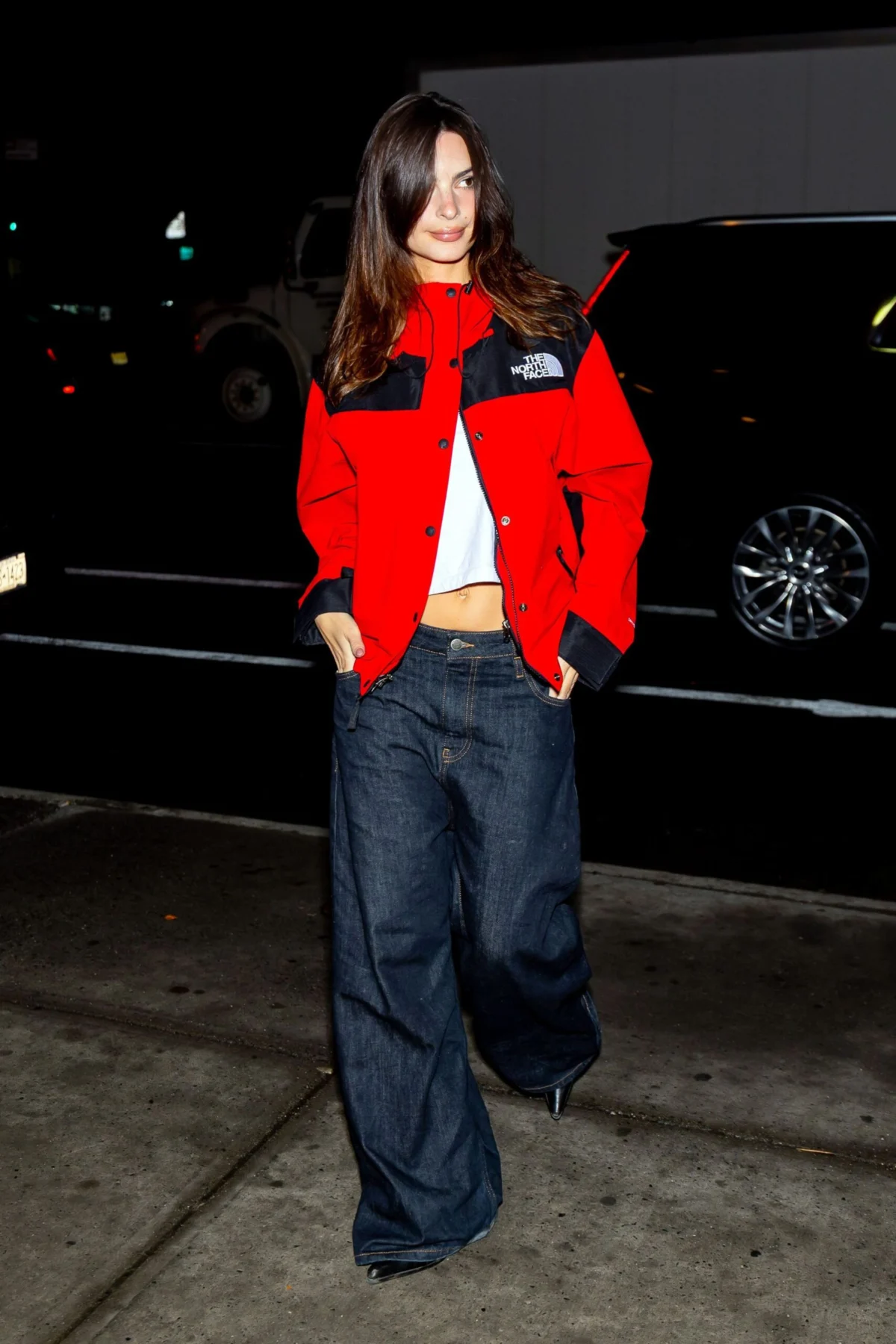
Emily Ratajkowski’s approach to April dressing focuses on the structural integrity of denim. The 2026 season has seen the definitive return of the ultra-wide-leg jean. These garments serve a dual purpose: the volume allows for air circulation during warmer hours, while the heavy-duty fabric provides insulation against the wind.

Ratajkowski has been observed pairing these high-volume trousers with technical outerwear, specifically lightweight shells from brands like The North Face. This "high-low" mix—pairing luxury denim with performance-based outdoor gear—reflects a broader cultural trend known as "Gorpcore," which has been refined for an urban setting. According to retail analysts, the "wide-leg denim" market is projected to reach a valuation of $88 billion by 2030, as consumers move away from restrictive silhouettes in favor of comfort-driven, "all-day" wear.
Avant-Garde Layering: Kendall Jenner’s Asymmetrical Neutrality
Kendall Jenner’s contribution to the Spring 2026 aesthetic is characterized by what stylists call "chic and shock." Her approach utilizes a palette of neutral tones—beiges, creams, and charcoals—to create a sophisticated foundation. However, the innovation lies in the cuts. Jenner has popularized the "scarf-cape" hybrid, an asymmetrical garment that functions as both a wrap and a light coat.
This piece is particularly effective for the April climate. It provides the warmth of a scarf for the neck and chest—areas most vulnerable to the morning chill—while leaving the arms free to prevent overheating. Fashion historians note that this trend draws inspiration from early 20th-century travel wear, reimagined for the 21st-century influencer. The use of asymmetrical lines also serves to elongate the silhouette, a key objective in the 2026 "visual lengthening" trend.

The Power of the Accessory: Lila Moss and the "Arm-Crook" Bag
Finally, the role of accessories in transitional dressing cannot be overstated. Lila Moss has demonstrated how a singular, high-impact accessory can elevate a simple ensemble of black coats and gray denim. Her focus is the "arm-crook" bag—a medium-to-large structured handbag carried in the bend of the elbow.
In the context of Spring 2026, the bag serves a functional role. As layers are shed throughout the day, the handbag must be large enough to accommodate a discarded sweater or scarf without losing its shape. Moss’s preference for vintage-inspired models reflects the ongoing "archival revival" in the luxury sector. Brands like Gucci and Prada have responded to this trend by re-releasing mid-century silhouettes, which are then integrated into modern, casual outfits.
Meteorological Impacts on the Global Fashion Supply Chain
The necessity for these specific styles is increasingly tied to climate volatility. Fashion houses are no longer designing for four distinct seasons but are instead creating "inter-seasonal" drops. This strategy allows retailers to maintain inventory that is relevant for longer periods. Data from the European Fashion Alliance indicates that brands which pivoted to "transitional-first" designs saw a 12% reduction in unsold inventory during the Q1-Q2 transition of 2025.

Furthermore, the materials used in these "It-girl" looks reflect a move toward technical textiles. Merino wool, recycled nylons, and organic heavy-weight cottons are being utilized for their natural thermoregulating properties. These fabrics allow the skin to breathe during the heat of the day while trapping heat during the cooler mornings and evenings.
Conclusion: The Strategic Future of Spring Fashion
The Spring 2026 season demonstrates that dressing for "cold then hot" weather is no longer a matter of compromise, but an opportunity for stylistic innovation. By following the blueprints provided by Jenner, Gerber, Bieber, Ratajkowski, and Moss, consumers are adopting a more analytical approach to their wardrobes.
The broader implications of these trends suggest a permanent shift in the retail landscape. As the "It-girl" aesthetic becomes increasingly synonymous with practical, weather-adaptive clothing, the gap between high-fashion runway concepts and "real-world" utility continues to close. The April 2026 wardrobe is defined by its fluidity—a collection of pieces that are as dynamic as the temperatures they are designed to withstand. As the industry moves forward, the success of a collection will likely be measured not by its adherence to a single season, but by its ability to navigate the complex, shifting environment of the modern world.

0 Comments