
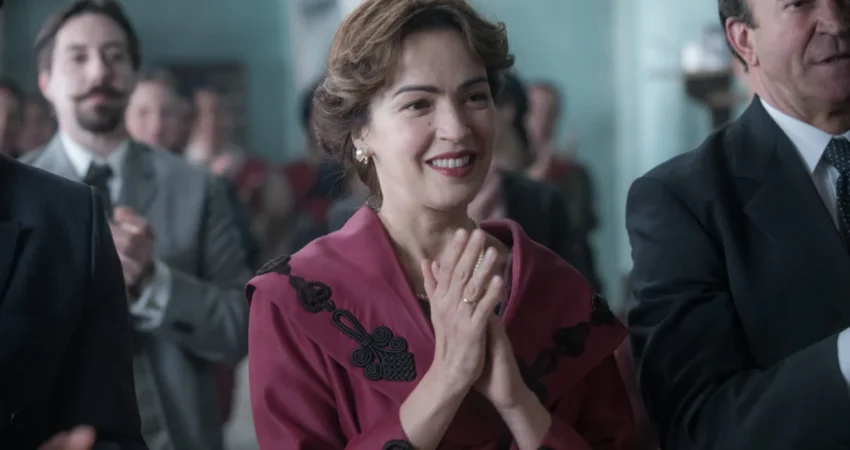
The highly anticipated adaptation of Sonsoles Ónega’s award-winning novel, "Las hijas de la criada," is set to make its debut on free-to-air television this Wednesday, September 3rd, premiering in prime time on Antena 3. This move marks a significant step for the series, which has already garnered considerable attention and critical acclaim on the Atresmedia platform, atresplayer, where it achieved the distinction of being the platform’s most successful premiere in the last three years.
The announcement of the series’ transition to Antena 3’s main channel was made by Pepa Romero during the conclusion of "YAS Verano." This strategic decision by Atresmedia highlights the significant viewership numbers and positive critical reception the series has enjoyed on atresplayer, reinforcing the network’s confidence in its prime-time appeal. The series will occupy the Thursday night slot, a move that positions it directly against a significant competitor.
A Prime Time Showdown
Antena 3 has allocated the entire eight-episode run of "Las hijas de la criada" to the Thursday prime-time slot, setting the stage for a direct confrontation with Televisión Española’s (TVE) flagship programming. Specifically, the series will go head-to-head with the premiere of the second season of "El perro andaluz" on La 1. This deliberate scheduling choice indicates Antena 3’s strategic intent to capture a significant share of the primetime audience on Thursdays, foregoing a more comfortable, less competitive launch. The battle for viewers on Thursday nights is expected to be intense, with both networks leveraging their most promising offerings to kick off the autumn television season.
Production and Narrative Scope
Directed by Menna Fité and Alejo Flah, "Las hijas de la criada" is a compact, eight-episode series, with each episode running approximately 50 minutes. The production, a collaboration with Buendía Estudios Canarias, was filmed across diverse and evocative locations in Galicia, Madrid, and the Canary Islands, promising a visually rich and expansive narrative backdrop. This streamlined format suggests a tightly woven plot, devoid of unnecessary filler, designed to maintain audience engagement throughout its run.
The narrative is deeply rooted in the Galicia of 1900, centering on the Pazo de Espíritu Santo. The story unfolds with the simultaneous birth of two girls on the same day: Clara, the daughter of the maid Renata, and Catalina, the daughter of the estate’s owners, the Valdés family. A pivotal act of vengeance disrupts the lives of both families, compelling Doña Inés to fight for her true daughter’s right to inherit a substantial empire. This struggle unfolds against the backdrop of an era where women’s autonomy and ownership rights were severely restricted. The plot ambitiously traverses from the Galician estate to a post-colonial Cuba, weaving a complex tapestry of forbidden loves, betrayals, class struggle, and deeply guarded secrets that define the Valdés saga. This dual setting provides ample opportunity for contrasting social dynamics and dramatic tension.

A Stellar Ensemble Cast
The series boasts a formidable cast led by Verónica Sánchez, Carlota Baró, and Alain Hernández. Their performances are complemented by a robust supporting ensemble, including Martina Cariddi, Judith Fernández, Álex Villazán, Tomy Aguilera, Álex Gadea, Xoel Fernández, Fede Pérez, Alicia Armenteros, Iolanda Muíños, Roque Ruiz, Fran Nortes, Adrián Ríos, Carlos Villarino, Camila Bossa, Alba Loureiro, and Alejandro Vergara. The extensive cast for an eight-episode series underscores the intricate web of subplots and character arcs that form the backbone of the narrative, suggesting a rich exploration of relationships and motivations.
Literary Foundation and International Reach
The source material for the series is not merely a novel but a literary phenomenon. "Las hijas de la criada" secured the prestigious Premio Planeta in 2023 and has since achieved remarkable commercial success. The book has undergone over twenty print editions and surpassed half a million copies sold, making it the best-selling book of its year. This significant literary pedigree provides a strong foundation for the television adaptation, indicating a story with broad appeal and proven resonance with readers.
The adaptation itself stems from a strategic agreement with Planeta Book & Film Rights. The international success of the novel is further evidenced by the sale of its translation rights in eight countries: Italy, France, Portugal, Romania, Bulgaria, Hungary, Mongolia, and Russia. This global reach suggests that the themes and narrative of "Las hijas de la criada" possess a universal quality, potentially translating into strong international viewership for the television series as well.
Strategic Programming and Future Implications
Antena 3’s decision to program "Las hijas de la criada" on a Thursday night is a clear indicator of the network’s commitment to solidifying its position in the competitive autumn schedule. This is not an experimental or speculative launch; rather, it represents a calculated move based on the series’ demonstrated success on atresplayer. The platform’s performance data, coupled with critical acclaim, provides a solid foundation for this strategic programming choice.
The premiere on September 3rd marks the moment when the Pazo de Espíritu Santo opens its doors to a wider, free-to-air audience. The key question remains whether this transition from a premium streaming platform to a generalist channel will validate the positive critical reception and strong viewership numbers already achieved. The success of "Las hijas de la criada" on Antena 3 could set a precedent for future adaptations of popular literary works, influencing how broadcasters leverage digital platform successes to bolster their terrestrial programming strategies. It also signals a continued trend of high-quality Spanish productions finding broader audiences through strategic multi-platform releases. The coming weeks will reveal if this ambitious project can sustain its momentum and capture the prime-time audience, further cementing its status as a significant cultural event.

0 Comments