
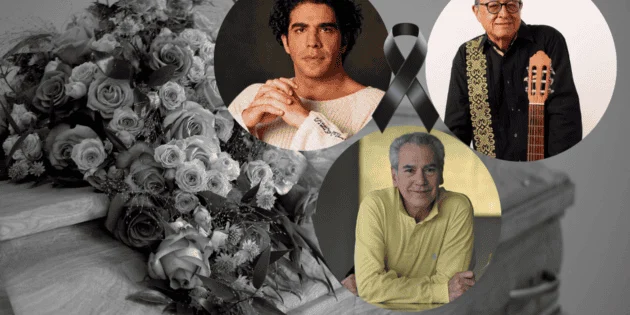
The entertainment and political spheres in Mexico have been plunged into mourning following the confirmed deaths of prominent figures Jorge Kahwagi, Otto Sirgo, and Gabino Palomares on September 29th and 30th. This somber cluster of losses, occurring within a mere 48-hour window, has once again brought to the forefront one of the most persistent and intriguing superstitions in public consciousness: the infamous "Rule of Threes" concerning celebrity deaths. The sudden departures of a former boxing champion turned politician, a revered television and stage actor, and an iconic singer-songwriter have not only sparked widespread grief but also ignited fervent discussions across social media, internet forums, and traditional news outlets about this mysterious pattern.
A Nation Mourns: The Recent Tragic Triad
The consecutive announcements of these three deaths sent shockwaves across Mexico, prompting an outpouring of condolences and tributes. Each individual, in their unique capacity, left an indelible mark on Mexican society.
Jorge Kahwagi: Born in Mexico City, Jorge Kahwagi Macari, who passed away at the age of 55, was a multifaceted public figure. He initially garnered national attention as a professional boxer, holding a WBC Continental Americas cruiserweight title. His career, though marked by controversy and criticism regarding the caliber of his opponents, captivated a significant audience. Beyond the ring, Kahwagi was a prominent businessman, inheriting a substantial textile empire, and ventured successfully into media, owning publications like El Gráfico. Perhaps his most notable public role was in politics, where he served as a federal deputy for the Ecologist Green Party of Mexico (PVEM) in two separate legislative terms (2000-2003 and 2003-2006). His political career, often intertwined with his flamboyant public persona, made him a recognizable and often debated figure in national discourse. His passing marks the loss of a truly unique character who navigated the worlds of sport, business, media, and politics with equal fervor.
Otto Sirgo: At 77 years old, Cuban-Mexican actor Otto Sirgo was a beloved and respected veteran of the screen and stage. With a career spanning over five decades, Sirgo became a household name through his extensive work in Mexican telenovelas, appearing in dozens of productions that captivated audiences both domestically and internationally. His roles, often embodying dignified and paternal figures, earned him critical acclaim and a loyal fanbase. Beyond television, Sirgo had a significant presence in theater and film, showcasing his versatility and dedication to his craft. His contributions to Mexican popular culture are immense, and his passing leaves a void in the nation’s acting community, remembered for his professionalism, talent, and warm personality.
Gabino Palomares: The passing of Gabino Palomares, a celebrated singer-songwriter and key figure in the Latin American Nueva Canción (New Song) movement, at 74, signifies the loss of a powerful artistic and political voice. Hailing from Guanajuato, Palomares was known for his socially conscious lyrics, which often addressed themes of justice, human rights, and political activism. His music, characterized by its folk roots and poignant storytelling, resonated deeply with generations of listeners, particularly during times of social and political upheaval. Songs like "La Maldición de Malinche" became anthems, reflecting collective sentiments and historical critiques. Palomares was not just an artist but an activist, using his platform to advocate for change and amplify the voices of the marginalized. His legacy is one of artistic integrity and unwavering commitment to social causes.
Unpacking the "Rule of Threes"
The "Rule of Threes," or Celebrity Death Rule of Threes, is a fascinating and persistent urban legend positing that public figures tend to pass away in groups of three, often within a short temporal span. While it undeniably lacks any scientific or statistical basis, the casual observation of such occurrences frequently lends an eerie, almost credible, quality to the superstition. This belief, deeply embedded in popular culture, speaks to a fundamental human tendency to seek patterns and meaning in random events, especially when confronted with the stark reality of mortality, particularly that of individuals who hold a significant place in the collective imagination.
The psychological underpinnings of this phenomenon are often attributed to cognitive biases such as confirmation bias, selective memory, and apophenia. Confirmation bias leads individuals to notice and remember instances that support an existing belief (e.g., three celebrity deaths in a row) while overlooking or forgetting instances that contradict it. Selective memory ensures that these "hits" are more readily recalled, reinforcing the pattern. Apophenia, or patternicity, describes the tendency to perceive meaningful connections between unrelated things. When applied to celebrity deaths, these cognitive shortcuts create the illusion of a recurring pattern where, statistically, only random distribution exists.
A Historical Deep Dive: The Genesis of a Legend
To truly understand the pervasive nature of the "Rule of Threes," one must look back to a pivotal event that is widely considered its origin point: February 3, 1959. This date, etched into music history as "The Day the Music Died," witnessed a tragic plane crash in Iowa that claimed the lives of three burgeoning rock and roll legends: Buddy Holly (22), Ritchie Valens (17), and J.P. "The Big Bopper" Richardson (28).
The accident, which occurred shortly after a performance as part of their "Winter Dance Party" tour, devastated the nascent rock and roll scene and sent shockwaves across the globe. Buddy Holly, a pioneering force known for hits like "Peggy Sue" and "That’ll Be the Day," had already established himself as an innovative songwriter and performer. Ritchie Valens, with his iconic "La Bamba," was a trailblazer for Chicano rock. The Big Bopper, famous for "Chantilly Lace," was a charismatic personality. Their sudden and simultaneous demise at such young ages, all at the peak of their creative powers, created an immediate and profound sense of collective loss. The media’s extensive and consecutive reporting of these three interconnected tragedies, keeping the public informed of every detail, inadvertently cemented the idea of "three" celebrity deaths occurring together in the collective consciousness. This single, devastating event became the foundational narrative upon which the "Rule of Threes" would build its enduring legacy.
Global Echoes: Reinforcing the Myth
Decades after its genesis, numerous other high-profile instances have continued to fuel the "Rule of Threes," solidifying its place in global popular culture.
One of the most widely cited examples occurred in the summer of 2009. Within a span of just a few days, the world bid farewell to three immensely influential figures: Michael Jackson, Farrah Fawcett, and Ed McMahon.
- Michael Jackson, the "King of Pop," died on June 25, 2009, at the age of 50. His sudden death from a drug overdose sparked global mourning on an unprecedented scale, with fans around the world expressing profound grief for the iconic musician whose influence spanned generations and genres.
- Just hours before Jackson’s death, on the same day, actress Farrah Fawcett passed away at 62 after a public and courageous battle with anal cancer. A quintessential 1970s icon, known for her role in "Charlie’s Angels" and her distinctive hairstyle, Fawcett’s struggle with illness had been closely followed by the public, making her death a moment of collective sorrow.
- Adding to the somber period, legendary television personality Ed McMahon died on June 23, 2009, at 86. Best known as Johnny Carson’s sidekick on "The Tonight Show," McMahon was a beloved figure in American broadcasting for decades.
The close proximity of these three deaths, spanning different fields of entertainment, created a powerful and poignant reinforcement of the "Rule of Threes" for a global audience.
Another significant cluster occurred in early 2016, leaving art and music aficionados worldwide in shock.
- On January 10, 2016, music legend David Bowie passed away at 69, just two days after releasing his critically acclaimed final album, "Blackstar." His death, kept secret during an 18-month battle with liver cancer, was a profound shock to millions, revealing "Blackstar" as a poignant farewell.
- Just four days later, on January 14, actor Alan Rickman, beloved for roles ranging from Hans Gruber in "Die Hard" to Severus Snape in the "Harry Potter" series, died at 69 after a battle with pancreatic cancer. His passing evoked deep sadness among film and theater communities.
- Completing this tragic trio, Glenn Frey, co-founder and guitarist of the iconic rock band Eagles, died on January 18, 2016, at 67, due to complications from rheumatoid arthritis, colitis, and pneumonia. His death marked a significant loss for classic rock fans.
The confluence of these three influential figures’ deaths within a short timeframe in 2016 further cemented the "Rule of Threes" in contemporary memory, sparking widespread commentary on the perceived phenomenon.
Mexico’s Own Tragic Triads
Mexico, with its rich cultural history and deep connection to its public figures, has also experienced its share of these perceived "triads," reinforcing the local validity of the urban legend. In 2023, for instance, the nation mourned the successive losses of three revered figures within a short period.
- Rebecca Jones, a prominent actress known for her powerful performances in telenovelas and theater, passed away on March 22, 2023, at 65, after a prolonged battle with cancer.
- Just days later, on March 25, 2023, the enigmatic and controversial Irma Serrano, famously known as "La Tigresa," died at 89. A singer, actress, and politician, Serrano was a larger-than-life figure whose career spanned decades and was marked by both artistic success and scandalous headlines.
- Completing this cluster, first actor Ignacio López Tarso, a titan of Mexican cinema, theater, and television, passed away on March 11, 2023, at the venerable age of 98. Known for his iconic roles in films like "Macario" and "Nazarín," López Tarso was a living legend whose death marked the end of an era.
These painful departures, occurring within a few weeks of each other, deeply affected the Mexican public, once again igniting discussions about the "Rule of Threes" and its uncanny ability to manifest.
Today, with the recent and deeply felt losses of Jorge Kahwagi, Otto Sirgo, and Gabino Palomares, the conversation surrounding this phenomenon has once again gained unprecedented traction. The immediacy and national prominence of these figures underscore the emotional weight of their passing and the human desire to find order, even if mythical, in the face of random tragedy.
The Science of Coincidence: Explaining the Phenomenon
While compelling, the "Rule of Threes" is consistently dismissed by psychologists and statisticians as a classic example of cognitive biases at play rather than a verifiable phenomenon. Experts point to several well-documented psychological principles that explain why humans perceive such patterns:
- Selective Perception and Confirmation Bias: As mentioned earlier, once a belief is formed (like the "Rule of Threes"), individuals are more likely to notice and retain information that confirms it, while subconsciously filtering out contradictory evidence. We are bombarded with news of deaths daily, but only the ones that fit the "three" pattern truly register and are remembered.
- Apophenia and Patternicity: The human brain is hardwired to detect patterns, a survival mechanism that helps us make sense of the world. However, this can sometimes lead to perceiving patterns where none exist, particularly in random data. The deaths of celebrities, though seemingly clustered, are statistically random events.
- Clustering Illusion: This is the tendency to erroneously believe that random events that occur in clusters are not, in fact, random. In a truly random sequence of events, clusters are inevitable and statistically expected. If you plot celebrity deaths over time, there will naturally be periods where they seem to occur more closely together, simply by chance.
- Availability Heuristic: This cognitive shortcut causes us to overestimate the likelihood of events that are easily recalled or vivid in our memory. Celebrity deaths, especially in clusters, are highly publicized and emotionally resonant, making them very "available" to our minds, thus exaggerating their perceived frequency and pattern.
Statistically, given the vast number of public figures globally, and the inherent randomness of death, it is inevitable that, from time to time, three or more prominent individuals will pass away in close succession. It is the human interpretation and the media’s narrative framing, rather than any mystical force, that transforms these coincidences into a perceived rule.
Beyond Superstition: A Cultural Reflection
Regardless of its scientific debunking, the enduring power of the "Rule of Threes" speaks volumes about how societies process loss, particularly when it involves public figures. These events serve as a collective moment of reflection, prompting widespread public discourse, tributes, and renewed appreciation for the deceased’s contributions.
The passing of beloved celebrities often transcends individual grief, becoming a shared cultural experience. Their lives, achievements, and even their controversies are interwoven into the fabric of society, shaping cultural narratives and influencing generations. When they depart, especially in perceived clusters, it acts as a poignant reminder of the fragility of life and the universal nature of mortality, even for those who seem larger than life. It encourages introspection on their legacies, the impact they had on their respective fields, and the personal connections millions felt with them.
Ultimately, while the "Rule of Threes" may be a statistical illusion, its prevalence underscores a deep-seated human need for narrative and meaning, even in the face of random tragedy. It highlights the profound and lasting impact that public figures have on our culture, and how their passing, whether in threes or individually, marks significant moments in our collective memory. These recent losses in Mexico, like those before them, offer a moment not only for mourning but also for celebrating the indelible contributions of Jorge Kahwagi, Otto Sirgo, and Gabino Palomares to the nation’s diverse heritage.

0 Comments