
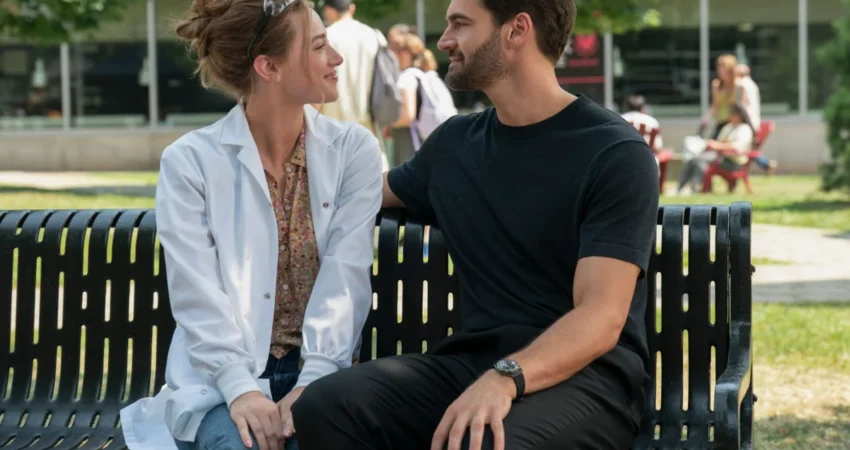
The cinematic adaptation of Ali Hazelwood’s bestselling novel, The Love Hypothesis, has officially debuted on Prime Video, marking a significant milestone for the "steminist" literary subgenre. Positioned as one of the most anticipated romantic comedies of 2026, the film features a high-profile cast led by Lili Reinhart, known for her role in Riverdale, and Tom Bateman, recognized for his work in Murder on the Orient Express. Directed by Claire Scanlon, the production attempts to translate the specific nuances of academic life and the viral success of its source material into a visual medium, navigating the complex transition from a digital fanfiction phenomenon to a major streaming feature.
Historical Context and Literary Origins
The Love Hypothesis was originally published in 2021 by Ali Hazelwood, a pseudonym for a professional researcher in neuroscience. Before its life as a New York Times bestseller, the story existed as a work of fanfiction titled "Head Over Feet," based on the "Reylo" pairing (Rey and Kylo Ren) from the Star Wars sequel trilogy. This origin is reflected in the physical descriptions of the protagonists—Olive Smith and Adam Carlsen—and the thematic tension between a determined underdog and a brooding, high-ranking figure.
Hazelwood’s transition from academia to literature was driven by a desire to highlight the systemic challenges women face in Science, Technology, Engineering, and Mathematics (STEM). According to the author’s acknowledgments, the book was intended to serve as both a romantic fantasy and a commentary on the "leaky pipeline" in science, where women are often discouraged or forced out of high-level research roles due to lack of support or systemic harassment. The novel’s success was propelled largely by "BookTok," a sub-community of TikTok, where it garnered millions of mentions, eventually leading to its acquisition and development by Prime Video.
Structural Adjustments in the Screenplay
In the transition from page to screen, several narrative adjustments were made to accommodate the constraints of a feature film’s runtime and the requirements of visual storytelling. One of the most prominent shifts involves the characterization of the protagonist, Olive Smith. In the novel, Olive is characterized by an internal monologue defined by high levels of anxiety and self-doubt. While these traits remain central to her identity in the film, the screenplay reduces the frequency of her internal spirals.
Critics and audiences have noted that the cinematic version of Olive appears more grounded, a choice likely made to ensure the character remains proactive in a visual medium. While the book uses humor to navigate Olive’s insecurity, the film relies on Reinhart’s performance to convey vulnerability without the exhaustive "uncertainty thoughts" that characterized the literary version. This change streamlines the narrative but alters the "best friend" dynamic that many readers felt with the book’s version of the character.

Character Dynamics and Relationship Enhancements
The film introduces a more robust exploration of the friendship between Olive and her colleague, Ahn. In the original text, the backstory of their friendship is established early on, but the narrative focus shifts heavily toward the central romance with Adam Carlsen as the plot progresses. The film adaptation, however, inserts several original scenes to solidify this bond, including a symbolic "sky lantern" scene during the Christmas season.
Furthermore, the film utilizes Ahn as a primary support system during the story’s more serious moments, specifically when Olive faces professional misconduct. This adjustment serves to ground the film in the reality of graduate school, where peer support is often the primary defense against institutional failures.
Another notable change involves the character of Jeremy. In Hazelwood’s novel, Jeremy is Olive’s ex-boyfriend, a detail that complicates her initial motivation for "fake dating" Adam Carlsen. To simplify the first act of the film, the writers repositioned Jeremy as a "crush" rather than a former partner. This modification allows for a faster setup of the central "fake dating" trope, providing a clear and immediate catalyst for Olive’s decision to kiss Adam in a hallway to prove she has moved on.
Significant Omissions and Character Revisions
One of the most debated aspects of the adaptation is the complete removal of Holden Rodrigues, Adam Carlsen’s best friend since childhood. In the novel, Holden serves as the primary window into Adam’s past. Through Holden, Olive—and the reader—learns about the hardships Adam endured at Stanford and the specific events that shaped his reputation as a cold, unyielding professor.
The absence of Holden necessitates a shift in how the audience perceives Adam. Without Holden’s testimonials, the film relies more heavily on Adam’s direct interactions with Olive to reveal his softer side. This omission also impacts the portrayal of the rivalry between Adam and the antagonist, Tom Benton. In the book, the conflict between Adam and Tom is deeply rooted in a shared history of academic theft and professional sabotage. The film presents this relationship with less historical depth, focusing instead on the immediate threat Tom poses to Olive’s career rather than the long-standing betrayal felt by Adam.
Additionally, the character of Malcolm undergoes a significant tonal shift. In the literary source, Malcolm is portrayed as a loyal friend and a dedicated scientist who provides emotional and domestic support to Olive. The film adaptation introduces a conflict where Malcolm is briefly depicted as an irresponsible student who blames Olive for his professional setbacks. While the character eventually redeems himself, the deviation has been noted by fans as a departure from the "lovable" archetype established in the book.

Representation of Women in STEM and Institutional Challenges
Central to both the book and the film is the depiction of the "Steminist" movement. The story addresses the power dynamics inherent in academia, particularly the relationship between PhD candidates and tenured faculty. Data from the National Science Foundation (NSF) suggests that while women earn approximately half of the doctorates in science and engineering, they remain underrepresented in tenured faculty positions.
The film addresses this through the subplot involving Tom Benton’s harassment of Olive. The adaptation maintains the severity of this encounter, highlighting how academic reputation can be used as a weapon to silence junior researchers. By portraying Olive’s struggle to report the incident and her fear of losing her research funding, the film aligns itself with contemporary discussions regarding the #MeToo movement in academic circles.
Analysis of the "Chapter 16" Phenomenon
In the lead-up to the film’s release, much of the online discourse centered on "Chapter 16," a pivotal sequence in the novel where the protagonists consummate their relationship at a hotel in Boston. In the book, this scene is noted for its length and explicit detail, contributing to its viral status on social media.
The film adaptation approaches this scene with a focus on emotional intimacy while maintaining the "PG-13" or "TV-MA" boundaries of a mainstream streaming platform. While the scene is condensed, the production retained key dialogue that fans considered essential to the characters’ chemistry, including Adam’s specific praise of Olive. This balance reflects a broader trend in streaming adaptations of romance novels, where "spicy" literary content is often stylized or edited for a broader audience without losing its narrative significance.
Market Impact and the "BookTok" Pipeline
The release of The Love Hypothesis is a testament to the power of digital communities in shaping modern entertainment. The "fake dating" trope, a staple of romantic fiction, has seen a resurgence in popularity due to its high engagement rates on social platforms. For Prime Video, the acquisition of this property represents a strategic move to capture the "New Adult" demographic—readers and viewers aged 18 to 30 who bridge the gap between Young Adult fiction and traditional adult literature.
Industry analysts suggest that the success of such adaptations depends heavily on the "faithfulness" perceived by the core fanbase. By casting established actors like Reinhart and Bateman, the production aimed to provide the "star power" necessary for a global release while adhering to the visual archetypes established by the book’s cover art and fan illustrations.

Broad Implications for Future Adaptations
The Love Hypothesis serves as a blueprint for the future of romantic comedy adaptations in the 2020s. It demonstrates that niche settings—such as the world of pancreatic cancer research and academic labs—can provide a fresh backdrop for universal romantic themes. Furthermore, it highlights the importance of addressing social issues, such as gender inequality and workplace harassment, within the framework of a commercial romance.
As the film continues to stream, its performance will likely influence the development of other Ali Hazelwood titles, such as Love on the Brain and Love, Theoretically, both of which follow similar thematic paths. The success of this adaptation confirms that the appetite for stories that combine intellectual rigor with emotional vulnerability remains high, signaling a continued investment in the "steminist" genre by major studios and streaming services alike.
In summary, while the film version of The Love Hypothesis makes tactical changes to its character roster and subplots, it remains a focused exploration of the hurdles women face in high-level research. By blending the escapism of the "fake dating" trope with the harsh realities of academic politics, the film provides an informative and engaging look at the modern pursuit of both scientific discovery and personal connection.

0 Comments