
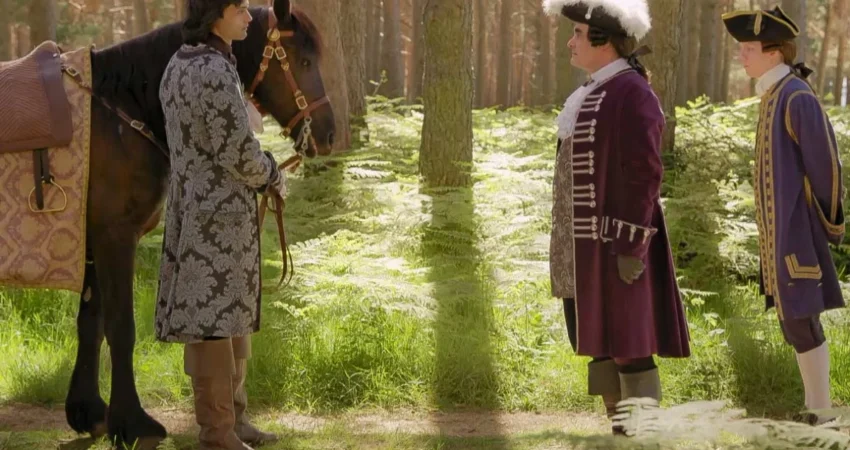
Chapter 516 of the popular drama series "Wild Valley" has culminated in a high-stakes confrontation that has left audiences on the edge of their seats, centering on a tense exchange between the young Duke Rafael and the influential Don Hernando. The heart of the conflict lies in the future of the ducal title and the personal choices of Alejo, whose potential marriage has become the focal point of a power struggle. This pivotal episode, broadcast on [Insert Broadcast Date, e.g., November 9, 2026], has escalated the narrative, revealing deep-seated tensions and challenging established hierarchies within the series’ intricate plot.
The dramatic climax of the episode unfolded following a public declaration by Luisa and Alejo, who revealed that Rafael openly supports their union. This announcement was perceived by Don Hernando, a figure of considerable authority within the aristocratic circles of "Wild Valley," as a direct act of defiance and betrayal. Don Hernando, who had apparently orchestrated a different path for Alejo, one that served his own strategic interests, found his plans directly challenged by the young duke’s unwavering stance. The ensuing dialogue between the two men was not merely a disagreement; it was a calculated duel of wills, where the very essence of power, principle, and family loyalty were pitted against each other.
The Genesis of the Conflict: A Question of Marriage and Succession
The seeds of this confrontation were sown in the preceding narrative arcs of "Wild Valley." For weeks, the romantic entanglements of Alejo and Luisa had been a central subplot, often met with resistance from the more traditional elements of the aristocratic families. Don Hernando, representing these established powers, had been actively working to secure a marriage for Alejo that would consolidate his own influence and secure advantageous alliances. The specific nature of these alliances, whether through political maneuvering or financial benefit, has been a recurring theme, highlighting the transactional nature of aristocratic unions within the series’ universe.
The public endorsement of Alejo and Luisa’s relationship by Duke Rafael marked a significant turning point. It signaled a departure from the expected subservience of a younger noble to the dictates of older, more powerful figures. Rafael’s decision to champion his brother’s personal happiness over the perceived dictates of societal or familial obligation has been interpreted by viewers as a bold assertion of independent thought and a nascent leadership quality. This act of solidarity, therefore, triggered the direct confrontation with Don Hernando, who saw it as an open challenge to his authority and the established order he represented.
A Tense Dialogue: Principles vs. Power
The confrontation between Don Hernando and Rafael was characterized by a measured yet menacing tone, indicative of the sophisticated power plays often depicted in "Wild Valley." Don Hernando initiated the exchange with a thinly veiled warning, employing a tone that masked a potent threat. He stated, "I understand that wielding a title like this, and being so young, will lead you to confuse status with power." This statement immediately established Don Hernando’s perspective: he viewed Rafael’s actions as the misguided overreach of someone who did not yet grasp the true nature of influence. He implied that Rafael’s support for Alejo was not born of genuine conviction but of youthful inexperience and a misunderstanding of his own position.
Rafael, however, did not falter under the weight of Don Hernando’s seasoned authority. His response was firm and resolute: "It’s not about power, it’s about principles." This declaration immediately reframed the debate, shifting it from a matter of authority and influence to one of moral conviction and personal integrity. Rafael articulated his core belief that his brother’s happiness should be the paramount consideration. "My brother will only be happy if he marries whom he chooses. I want my brother’s happiness," he asserted. This statement directly countered Don Hernando’s presumed agenda of an arranged marriage for strategic advantage, emphasizing the intrinsic value of individual choice and emotional well-being over political expediency.
Adding further weight to his argument, Rafael deftly alluded to a truth that had been implicitly acknowledged but rarely voiced openly within their social circles: the scarcity of genuinely happy marriages among their families in recent times. This uncomfortable truth served to bolster his stance, suggesting that the traditional approach to aristocratic unions had, in many instances, led to unhappiness and discord, thus validating his pursuit of a different path for his brother.

Don Hernando’s Shifting Tactics: From Influence to Threat
Recognizing that his initial approach of veiled condescension was not yielding the desired result, Don Hernando shifted his strategy. He began to appeal to a sense of obligation, invoking the concept of a debt owed. "Do you not know how disappointed I am with your response? After all I have done for your family?" he questioned, his tone laced with a calculated bitterness. This tactic was designed to leverage past favors and create a sense of indebtedness, implying that Rafael’s defiance was ungrateful and disrespectful.
Rafael acknowledged the historical support his family had received, stating, "My family is more than grateful to you, and I, first and foremost." However, he was unwilling to allow gratitude to compromise his principles. He drew a clear line, emphasizing the gravity of the situation: "Let’s not be mistaken, we are not talking about trivial matters here. We are talking about my brother’s life." This declaration underscored his unwavering commitment to Alejo’s personal future and his refusal to let past debts dictate present choices concerning such a fundamental aspect of life.
This firm assertion marked a critical turning point in the conversation. Don Hernando, realizing that subtle pressure and appeals to obligation were ineffective, resorted to his most direct threat. He explicitly stated his intention to use his considerable influence to strip Rafael of his ducal title. This retaliatory measure represented an escalation of the conflict to an unprecedented level, revealing the true depth of Don Hernando’s determination to maintain control and the potential consequences for those who dared to defy him.
Analysis: Power, Responsibility, and Future Implications
The power of this scene lies significantly in the stark contrast between the two protagonists. Don Hernando embodies the archetype of a seasoned patriarch who wields power as a tool for control and the preservation of a rigid social order. His actions are driven by a desire to maintain influence and ensure that the aristocratic lineage adheres to established traditions and alliances. His approach is pragmatic, often prioritizing strategic advantage over individual sentiment.
Conversely, Rafael represents a new generation of leadership, one that views power not as a means of control but as a profound responsibility towards one’s kin and community. His defense of Alejo’s right to choose is rooted in a more modern understanding of personal autonomy and the importance of genuine happiness within familial relationships. His youth, rather than being a sign of inexperience as Don Hernando suggests, is portrayed as a catalyst for progressive thinking and a willingness to challenge outdated norms.
Rafael’s emergence from this confrontation with a reinforced sense of purpose suggests that the threat of losing his title has not intimidated him but rather galvanized his resolve. His determination to protect his brother’s autonomy appears to have spurred him to consider more proactive measures. This is further evidenced by his subsequent revelation to Rosalía of a plan that could potentially secure their future together. This subtle hint suggests that Rafael possesses undisclosed strategies and resources, indicating that Don Hernando may be underestimating the young duke’s capabilities and foresight.
The Unfolding Narrative: A Game of Chess
As "Wild Valley" progresses into the following week, the open and unresolved conflict between Don Hernando and Rafael is set to dominate the narrative. Don Hernando has unequivocally demonstrated the lengths to which he is willing to go to assert his authority, leaving no doubt about his formidable influence. Rafael, on the other hand, has solidified his position as an individual unwilling to yield to oppressive demands, proving his resilience and commitment to his principles. The dramatic tension now lies in anticipating the next moves of each character. This high-stakes game of chess, where the fate of a ducal title and the personal freedom of a young man hang in the balance, promises to be a defining arc of the current season. The audience is left to ponder whether Don Hernando’s established power will prevail or if Rafael’s principled stand will ultimately lead to a redefinition of authority and tradition within the world of "Wild Valley."

0 Comments