
Carolina Herrera, the Venezuelan-born doyenne of American high fashion, has long been synonymous with an aesthetic that transcends the ephemeral nature of seasonal trends, positioning herself as a primary exponent of a style that is both sophisticated and versatile. While the fashion industry is currently witnessing a surge in experimental footwear—ranging from the revamped pumps showcased by Chanel and Stella McCartney to the avant-garde mules seen at Bottega Veneta and Victoria Beckham—the classic black shoe remains a cornerstone of the modern wardrobe. As the industry looks toward the Spring 2026 season, a retrospective analysis of Herrera’s personal style during the 1990s reveals why the black shoe was, and remains, her "secret weapon" for achieving effortless distinction.
The persistence of timeless garments and footwear serves as a counterbalance to the rapid "micro-trend" cycles of the digital age. In the department of footwear, Herrera has frequently gravitated toward bicolor models, yet it was her consistent use of black silhouettes during the 1990s that defined her most iconic archival looks. By examining these historical ensembles, fashion historians and contemporary stylists find a blueprint for the "Quiet Luxury" movement that continues to dominate the high-fashion discourse.

The Historical Context of the 1990s Minimalist Shift
To understand the significance of Herrera’s footwear choices, one must consider the broader sartorial landscape of the late 20th century. The 1990s represented a stark departure from the maximalist excesses of the 1980s. The previous decade had been defined by exaggerated shoulder pads, vibrant neon palettes, and the flamboyant vintage revivals championed by figures like Karl Lagerfeld at Chanel. As the 90s dawned, the industry pivoted toward a "less is more" philosophy, characterized by clean lines, monochromatic palettes, and a focus on textile quality over ornamental distraction.
Carolina Herrera was at the forefront of this transition. Her designs and personal wardrobe during this era focused on the architecture of the garment and the precision of the fit. Within this minimalist framework, the black shoe functioned as a grounding element, allowing the silhouette of the clothing to take center stage while providing a polished finish. Data from luxury retail archives suggests that during this period, the demand for black pointed-toe and almond-toe pumps increased by approximately 40% as professional women sought to emulate the "Power Dressing" aesthetic popularized by Herrera and her contemporaries.
Analyzing the Herrera Archive: Five Definitive Looks
The resurgence of interest in Herrera’s 90s archive provides specific templates for how black footwear can be integrated into the Spring 2026 wardrobe. These looks demonstrate the versatility of the color black across different textures and silhouettes.

The Monochromatic Mini and the Tonal Silhouette
One of Herrera’s most enduring strategies for visual cohesion involved the pairing of a black minidress with matching opaque tights and black shoes. This monochromatic approach creates an unbroken vertical line, which serves to elongate the wearer’s frame. To prevent the look from appearing overly somber, Herrera utilized strategic accessories. In several documented appearances from the mid-90s, she accented this ensemble with a slender belt to define the waist and a lightweight sweater draped over the shoulders. This combination transformed a simple cocktail look into a versatile outfit suitable for both daytime engagements and evening events.
The Professional Evolution: Blazers and Almond Toes
The 90s "sartorial image" was perhaps best captured by Herrera’s pairing of miniskirts with tailored blazers. Moving away from the boxy shapes of the 80s, these sets featured more feminine, contoured cuts. Herrera often opted for a crisp white round-neck blouse beneath the blazer, a choice that effectively lowered the formality of the outfit without sacrificing its inherent elegance. The choice of footwear here was critical: black almond-toe pumps. Unlike the aggressive sharpness of a stiletto, the almond toe offers a softer, more approachable aesthetic that remains a staple for modern office environments.
The 1999 Vogue Gala: Contrast and Texture
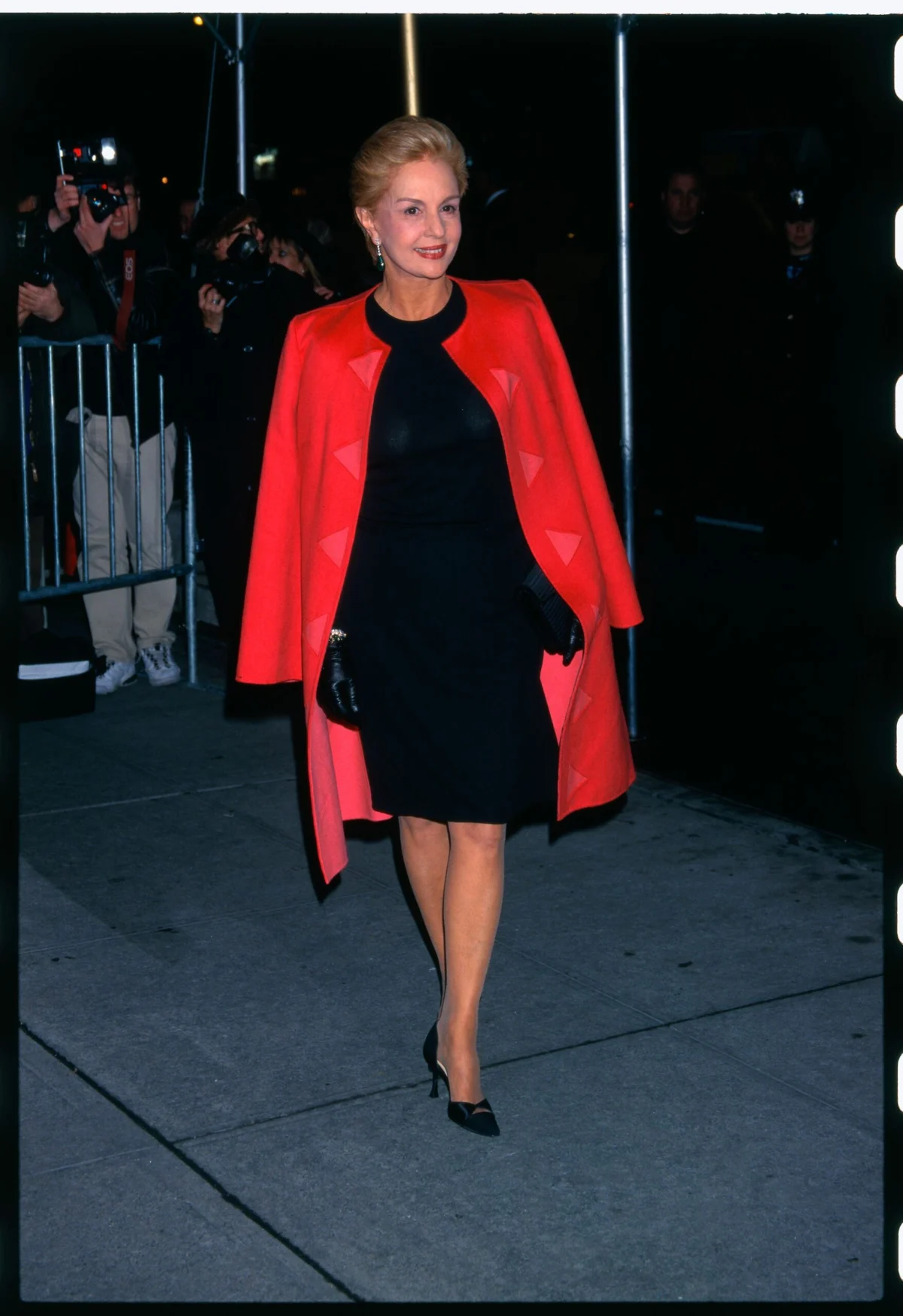
The year 1999 marked a significant moment in Herrera’s style evolution. Attending a high-profile event hosted by Vogue, she utilized a black dress as a foundational "wildcard" piece—a concept that has been a fashion industry standard since the 1950s. However, Herrera elevated the look by introducing a bold red coat, short leather gloves, and black high-heeled shoes featuring intricate cut-out details. This look serves as a case study in how black footwear can anchor vibrant colors and complex textures, providing a sophisticated base that allows an outer garment to serve as the focal point.

Balancing Textures: Velvet and Low Heels
Early 1990s street style often experimented with heavy textures, a trend that is currently being mirrored in the Spring 2026 forecasts for plush coats and velvet accents. Herrera demonstrated mastery over this challenge by pairing a velvet skirt with an embroidered jacket and semi-transparent tights. To balance the visual weight of the velvet, she selected low-heeled black shoes. This choice emphasized comfort and functionality, proving that high-fashion sophistication does not always require extreme heel heights.
Feminine Architecture: The Peplum and the T-Bar Shoe
Herrera’s design philosophy has always prioritized the woman as a muse, often resulting in highly feminine silhouettes. The peplum blouse was a recurring element in her 90s wardrobe. By using a restrained peplum that fell gently over a straight skirt, she highlighted the waist without the drama of 80s ruffles. To complete this classic look, she frequently chose T-Bar black shoes. The T-Bar silhouette provides additional support and a vintage-inspired charm that bridges the gap between formal and casual attire.
Industry Implications and the Spring 2026 Forecast
The cyclical nature of fashion—often referred to as the "30-year rule"—suggests that trends from the mid-to-late 90s are currently reaching their peak of contemporary relevance. Market analysis from the luxury resale sector indicates a 30% year-over-year increase in searches for "vintage Carolina Herrera" and "90s minimalist footwear."

For the Spring 2026 season, designers are expected to lean heavily into "New Minimalism." While brands like Bottega Veneta continue to push the boundaries of shoe construction, there is a clear return to the "Herrera Standard" among retail manufacturers. Production data from major footwear hubs indicates a shift back toward classic black pumps with updated comfort technology, catering to a consumer base that values longevity over fast-fashion novelty.
Statements and Reactions from the Fashion Community
Fashion critics have noted that Herrera’s 90s looks are more than just historical references; they are functional solutions for the modern woman. "Carolina Herrera understood that the black shoe is the punctuation mark of an outfit," says Elena Rodriguez, a senior fashion analyst. "In the 90s, she showed us that you don’t need a different shoe for every dress; you need the right black shoe that can adapt to every context. We are seeing that same philosophy return to the runways for 2026."
Industry insiders also suggest that the return to Herrera’s 90s aesthetic is a reaction to "trend fatigue." As social media platforms accelerate the rise and fall of "aesthetic" trends (such as ‘Barbiecore’ or ‘Mob Wife’), the stability of Herrera’s black-shoe-centric wardrobe offers a sense of relief and reliability for high-end consumers.

Conclusion: The Enduring Power of a Secret Weapon
The legacy of Carolina Herrera’s 1990s footwear choices lies in their refusal to be dated. By prioritizing the black shoe—whether in the form of a T-bar, an almond-toe pump, or a cut-out heel—she established a visual language of elegance that remains as potent today as it was three decades ago.
As the fashion world prepares for the Spring 2026 season, the influence of the Caraqueña designer is undeniable. The transition from the experimental shapes of recent years back toward the classic, well-coordinated looks of the 90s suggests that the industry is once again embracing the art of dressing with "distinction without effort." For the modern woman, the archival inspiration of Carolina Herrera serves as a reminder that while trends are fleeting, the right pair of black shoes is a permanent investment in style. Through her strategic use of color, texture, and silhouette, Herrera did not just wear shoes; she utilized them to build an empire of timelessness that continues to define the pinnacle of global fashion.

0 Comments