
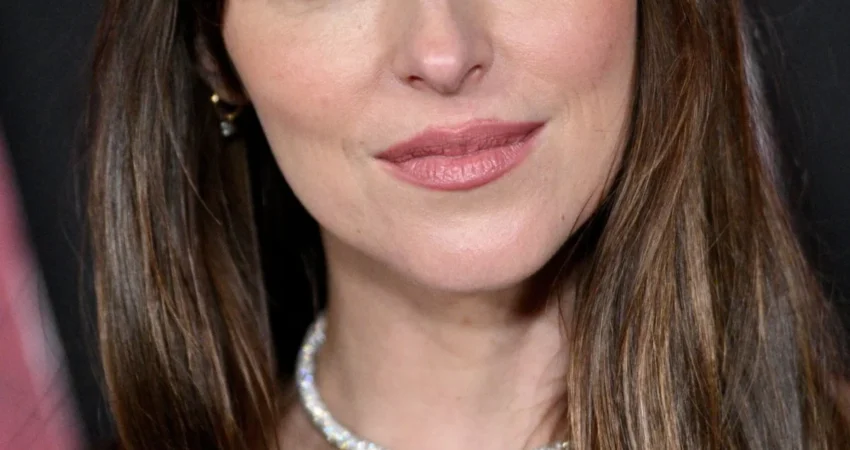
The cyclical nature of the beauty industry often finds its center of gravity in the signature styles of a few influential figures, and few have maintained a more consistent grip on the public imagination than Dakota Johnson. Since her meteoric rise to international prominence following the 2015 release of Fifty Shades of Grey, Johnson’s hair—specifically her curtained, effortless bangs—has transcended simple celebrity styling to become a global aesthetic benchmark. What was once a stylistic choice for a role has evolved into a perennial reference point in salons from Los Angeles to Paris. As the industry looks toward the Fall-Winter 2026 season, Johnson’s influence is experiencing a significant resurgence, driven by a confluence of high-profile cinematic projects, musical collaborations, and a definitive endorsement from the world’s leading fashion houses.
The current revitalization of the "Johnson Fringe" is not merely a matter of nostalgia but is anchored in the actress’s active presence in the cultural zeitgeist. Her upcoming role in the film adaptation of Verity—a psychological thriller based on the bestselling novel by Colleen Hoover, in which she stars alongside Anne Hathaway and Josh Hartnett—has already begun to generate significant visual data for trend forecasters. Furthermore, her appearance in the music video for "Patient Zero," a standout track from the encore edition of Taylor Swift’s speculative project The Life of a Showgirl, has solidified her status as a muse for the intersection of film, music, and fashion. This visibility has ensured that her signature look remains a primary driver for hair trends as the industry prepares for the 2026 winter cycles.
A Chronology of Stylistic Evolution: From 2015 to 2026
To understand the current dominance of this trend, one must examine the timeline of Johnson’s hair evolution. In 2015, the "Anastasia Steele" bangs were characterized by a certain youthful innocence—straight, slightly blunt, and heavy. However, over the subsequent decade, Johnson and her styling team refined this into a more versatile "French-girl" aesthetic. By 2020, the look had transitioned into a more textured, lived-in style that allowed for greater movement.

The projected trends for Fall-Winter 2026 indicate a further refinement of this trajectory. Data from major fashion capitals suggests that the "fringe" is no longer a monolithic concept but a modular one. Johnson herself has frequently stated in interviews that she often trims her own hair, a fact that has contributed to the "undone" and accessible appeal of her look. This DIY ethos has resonated with a consumer base that increasingly values authenticity and low-maintenance luxury over the rigid, high-shine styles of previous decades.
High Fashion Endorsement: The Runway Connection
The resurgence of the fringe is heavily supported by the Fall-Winter 2026 collections of premier luxury brands. While Johnson remains the celebrity face of the movement, the technical execution of the trend was visible across several key runways:
- The Micro-Fringe and Pixie Fusion: Balenciaga and Chanel have pushed the boundaries of the trend by proposing "mini-bangs." These are shorter, more architectural iterations that, when paired with pixie cuts, offer a stark, modernist contrast to Johnson’s more classic length.
- Textured Nonchalance: Brands such as Collina Strada, Louis Vuitton, and Erdem have leaned into the "disheveled" look. Their models featured bangs with irregular lengths and high texture, mimicking the natural separation that occurs when hair is not over-styled.
- The Y2K Revival: In a nod to the early 2000s, Alexander McQueen and Christian Dior have reintroduced the side-swept fringe. This iteration focuses on a deep side part, creating a dramatic diagonal line across the forehead, a style that provides a more structured alternative to the center-parted curtain bang.
- The Neo-French Aesthetic: Chloé and Eckhaus Latta have revisited the 1970s "Birkin Bangs." This style, synonymous with style icon Jane Birkin, is a direct ancestor of Johnson’s current look—wispy, lash-grazing, and effortlessly chic.
- The Shag Influence: Simone Rocha and Valentino have integrated the fringe into the "shag" cut. Drawing inspiration from 1970s figures like Jane Fonda and Linda McCartney, this version utilizes heavy layering to create volume and a rock-and-roll edge.
The Science of Facial Proportions: The Three-Finger Rule
As the trend gains momentum, the primary concern for consumers is the "suitability factor." Beauty analysts and professional stylists have popularized various methodologies to determine if a fringe will complement an individual’s facial structure. One of the most prominent metrics currently circulating in the industry is the "Three-Finger Rule" (or the Rule of Three). This viral formula uses a three-digit code derived from specific facial measurements to predict aesthetic harmony.
The process involves three distinct steps:

- Forehead Width: A visual measurement is taken by placing fingers horizontally across the forehead. If three fingers fit between the brows and the hairline, a value of 1 is assigned. Four fingers equal a 2, and five fingers equal a 3.
- Facial Width Dominance: The widest part of the face is identified. If the forehead is the widest, the value is 1. If the cheekbones are widest, the value is 2. If the jawline/chin is the widest, the value is 3.
- Inter-Ocular Distance: The distance between the eyebrows is compared to the width of a single eye. If the gap is wider than the eye, the value is 1. If it is narrower, the value is 2.
According to this analytical framework, specific codes such as 222, 321, 312, 212, and 322 indicate a high probability that a fringe will be visually flattering. Conversely, codes like 111, 121, 221, and 231 suggest that the facial proportions may be better served by styles that do not obscure the forehead.
Geometric Harmony: Adapting the Fringe to Face Shape
Beyond the numerical data of the Rule of Three, professional stylists emphasize the importance of geometric harmony. Dakota Johnson possesses an oval face shape, which is traditionally considered the most versatile "canvas" for hair styling. However, the 2026 trend focuses on inclusivity, adapting the fringe to various bone structures:
- Round Faces: To avoid over-emphasizing the width of a round face, stylists recommend lateral, thinned-out, or center-parted bangs. These vertical lines create an illusion of length, drawing the eye upward and downward rather than side-to-side.
- Square Faces: Strong jawlines are best balanced by long, layered "curtain" bangs. The soft edges of the hair counteract the angularity of the bone structure, providing a more balanced silhouette.
- Elongated or Rectangular Faces: For faces with significant vertical length, a blunt, thick fringe can be transformative. By cutting across the forehead, the hair visually "shortens" the face, bringing the features into closer proportion.
- Heart or Inverted Triangle Faces: To soften a wide forehead and a narrow chin, wispy, side-swept bangs are the preferred choice. These provide a delicate frame that does not overwhelm the lower half of the face.
Materiality and Maintenance: The Role of Hair Texture
A critical component of the 2026 hair trend analysis is the recognition of hair texture. The "Dakota Johnson look" was long thought to be the exclusive domain of those with straight or slightly wavy hair. However, current industry standards have shifted toward texture-positive styling.
For individuals with wavy or curly hair, the "dry cut" method has become the gold standard. By cutting the fringe while the hair is in its natural, dry state, stylists can account for the "shrinkage factor"—the tendency of curls to bounce upward once they lose the weight of water. This prevents the common error of a fringe becoming significantly shorter than intended once dried.

Furthermore, hair density plays a vital role. Those with fine or thinning hair are advised to opt for lighter, "bottleneck" bangs rather than heavy, blunt cuts. A heavy fringe on fine hair can deplete the volume of the remaining hair, whereas a wispy fringe adds the illusion of layers and movement without sacrificing density.
Broader Cultural and Economic Implications
The persistence of the Dakota Johnson aesthetic reflects a broader shift in consumer behavior within the beauty sector. There is an increasing move away from "high-gloss" perfection toward "functional" beauty. The fringe serves as a versatile tool for self-expression; it can be hidden with pins, grown out into layers, or trimmed at home.
Economically, the "fringe effect" drives significant revenue for the professional salon industry. While the cut itself may be a small service, it necessitates more frequent "fringe trims" between full haircuts, increasing the frequency of salon visits. Additionally, the maintenance of a fringe has spurred growth in the specialized hair tool market, with increased sales of mini-flat irons, round brushes, and dry shampoos specifically formulated for the forehead area.
As we approach the Fall-Winter 2026 season, the "Dakota Johnson Bangs" stand as a testament to the power of a signature look. Supported by cinematic success, musical influence, and high-fashion validation, the trend proves that in the world of beauty, the most enduring styles are those that offer a blend of classic elegance and adaptable, modern reality. Whether through a calculated "Rule of Three" analysis or a spontaneous DIY trim, the fringe remains the definitive accessory for the coming years.

0 Comments