
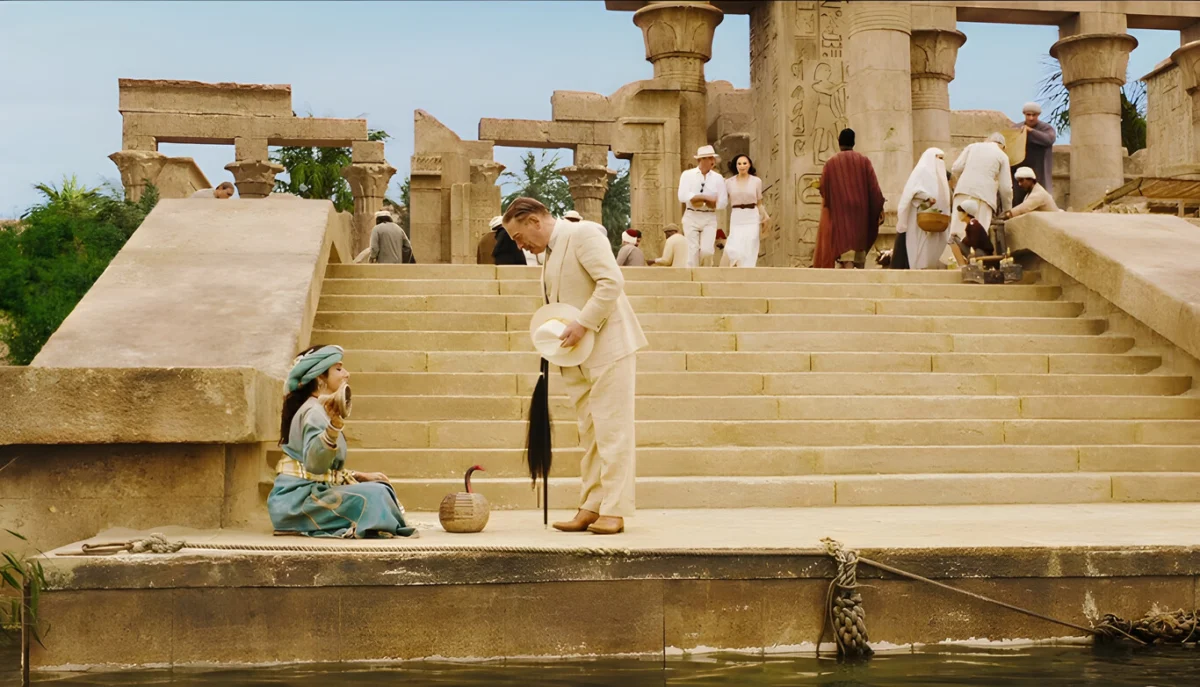
The 2022 cinematic adaptation of Agatha Christie’s seminal mystery novel, Death on the Nile, has officially transitioned to the Netflix streaming platform, marking a significant milestone in the digital distribution of the 20th Century Studios production. Directed by and starring Kenneth Branagh as the iconic Belgian detective Hercule Poirot, the film serves as a direct sequel to the 2017 hit Murder on the Orient Express. While the production is lauded for its sweeping vistas of the Egyptian landscape and the architectural majesty of the Giza pyramids, the film’s technical execution reveals a sophisticated feat of modern filmmaking: the entirety of the production was captured within the United Kingdom, primarily at Longcross Studios in Surrey and on various locations across London. This move to Netflix expands the film’s reach, offering a new audience the opportunity to dissect one of the most celebrated "whodunnit" narratives in literary history within a high-definition streaming environment.
The Narrative Framework and Adaptation Strategy
The plot of Death on the Nile centers on Hercule Poirot’s attempt at a peaceful vacation in Egypt, which is abruptly interrupted when he is invited to join a glamorous wedding party aboard the S.S. Karnak, a luxury paddle steamer. The celebration involves the wealthy heiress Linnet Ridgeway, portrayed by Gal Gadot, and her new husband, Simon Doyle, played by Armie Hammer. The festive atmosphere is quickly overshadowed by the arrival of Jacqueline de Bellefort (Emma Mackey), Simon’s former fiancée and Linnet’s erstwhile friend, whose presence creates a palpable sense of dread. When a brutal murder occurs mid-voyage, the vessel becomes a floating crime scene where every passenger—each harboring a distinct motive and hidden secret—falls under Poirot’s meticulous scrutiny.
Screenwriter Michael Green, who also penned the script for Murder on the Orient Express, sought to modernize the 1937 source material while maintaining the core suspense that made Christie the "Queen of Crime." The 2022 version introduces deeper psychological backstories for its characters, including an opening sequence set during World War I that provides a definitive origin story for Poirot’s famous mustache and his penchant for solitude. By grounding the detective in personal tragedy, the film attempts to elevate the stakes of the central mystery, transforming it from a mere intellectual puzzle into a meditation on the destructive power of obsessive love.

Technical Mastery: Recreating Egypt in London
One of the most discussed aspects of Death on the Nile is its visual presentation, which suggests a massive on-location shoot in North Africa. However, due to various logistical challenges and the complexity of the required sets, the production team opted to recreate the Egyptian environment in England. Production designer Alice Felton and set decorator Jim Clay oversaw the construction of a massive replica of the Temple of Abu Simbel, which was built to scale at Longcross Studios. The physical set stood approximately 150 feet high, allowing the actors to interact with the environment in a way that purely digital backgrounds often fail to facilitate.
The S.S. Karnak itself was a marvel of practical engineering. Rather than relying solely on computer-generated imagery (CGI), the crew built a 236-foot-long, 1,000-ton vessel. While the ship was not fully functional for river travel, it featured meticulously detailed interiors, including a grand saloon, a dining hall, and individual cabins, all designed to reflect the Art Deco aesthetic of the 1930s. To simulate the Nile’s movement and the shifting light of the Egyptian sun, the production utilized advanced lighting rigs and a sophisticated "blue screen" perimeter, which was later replaced in post-production with high-resolution plates filmed in Egypt by a second unit team. This hybrid approach allowed cinematographer Haris Zambarloukos to shoot on 65mm film, providing a texture and depth of field that enhances the film’s sense of old-world grandeur.
A Legacy of Adaptation: From 1937 to the Modern Era
Agatha Christie’s Death on the Nile has enjoyed a long history of adaptation, reflecting its status as one of her most enduring works. The novel was first adapted for the stage by Christie herself in 1944, under the title Murder on the Nile. However, the most famous predecessor to the 2022 film is the 1978 version directed by John Guillermin, which featured Peter Ustinov in his first outing as Poirot. That production was notable for its extensive on-location filming in Egypt and an ensemble cast including Bette Davis, Mia Farrow, and Maggie Smith.
The 2022 iteration distinguishes itself by leaning into the "spectacle" of modern cinema. Under the stewardship of Kenneth Branagh, the film is part of a broader "Christie-verse" revival. Branagh’s interpretation of Poirot is notably more physically active and emotionally vulnerable than Ustinov’s or David Suchet’s celebrated television portrayal. This evolution reflects a broader trend in contemporary cinema where classic intellectual properties are revitalized with higher production values and a focus on character-driven drama to compete with blockbuster franchises.

Cast Dynamics and Commercial Performance
The ensemble cast of Death on the Nile was a central pillar of its marketing strategy. Beyond Gadot and Hammer, the film features Letitia Wright, Annette Bening, Russell Brand, Jennifer Saunders, and Dawn French. Each actor represents a different archetype within the social hierarchy of the 1930s, from the cynical socialite to the radical doctor. The chemistry between the performers is vital to the film’s "closed-circle" mystery format, where the tension is derived from interpersonal friction within a confined space.
Financially, the film faced a tumultuous path to the screen. Originally slated for a 2019 release, the project was delayed multiple times due to the COVID-19 pandemic and the subsequent restructuring of 20th Century Fox following its acquisition by Disney. When it finally premiered in theaters in February 2022, it earned approximately $137.3 million at the global box office against a production budget estimated at $90 million. While these figures were modest compared to its predecessor, the film performed strongly on digital rental platforms and Disney+, leading to the greenlighting of a third installment, A Haunting in Venice, which was released in 2023.
Critical Reception and Audience Impact
Death on the Nile received generally positive reviews from critics, holding a 62% approval rating on Rotten Tomatoes, while the audience score remains significantly higher at 82%. Critics praised the film’s visual opulence and Branagh’s directing, though some noted that the heavy use of CGI in certain landscapes occasionally broke the immersion. However, the audience’s enthusiasm suggests a robust appetite for traditional mystery narratives in an era dominated by superhero and action-oriented cinema.
The film’s arrival on Netflix is expected to trigger a resurgence in viewership, as the platform’s algorithm often breathes new life into mid-budget studio films. Industry analysts suggest that the success of the Knives Out franchise has paved the way for a "Whodunnit Renaissance," making films like Death on the Nile highly valuable assets for streaming libraries. The accessibility of the film on both Netflix and Disney+ ensures that it remains a cornerstone of the mystery genre’s modern catalog.

Broader Implications for the Streaming Landscape
The licensing of 20th Century Studios content to Netflix, despite Disney owning the studio, highlights the complex nature of contemporary streaming agreements. Many of these deals were brokered prior to the launch of Disney+, or involve shared windows to maximize revenue. For Netflix, the addition of a high-gloss, star-studded mystery aligns with its strategy of offering diverse, premium content to maintain its subscriber base.
Furthermore, the film’s success serves as a testament to the enduring power of Agatha Christie’s brand. Nearly a century after the publication of the original novel, the themes of greed, jealousy, and the search for justice continue to resonate with international audiences. As Death on the Nile begins its tenure on Netflix, it stands as a bridge between the Golden Age of detective fiction and the technological capabilities of 21st-century filmmaking, proving that a well-crafted mystery is timeless, regardless of whether it is filmed on the banks of the Nile or in a studio in London.
Chronology of the Death on the Nile 2022 Production
To understand the scale of this project, one must look at the timeline of its development:
- November 2017: Following the success of Murder on the Orient Express, 20th Century Fox announces the development of Death on the Nile.
- September 2019: Principal photography begins at Longcross Studios, UK. Second unit filming takes place in Egypt to capture background plates.
- December 2019: Filming officially wraps.
- 2020–2021: The film’s release date is postponed six times due to the global pandemic and industry shifts.
- February 11, 2022: The film is released theatrically in the United States and international markets.
- Late 2023–2024: The film enters its secondary and tertiary streaming windows, arriving on Netflix to reach a broader demographic.
By analyzing the production’s journey, it becomes clear that Death on the Nile is more than just a remake; it is a meticulously planned corporate and artistic endeavor designed to sustain the relevance of the mystery genre in the digital age. Its presence on Netflix signifies the final stage of its global rollout, cementing its place as a staple of modern home entertainment.

0 Comments